Track saws explained: rails, plunge cuts and accuracy vs circular saws
How a track saw and its guide rail make clean, straight cuts, which rail lengths and blade sizes to choose, and when a circular saw with a guide does the job.
Cutting a full sheet of plywood straight and clean is one of the hardest jobs in home woodworking. A table saw needs a lot of room and a helper, and a circular saw guided by a clamped board tends to wander and splinter the edge. A track saw solves this by putting the saw on a rail that you lay on your marks. This guide explains how track saws work, which rails you'll need and when a circular saw with a guide is enough.
What a track saw is
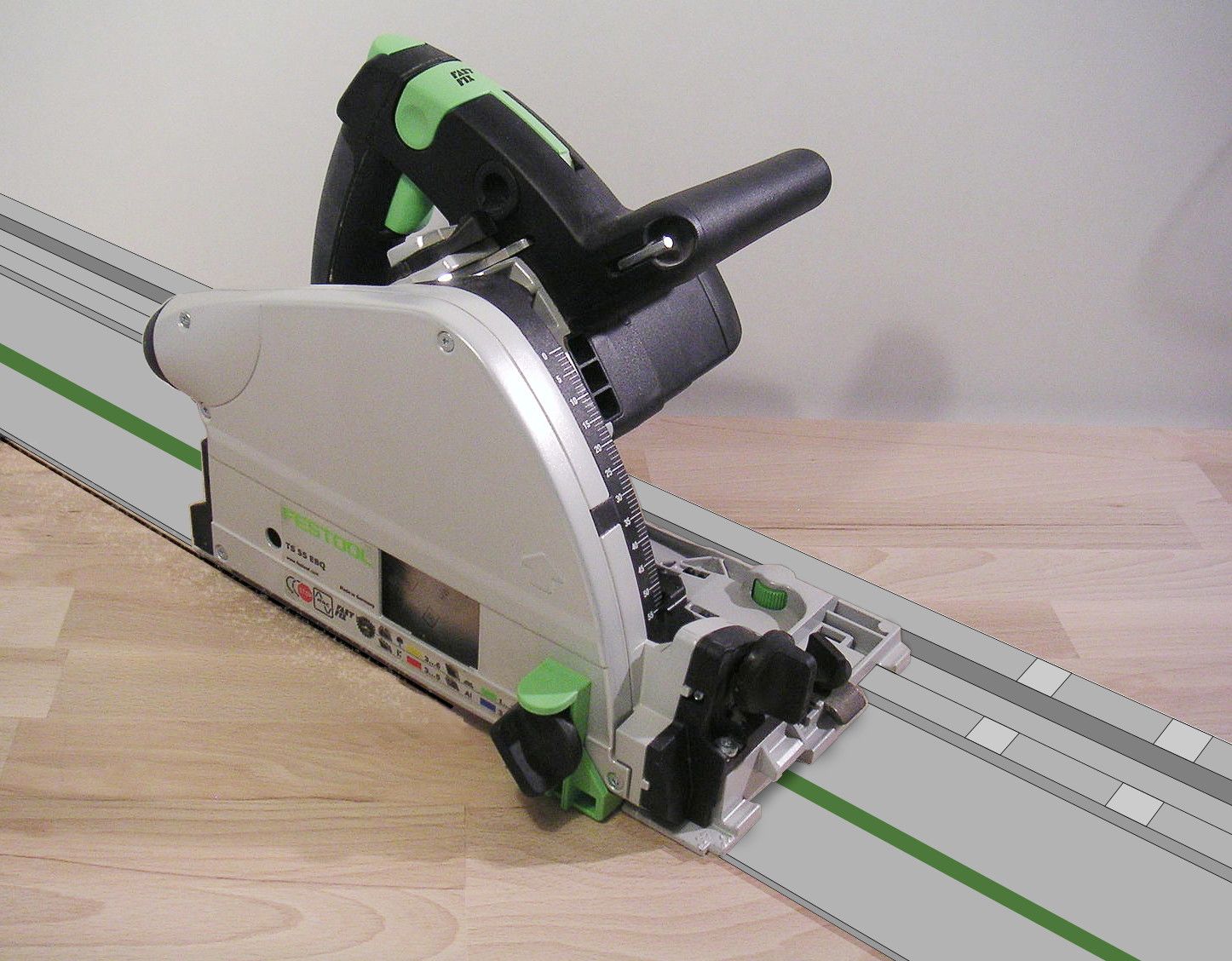
A track saw is a plunge-cut circular saw designed to run on an aluminium guide rail (also called a track). Two features set it apart from an ordinary circular saw:
- The plunge action. The blade sits fully inside the housing until you press the saw down to a preset depth. You can start a cut anywhere, including in the middle of a panel.
- The rail. A groove in the saw's base fits a rib on the rail, so the saw can only move in a straight line. Strips on the underside of the rail grip the workpiece, and a rubber or plastic splinter guard runs along the cutting edge.
The first time you use a new rail, the saw trims the splinter guard to exactly where the blade cuts. From then on, the edge of the rail is the cut line: line it up with your pencil marks and cut. There's no need to measure an offset from the blade to the edge of the base, as you would with a clamped straightedge.
Why the cuts are so clean and accurate
- Less tear-out. The splinter guard presses the wood fibres down right at the blade, so the edge on the rail side stays crisp, even on veneered plywood and melamine-faced boards.
- No wandering. The saw can't drift away from the line, so a long cut is as straight as the rail.
- A shallow first pass. For delicate surfaces, a scoring pass a few millimetres deep followed by a full-depth pass gives a very clean edge. Some saws have a dedicated scoring setting.
- Good dust collection. With an enclosed blade guard and a port connected to an extractor, most of the dust is captured, which matters when cutting MDF indoors. See our guide to wet/dry shop vacuums.
Accuracy still depends on you: marking carefully, adjusting the saw so it slides on the rail without side-to-side play, and squaring the rail for crosscuts with a rail square or a large framing square.
Plunge cuts and other jobs it does well
Because it can start a cut anywhere, a track saw handles jobs that are awkward with other saws:
- Cut-outs in the middle of a panel, such as openings in worktops or wall sheathing. A round blade can't cut fully into the corners, so they still need finishing with a jigsaw or handsaw; see our guide to jigsaws and reciprocating saws.
- Trimming doors cleanly without splintering the face.
- Straightening the rough edge of a board or a damaged sheet, giving you a true edge to work from.
- Long bevel cuts along panels. Most track saws tilt to 45°, and many pivot so the bevelled cut still lines up with the edge of the rail.
Before plunging into floors, walls or anything fixed, check for pipes and cables. Our guide to stud finders explains what detectors can and can't find.
Blade size, cutting depth and power
The most common track saws use blades of about 160–165 mm (6-1/2 in). On the rail, that typically gives a maximum depth of around 50 mm at 90° and roughly 40 mm at 45°, enough for 18 mm plywood, most worktops and many solid boards. The rail itself takes a few millimetres off the depth, so check the "on rail" figure in the specifications.
- Larger saws with blades of about 210 mm cut considerably deeper, for thick worktops and beams.
- Compact saws with smaller blades are lighter and easier to handle but cut less deeply.
- Cordless track saws are now common and handy on site. Long rips in thick hardwood drain batteries quickly, so higher-capacity batteries help. Our guide to cordless tool battery platforms explains why staying in one system pays off.
- Variable speed helps with plastics, laminates and, with a suitable blade, aluminium.
As with any saw, fewer teeth cut faster in solid wood, and more teeth cut more cleanly in plywood and laminate.
Rails: length, joining and compatibility
Rail length decides which cuts you can make:
- About 1.4–1.5 m (55–60 in): crosscuts a standard 1.22 m (4 ft) wide sheet, with room for the saw to start and finish off the panel. This is the usual first rail.
- About 2.7–3 m (106–118 in): rips a full 2.44 m (8 ft) sheet in one pass. The rail needs to extend beyond each end of the sheet by roughly the length of the saw's base.
- Short rails of about 1 m or less: handy for doors, shelves and small parts.
Long rails are awkward to store and transport, so many people join two shorter rails with connectors. Check the joint with a straightedge, because a slight kink shows up in the cut.
Rail profiles differ between makers. Some share a common profile and adapters exist for others, so check compatibility before mixing brands. Useful accessories include rail clamps that fit the channel under the rail (see our clamps guide), a rail square for quick square crosscuts, and parallel guides for cutting several strips to the same width. Store rails flat or hanging so they can't bend.
Track saw vs a circular saw with a guide
You can get close to track-saw results with an ordinary circular saw and a guide, and for some people that's the better choice.
| Track saw | Circular saw and clamped straightedge | Circular saw on an add-on rail system | |
|---|---|---|---|
| Edge quality on veneers | Very clean | Prone to splintering | Better, but no splinter guard on most |
| Setting up a cut | Lay the rail on the marks | Measure and allow for the base offset | Lay the rail on the marks |
| Plunge cuts | Yes | Awkward and less safe | Awkward |
| Dust collection | Very good with an extractor | Fair | Fair |
| Framing and rough cuts | Possible, but slower to set up | Excellent | Good |
| Budget | Highest | Lowest | In between |
A standard circular saw remains the more versatile tool for framing, decking and rough cutting, and its larger blade cuts deeper. A track saw earns its place when you cut a lot of sheet goods, doors or worktops and want finished edges straight off the saw.
Compared with a table saw, a track saw is better at breaking down full sheets, because the saw moves and the panel stays still. A table saw is better at cutting many narrow strips to an identical width and at joinery. Many home workshops use both: the track saw to cut sheets down to manageable sizes, the table saw for the final dimensions. Our guide to circular, mitre and table saws explains what each does best.
Setting up for a safe, clean cut
- Support the whole panel so neither piece can drop or pinch the blade. A sheet of rigid foam insulation on the floor or a grid of sacrificial battens on a workbench works well. Set the blade a few millimetres deeper than the material.
- Clamp the rail for long rips, bevels and slippery materials, even though its grip strips usually hold it.
- Let the blade reach full speed before plunging, then push steadily. Keep the cord and extraction hose clear of the end of the rail so they can't snag.
- Keep the riving knife fitted and adjusted, and stand to the side of the saw's path rather than directly behind it.
- Wear eye, hearing and dust protection, and unplug the saw or remove the battery before changing blades.
The short version
- A track saw is a plunge-cut circular saw on a rail, built for straight, splinter-free cuts in sheet goods, doors and worktops.
- Buy rails for the cuts you make: about 1.4–1.5 m for crosscutting sheets, about 2.7–3 m (or two joined rails) for full-length rips.
- A 160–165 mm blade covers most home work; check the cutting depth on the rail at 90° and 45°.
- Check rail compatibility, the dust port and accessories such as clamps, a rail square and parallel guides.
- Mostly framing and rough cuts? A circular saw with a good guide may be all you need.
Bloiq is reader-supported. Some links may earn us a commission; it never affects what we write. How we make money.
Cover photo: Oxensepp, Westbahnhof, CC BY-SA 3.0, via Wikimedia Commons