Plumbing tools: pipe wrenches, tubing cutters, PEX tools, drain snakes
The plumbing tools worth owning, from plungers and drain snakes to pipe wrenches, tubing cutters and PEX crimp, clamp and expansion tools, and how to use them safely.
Most household plumbing jobs, such as clearing a slow drain, replacing a tap or fitting a filter under the sink, need only a handful of tools. But plumbing tools are specialised: the wrong wrench chews up a chrome nut, and a PEX ring crimped with the wrong tool can leak behind a wall. This guide covers the tools worth owning, what each is for and how your pipe materials decide what you need.
A starter kit for most homes
You can deal with the most common jobs with a short list:
- Two plungers: a cup plunger for sinks, baths and showers, and a flange plunger for toilets.
- A hand drain snake (auger) and a toilet auger.
- Tongue-and-groove pliers (also called slip-joint or water-pump pliers), ideally two pairs.
- An adjustable spanner (adjustable wrench).
- A basin wrench for nuts hidden behind sinks.
- A tubing cutter sized for your pipes.
- PTFE thread tape, a bucket, old towels and a good torch or headlamp.
Add a pipe wrench, PEX tools and a soldering kit only when your projects call for them.
Plungers and drain snakes for clogs
A plunger is the first thing to try. A cup plunger seals on flat surfaces; a flange plunger has an extra rubber sleeve that fits a toilet's outlet. Before plunging a sink or bath, block the overflow with a wet cloth, and on a double sink seal the other drain, or the pressure simply escapes.
When plunging fails, a drain snake reaches the clog:
- Hand drum augers hold a coiled steel cable, often 6–8 mm thick and several metres long, that you feed into the drain and turn to hook or break up the blockage. They suit sinks, baths and showers.
- Toilet (closet) augers have a short, stiff cable in a curved tube with a protective sleeve, so they won't scratch the porcelain.
- Plastic barbed strips are a simple, disposable way to pull hair out of bath and shower drains.
- Drill-powered and electric augers handle tougher, longer runs. Follow the maker's instructions closely: a cable that binds can kink or whip and injure hands.
A wet/dry shop vacuum can also suck out a clog. If several fixtures back up at once, the main drain is probably blocked, which is usually a job for a professional. Don't plunge or snake after pouring in a chemical drain cleaner, since the caustic water can splash back, and wear gloves and eye protection for any drain work.
Wrenches and pliers: pipe wrench, basin wrench and more
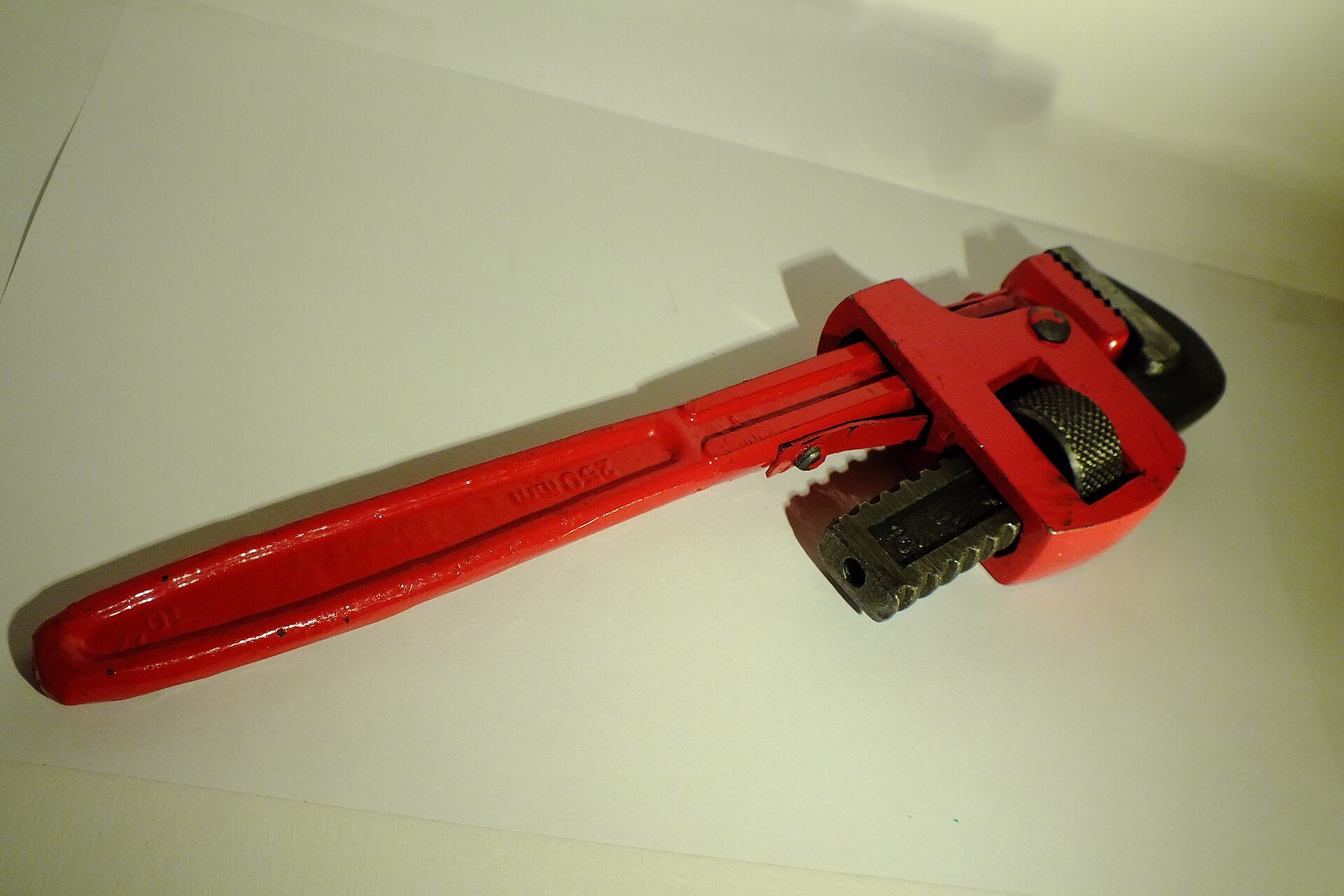
A pipe wrench grips round pipe and fittings with toothed jaws. The hook jaw is deliberately slightly loose, so the harder you pull, the tighter it bites, and it only grips in one direction.
- Sizes are given by length. A 250–350 mm (10–14 in) wrench covers most household pipe; larger ones give more leverage on stubborn joints.
- Aluminium handles are noticeably lighter than cast iron; offset versions reach fittings close to walls.
- Use two wrenches: one to turn the fitting and one to hold the pipe or valve body, so you don't twist and damage the rest of the pipework.
- Keep them off chrome and plastic. The teeth will mark or crush them; use a strap wrench or wrap the part first.
Tongue-and-groove pliers adjust to many sizes and handle trap slip nuts, compression nuts and supply connections. An adjustable spanner is better on hexagonal nuts because its flat jaws don't round the corners. A basin wrench, with a long shaft and a pivoting, spring-loaded jaw, reaches the nuts that hold taps in place from beneath the sink, where no other tool fits.
Cutting pipe: match the cutter to the material
| Pipe material | Where you'll find it | Cutting tool | Common joining methods |
|---|---|---|---|
| Copper | Water supply, heating | Tubing cutter (or mini cutter) | Solder, compression, push-fit, press |
| PEX and other plastic supply pipe | Newer water supply | PEX or plastic pipe cutter | Crimp, clamp, expansion, push-fit, press |
| PVC or ABS | Drains and waste | Fine-tooth saw or ratchet cutter | Solvent cement, push-fit waste fittings |
| Galvanised steel and cast iron | Older homes | Reciprocating saw or specialist cutter | Threaded or mechanical couplings |
A tubing cutter clamps around copper pipe with a hardened cutting wheel: rotate it, tighten the knob a little, and repeat until the pipe parts. Tighten too fast and you'll squash the pipe. Mini cutters fit tight spaces. Afterwards, remove the burr inside and out with the built-in reamer or a deburring tool, because burrs disturb flow and can damage O-rings in push-fit fittings.
PEX and plastic pipe cutters work like shears and give the square cut fittings need. For drain pipe, use a fine-tooth saw in a mitre box or a ratchet cutter, then chamfer the edge. For old steel pipe, a reciprocating saw is often the practical choice, and an oscillating multi-tool can cut flush in tight spots.
PEX tools: crimp, clamp, expansion and press
PEX (cross-linked polyethylene) pipe is flexible and quick to install, but each joining system has its own rings or sleeves, and the tool must match.
- Crimp: a copper ring is squeezed around the pipe over a ribbed fitting. Each pipe size needs the right jaws, and a go/no-go gauge checks every crimp.
- Clamp (cinch): a stainless-steel ring with a tab is pinched closed. One tool usually handles several sizes, and the deformed tab gives a visible check.
- Expansion: the pipe end and a reinforcing ring are stretched with an expander tool, then shrink back over the fitting. It's mostly used with PEX-A pipe and gives a full-bore joint, but the tool costs more and contraction is slower in the cold.
- Press: a sleeve is pressed by a press tool. It's fast and consistent, but the tools are expensive, so they're often hired.
Don't mix brands and systems unless the pipe and fitting makers approve it, and check that fittings carry the standard your local code requires. In the UK and much of Europe, plastic supply pipe is more often joined with push-fit fittings and pipe inserts.
Joining and sealing: tape, compression, push-fit and solder
- Threaded joints need PTFE tape or pipe-jointing compound on tapered threads. Choose products approved for drinking water or gas as appropriate.
Rule of thumb: wrap PTFE tape clockwise as you look at the end of the male thread, so screwing the fitting on smooths the tape down rather than unwinding it. Two to four turns is typical.
- Compression fittings seal with a brass or copper ring (the olive or ferrule) squeezed onto the pipe, not with the thread, so tape on the thread isn't normally needed. Hold the fitting body with one spanner while tightening the nut with another, and don't overtighten.
- Push-fit fittings need a square, deburred cut and the correct insertion depth: mark the pipe and push until the mark meets the fitting. Use the release collar or clip to remove them. Check where your local rules allow them, especially behind walls.
- Soldered copper joints use a torch, flux and lead-free solder, which is required for drinking-water pipes in many countries. Drain the pipe, use a heat-resistant mat, keep a fire extinguisher handy and check for smouldering afterwards. Press fittings are a flame-free alternative.
- PVC and ABS drains use the solvent cement (and primer, where required) made for that plastic.
Safety, shut-off valves and when to call a pro
- Find your main stop valve (stopcock) before you need it, and make sure it turns. Use the small isolation valves under sinks and toilets for local jobs.
- Drain the line by opening a tap below the work area, and keep a bucket and towels ready.
- Turn off the power or gas to a water heater before draining it.
- Leave gas pipework to professionals. In many places it legally requires a licensed or registered fitter.
- Check local codes and permits before adding new pipe runs or moving fixtures; some jobs must be done or inspected by a licensed plumber.
- Old pipes may be lead or corroded steel. Get advice before cutting into them.
If you're fitting water treatment, see our guides to under-sink reverse osmosis filters and water softeners and whole-house filters.
The short version
- Start with two plungers, a hand auger, a toilet auger, tongue-and-groove pliers, an adjustable spanner and a basin wrench.
- Buy a pipe wrench for threaded steel and stubborn fittings, and use two wrenches together.
- Match the cutter to your pipe material, and always deburr.
- Choose one PEX system and the matching tool, rings and gauge.
- Use approved tape, compound, solder and cement for drinking water.
- Know where your stop valve is, and call a professional for gas, main drains and permitted work.
Bloiq is reader-supported. Some links may earn us a commission; it never affects what we write. How we make money.
Cover photo: Altoscroll, CC BY-SA 3.0, via Wikimedia Commons