Screwdrivers and bit sets: Phillips, Pozidriv, Torx and Robertson
How to tell Phillips from Pozidriv, why Torx and Robertson grip better, what bit sizes you really use, and when you need impact-rated bits.
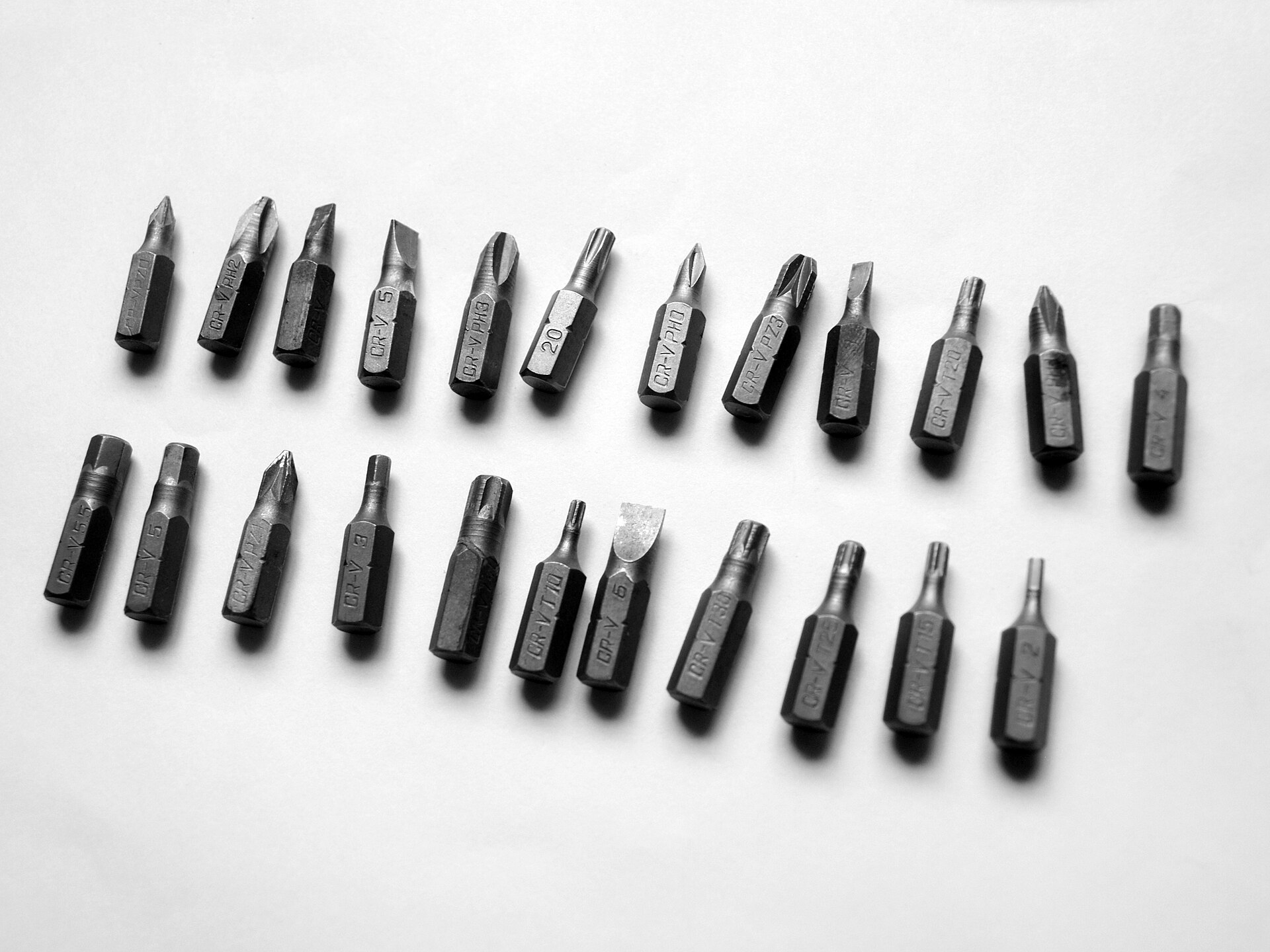
Most stripped screws come from a bit that doesn't match the screw, not from a weak tool. A Phillips bit in a Pozidriv screw, or a worn bit in a hard deck screw, will slip out and chew up the head. This guide explains the common drive types and sizes, what makes a good bit set, and when you need impact-rated bits.
The main drive types at a glance
| Drive | How to recognise it | Common sizes | Where you'll find it |
|---|---|---|---|
| Slotted (flat) | A single straight slot | Sized by blade width | Old hardware, switch plates, some electrical terminals |
| Phillips (PH) | A cross with rounded inner corners | PH1, PH2, PH3 | Drywall screws, furniture, appliances, much of North America |
| Pozidriv (PZ) | A cross plus four fine lines between the arms | PZ1, PZ2, PZ3 | Wood screws and fittings in the UK and Europe |
| Torx (T) | A six-pointed star | T10 to T40 | Deck and structural screws, cars, electronics |
| Robertson / square (SQ) | A square recess | #1, #2, #3 | Construction and woodworking in Canada, growing elsewhere |
| Hex (Allen) | A hexagonal socket | Metric and imperial | Flat-pack furniture, bikes, machinery |
Phillips and Pozidriv: similar, not the same
Phillips screws have a cross-shaped recess with slightly tapered sides. Under heavy load, the bit tends to ride up and out of the recess, which is called cam-out. Size PH2 fits the large majority of everyday screws; PH1 is for small hinges and electronics, PH3 for larger construction screws.
Pozidriv was developed from the Phillips design. You can identify it by four short lines stamped on the screw head, between the arms of the cross. The recess and bit have straighter, more parallel walls, so the bit stays seated better and cams out less.
The two look alike, and that causes a lot of damage:
- A Phillips bit in a Pozidriv screw sits loosely and slips out under load.
- A Pozidriv bit in a Phillips screw binds on the tapered walls and can tear the recess.
If you live in the UK or Europe, or assemble furniture made there, check the head for those fine lines and keep both types in your kit. A related trap: many Japanese machines and electronics use JIS cross-head screws, often marked with a small dot. They resemble Phillips but fit a JIS bit better.
Torx and Robertson: built for grip
Torx (also called star or hexalobular) has six rounded lobes. The bit drives on nearly vertical faces, so it transmits a lot of torque with very little cam-out, which is why most modern deck, timber and structural screws use it. Sizes are numbered: T20 and T25 cover most construction screws, T15 smaller wood screws, T30 and above heavy timber screws and car parts. The sizes are close together, so if a bit feels loose, try the next size up. Security Torx has a pin in the centre and needs a bit with a hole.
Robertson (square drive) was invented in Canada in the early twentieth century and is still standard there. The tapered square holds the screw on the bit, which makes one-handed driving easy. Bits are colour-coded by convention: #1 green, #2 red, #3 black (and #0 yellow). #2 is the everyday size. Many screws now combine a square and a cross recess, so either bit will work.
Slotted screws are mostly found on older hardware and some electrical terminals; use a blade that fills the slot's width and thickness. Hex keys and bits come in metric and imperial sizes that are close but not interchangeable, so match the system as well as the size.
Hand screwdrivers worth owning
- A multi-bit screwdriver with a magnetic hex holder covers most household jobs and uses the same 1/4-inch (6.35 mm) bits as a drill.
- Fixed-blade screwdrivers in PH2, PZ2 and a medium slotted size give better feel and reach into recesses where a multi-bit's wide shaft won't fit.
- A stubby screwdriver for tight spaces behind appliances and inside cabinets.
- A precision set for glasses, toys, electronics and battery covers.
- Insulated screwdrivers for electrical work, made and tested to standards such as IEC 60900 (often marked with a double triangle and "1000V"). They are a backup, not a substitute for switching off and testing that the circuit is dead.
A comfortable, grippy handle matters more than it sounds: most of the force that keeps a bit seated comes from pushing, and a larger handle lets you push and turn at once.
Bits for drills and impact drivers
Almost all driver bits use a 1/4-inch hex shank. Two lengths are common:
- Insert bits, about 25 mm (1 in) long, which sit in a magnetic bit holder or a multi-bit screwdriver.
- Power bits, 50 mm (2 in) or longer, with a groove that locks into an impact driver's quick-release chuck. Longer bits reach into recesses and let you see the screw.
A magnetic bit holder speeds up work; a screw guide (a sleeve that slides forward around the screw) helps start long screws straight. Some bits have fine ribs or textured tips that grip the recess better; they help, but a worn bit should simply be replaced. Wear shows as rounded edges, and it is the main cause of stripped heads.
Impact-rated bits
An impact driver delivers rapid rotational blows. Standard bits are made hard to resist wear, and that hardness makes them brittle under repeated impacts: tips chip or snap.
Impact-rated bits are made to flex slightly and absorb those blows. Look for:
- A marking such as "impact" or "impact-rated" on the bit or packaging.
- A narrow torsion zone, a thinner section of the shank that twists a little under load.
- Tougher steel grades and often a black or dark coating, though colour alone doesn't prove anything.
Use impact-rated bits in an impact driver and for long runs of deck or structural screws. In a drill/driver with the clutch set, ordinary bits are fine. For drilling rather than driving, see our guide to drill bit types.
Rule of thumb: match the bit to the recess exactly, push firmly in line with the screw and let the tool turn. If the bit starts to slip, stop: a damaged head is much harder to remove than a tight screw.
What a good bit set contains
Large sets with a hundred pieces look generous, but you'll use a dozen bits most of the time. Check that the set includes, ideally as several of each:
- PH1, PH2 (several), PH3
- PZ1, PZ2 (several), PZ3
- T10, T15, T20, T25 (several), T27, T30
- SQ1, SQ2 (several), SQ3
- A few slotted sizes and metric and imperial hex bits
- A magnetic holder, ideally with a locking sleeve, and some power-length bits
Also look for sizes clearly stamped on each bit, a case with labelled slots so you can see what's missing, and a clear statement of which bits are impact-rated. Extra security or specialist bits are useful only if you work on appliances or electronics.
Avoiding stripped screws
- Check the recess first. Pozidriv lines, Torx lobes and square sockets are easy to miss on a dirty screw head.
- Use low speed and the clutch on a drill/driver; on an impact driver, slow down as the head seats.
- Drill pilot holes in hardwood and near board ends.
- Replace worn bits often, especially the PH2, PZ2, T25 and SQ2 bits you use most.
- For a stripped head, a wide rubber band between bit and screw or a screw extractor can help.
Keep a small case of your everyday bits with your drill so the right one is always to hand. If you're choosing the drill itself, our guide to cordless battery platforms explains how to pick a system.
The short version
- Learn to tell Phillips from Pozidriv and own both.
- Torx and Robertson grip best; most modern construction screws use them.
- A small set of quality bits in the common sizes beats a giant set of soft ones.
- Use impact-rated bits in an impact driver.
- Replace worn bits before they strip a screw.
Bloiq is reader-supported. Some links may earn us a commission; it never affects what we write. How we make money.
Cover photo: Santeri Viinamäki, CC BY-SA 4.0, via Wikimedia Commons