Pliers explained: combination, long-nose, locking, water-pump and cutters
What each common type of pliers is for, from combination and long-nose to slip-joint, locking, water-pump and cutters, plus what separates good pliers from poor ones.
Pliers are the tool people reach for when nothing else fits, which is why so many nuts end up rounded and so many cutters end up notched. Each type is shaped for a particular job: gripping, bending, holding, turning or cutting. This guide explains the main kinds, what each does well, what it shouldn't be used for, and how to tell well-made pliers from poor ones.
The common types at a glance
| Type | Jaw shape | Best for | Avoid using it for |
|---|---|---|---|
| Combination | Flat serrated tip, round pipe grip, side cutter | General gripping, bending, cutting soft wire | Nuts and bolts, hardened wire |
| Long-nose (needle-nose) | Long tapered jaws | Reaching into tight spots, bending loops in wire | Heavy twisting, which springs the tips |
| Slip-joint | Two-position pivot | Gripping objects of two size ranges | Precise or heavy work |
| Water-pump (tongue-and-groove) | Angled jaws, many pivot positions | Pipes, fittings, large round objects | Small fasteners |
| Locking | Adjustable jaws that lock shut | Holding parts, clamping, freeing seized fasteners | Everyday nut turning |
| Diagonal cutters | Angled cutting edges | Cutting wire, cable ties, small pins | Steel wire harder than they are rated for |
| End-cutting nippers | Cutting edges across the end | Cutting flush to a surface, pulling small nails | Gripping |
Combination pliers
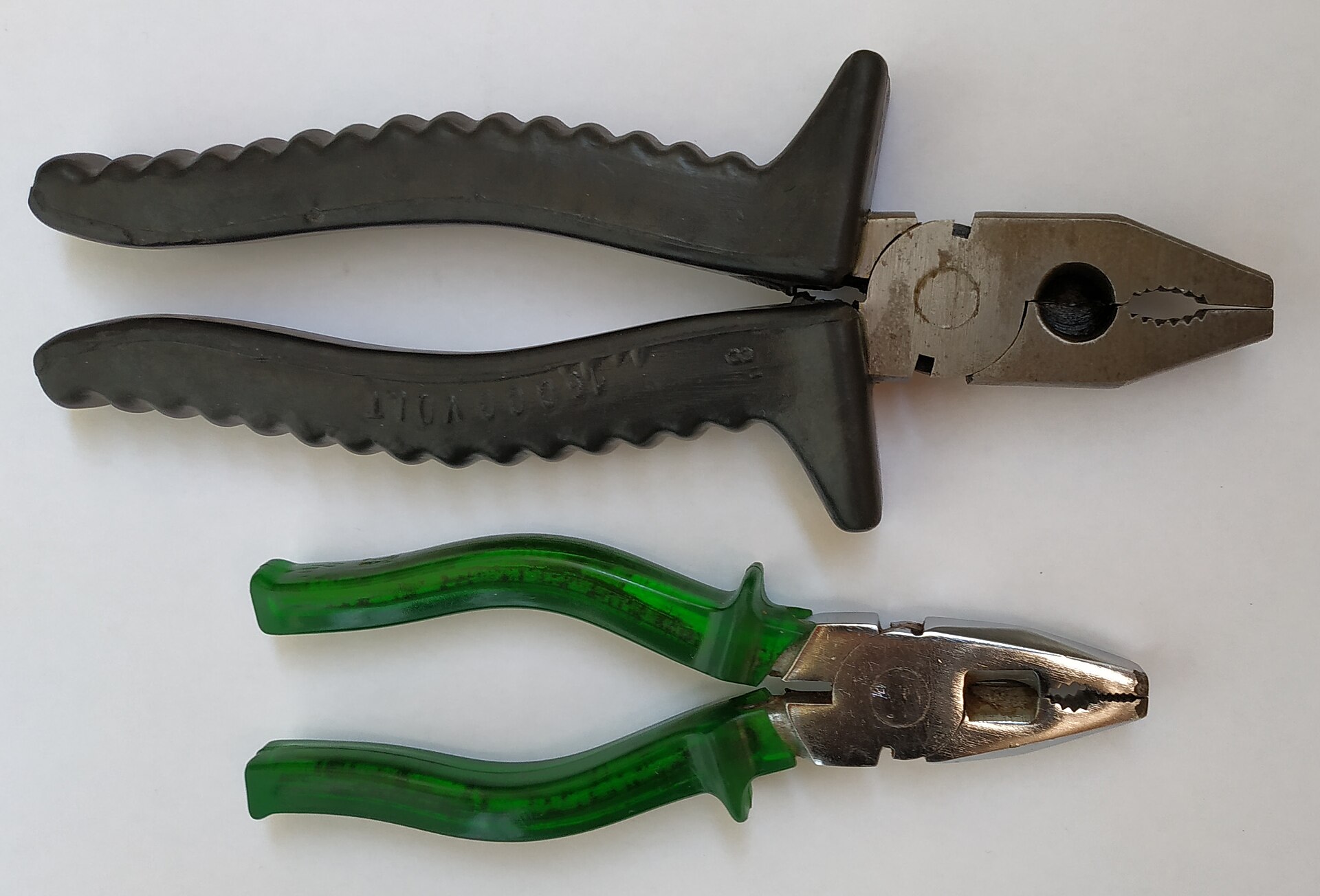
Combination pliers are the general-purpose pair. Behind the flat, serrated tip there is usually a rounded section for gripping round stock and, near the pivot, a pair of side cutters. In North America, the heavier version with a squarer nose is called lineman's pliers and is used by electricians for twisting and cutting cable.
A 180–200 mm (7–8 in) pair suits most homes. Longer handles give more leverage for cutting, while shorter pairs fit into small spaces. Some models have a crimping area or a joint designed to cut harder wire with less effort.
Long-nose and needle-nose pliers
Long, slim jaws reach where fingers can't: behind appliances, inside car engine bays, into electrical boxes. They are the right tool for forming loops in wire to fit under a screw terminal, holding small parts, and retrieving dropped screws. Many have a cutter near the pivot.
Variants include bent-nose pliers, angled at 45 or 90 degrees for awkward approaches, and fine jewellery and electronics pliers with smooth jaws that don't mark soft metal. The thin tips are the weak point: twisting hard against them will spring them apart permanently, so move to combination pliers for anything heavy.
Slip-joint and water-pump pliers
Slip-joint pliers have a pivot that slides between two positions, giving a narrow and a wide jaw opening. They are a common household tool, useful for gripping a range of objects, but they are not as solid as combination pliers.
Water-pump pliers, also called tongue-and-groove or groove-joint pliers, take the same idea further. The pivot sits in one of several grooves, so the jaws can open wide while staying close to parallel, and the jaws are angled away from the handles. They are made for pipes, plumbing fittings, sink and shower nuts, and any large round object. Some newer designs adjust with a push-button instead of lifting the joint out of a groove, which is quicker and less likely to slip.
The serrated jaws mark chrome and soft brass, so wrap the part in a cloth or use smooth-jawed versions on visible fittings. Our plumbing tools guide covers basin wrenches, pipe wrenches and the rest of a plumbing kit.
A related tool, the pliers wrench, has smooth parallel jaws that adjust to the size of a nut. Unlike ordinary pliers, it can turn nuts without damaging them.
Locking pliers
Locking pliers have a screw in one handle that sets the jaw opening and an over-centre linkage that locks the jaws onto the work. A release lever opens them. Once locked, they hold on by themselves. That makes them an extra pair of hands for welding, gluing and drilling, and the tool of last resort for a seized or rounded bolt.
They come with different jaws: curved jaws for round objects and nuts, straight jaws for flat stock, long-nose jaws for reach, and C-clamp and sheet-metal versions for holding panels. Adjust the screw so the handles close with firm hand pressure. Too tight, and they crush or slip at the last moment. For holding work during glue-ups and assembly, dedicated clamps are usually better.
Cutters and wire strippers
- Diagonal cutters (side cutters) are the standard wire cutters. The cutting edges sit at an angle so you can reach the wire. Edge hardness decides what they will cut; better pairs list the maximum diameter for soft wire, medium-hard wire and hard (piano) wire. Cutting harder wire than the rating leaves a dent in the edges.
- Flush cutters leave a flat end, useful for electronics, cable ties and plastic parts.
- End-cutting nippers cut flush to a surface and are also used to pull small nails and staples.
- Cable cutters use curved shearing blades to cut thick copper or aluminium cable cleanly without crushing it. Most are not for steel wire rope, so check what they are made to cut.
- Wire strippers remove insulation without nicking the conductor, using holes sized for each wire gauge. Automatic strippers grip and strip in one squeeze.
- Bolt cutters use compound leverage for chain, rods and bolts. They are a separate tool rather than pliers, but people often shop for them alongside.
Specialist pliers you may meet
- Circlip (snap-ring) pliers, for internal or external retaining rings. Check which kind, as the tips work in opposite directions.
- Crimping pliers for cable terminals and connectors, with dies matched to each terminal type.
- Hose-clamp pliers for the spring clips on car and appliance hoses.
- Fencing pliers, with a hammer face, a staple puller and wire cutters, for wire fences.
- Tile nippers for snapping and shaping tile edges; see our guide to tile saws and tile tools.
What separates good pliers from poor ones
- Steel and hardening. Chrome-vanadium or similar tool steels are common in good pliers. Look for induction-hardened cutting edges, which stay sharp far longer than the softer jaws.
- The joint. A tight joint without wobble keeps the jaws aligned. In a box joint, one handle passes through a slot in the other, which is stiffer than the simpler lap joint, where the halves simply sit on top of each other.
- Jaws that meet. Close the pliers and look at the tips against a light: they should touch evenly, and cutters should meet along their whole length with no gap.
- Handles. Dipped plastic handles are basic. Moulded two-component grips are more comfortable for long use and are less likely to slip when oily.
- Insulated pliers for electrical work. Pliers made and tested to IEC 60900 are marked with a double triangle and "1000V". Comfort grips without that marking offer no protection. Even rated tools are a backup: switch off the circuit and test that it is dead first, for example with a multimeter.
Rule of thumb: pliers grip, bend and cut; spanners and sockets turn nuts. If you find yourself turning a hexagon with ordinary pliers, stop and fetch the right spanner before the corners round off.
Using and caring for pliers
- Don't hammer with them or extend the handles with a pipe; both bend the joint and crack the jaws.
- Cut at right angles to the wire and wear eye protection: cut ends can fly off at speed.
- Keep the joint lightly oiled and wipe pliers dry after damp work so the pivot doesn't stiffen with rust.
- Store cutters so the edges don't knock against other tools.
The short version
- Start with three pairs: combination, long-nose and diagonal cutters. Add water-pump pliers if you do any plumbing.
- Locking pliers are the clamp and rescue tool for seized fasteners.
- Check the joint, the jaw alignment and the cutting edges before buying.
- Only pliers marked to IEC 60900 are insulated for electrical work.
- Use spanners on nuts, and respect the cutting rating of your cutters.
Bloiq is reader-supported. Some links may earn us a commission; it never affects what we write. How we make money.