Tyre tread depth: legal limits, wear bars and when to replace tyres
How to measure tyre tread depth, what wear bars and uneven wear patterns tell you, how to read a tyre's age, and when tyres should be replaced.
Tyres are the only part of a car that touches the road, and their tread is what keeps that contact on wet roads, slush and snow. Tread wears so gradually that it's easy to miss the point where grip has dropped away. This guide explains how to measure tread, what the legal minimums look like in general terms, what uneven wear is telling you, and why a tyre's age matters as much as its depth.
Why tread depth matters
On a dry road, a smooth tyre can actually grip well; racing slicks have no tread at all. The problem is water. Tread grooves channel water out from under the tyre so the rubber can touch the road. As grooves get shallower, they move less water, and the tyre is more likely to skim on a film of it (aquaplaning, or hydroplaning).
The loss of grip isn't linear. Tests by tyre makers and motoring organisations consistently show wet stopping distances getting noticeably longer as tread falls towards the legal limit, even though the tyre still looks usable. In snow and slush the effect is stronger, because the tread blocks and the small slits in them (sipes) need depth to bite.
Legal minimums in general terms
Every country sets its own rules, and they change, so check the current rules where you live and where you'll drive. As a broad picture:
- In the UK, across the European Union and in most US states, the minimum for car tyres is around 1.6 mm (2/32 in, which is about the same).
- Some places measure across the central part of the tread and around the whole circumference, not just at one point.
- Several countries and provinces set a higher minimum for winter tyres, often around 3.5–4 mm, and some require winter or snow-rated tyres in certain months or on certain roads.
- Rules for vans, trucks, motorcycles and trailers can differ from those for cars.
Being legal isn't the same as being ideal. Many safety organisations and tyre makers suggest considering replacement at around 3 mm (4/32 in) for summer and all-season tyres if you drive a lot in the wet, and at around 4 mm for winter tyres.
Rule of thumb: a new car tyre usually starts with roughly 7–9 mm of tread. By the time it's down to 3 mm, plan the replacement; at 1.6 mm, it's due now.
How to measure tread depth
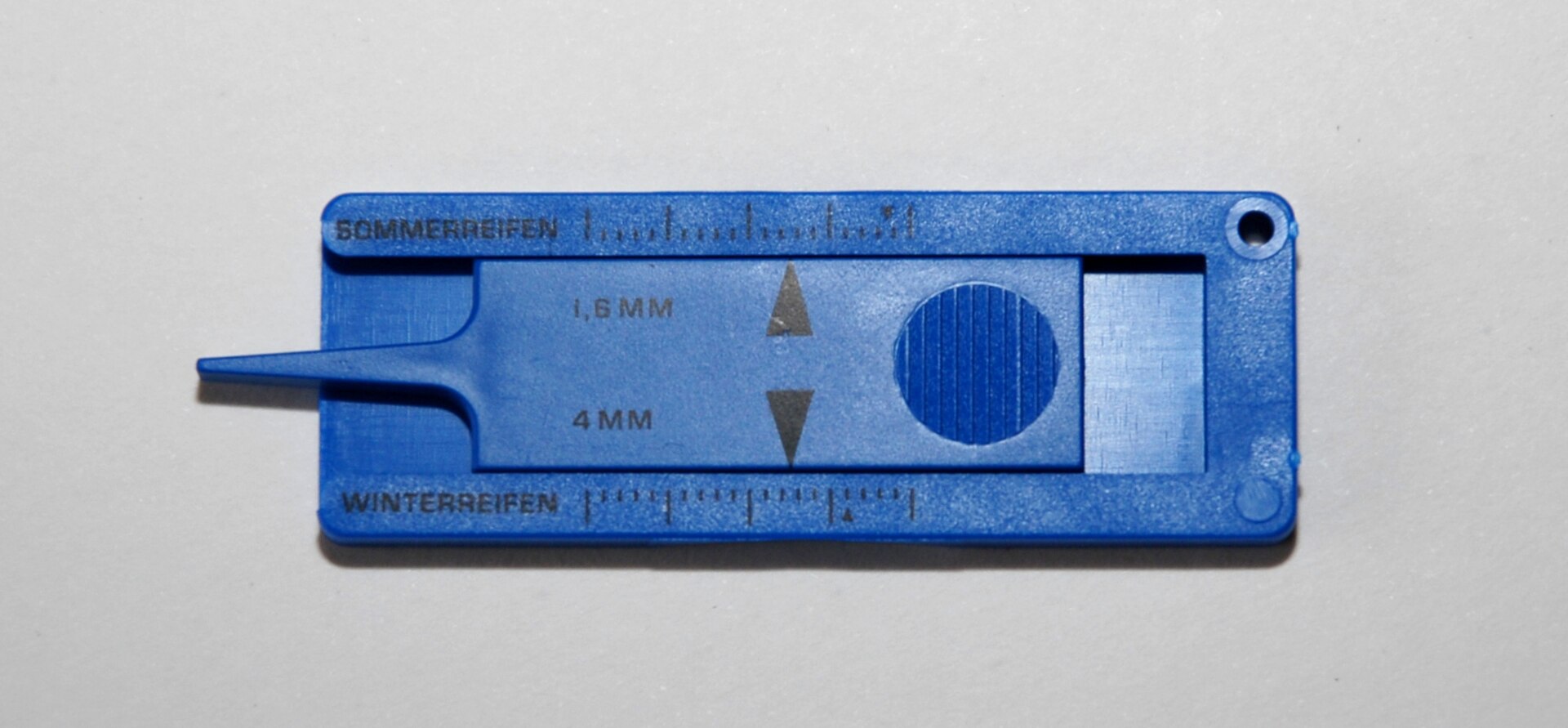
A tread depth gauge is the most reliable method. They're inexpensive and come as simple sliding plastic gauges, pen-style metal ones and digital ones. Push the probe into a main groove (not on a wear bar), press the base flat on the tread blocks and read the depth.
Measure in several places:
- in the inner, centre and outer grooves, because wear is rarely even;
- at three or four points around the tyre, rolling the car a little between readings, or turning the steering for the front tyres.
Coin tests give a quick rough check. In the UK, the border of a 20p coin should be hidden when you insert it into the main grooves; in the US, the long-standing penny test uses the top of Lincoln's head as a guide to 2/32 in, and a quarter with Washington's head roughly indicates 4/32 in. They're useful for a quick look, but a gauge is better for deciding when to buy.
Wear bars (tread wear indicators)
Tyres have small raised bars moulded into the bottom of the main grooves, called tread wear indicators or wear bars. They sit at about the common legal minimum. When the surface of the tread is level with the bars, the tyre is at the limit and needs replacing.
To find them, look on the tyre's shoulder for a small triangle, the letters "TWI" or a maker's logo; the bar lies in the groove in line with that mark. There are several around each tyre. Some winter and all-weather tyres have an additional indicator, often marked with a snowflake, showing the depth below which the tyre is no longer effective in snow.
What uneven wear is telling you
Tyres should wear fairly evenly across their width. If they don't, something needs attention, and fixing it will make the next set last longer.
| Wear pattern | Likely cause | What to do |
|---|---|---|
| Both outer edges worn | Underinflation | Check pressures cold and adjust to the vehicle's placard |
| Centre worn | Overinflation | As above |
| One edge worn (usually the inner) | Wheel alignment (camber or toe) out of specification | Have the alignment checked |
| Feathered tread blocks, sharp on one side | Toe misalignment | Alignment check |
| Cupping or scalloped patches | Worn shock absorbers or suspension, or wheel imbalance | Suspension and balance check |
| A single flat spot | Locked wheel under hard braking, or a car left standing for a long time | Inspect; a severe flat spot needs replacement |
Regular pressure checks prevent the first two. Use the pressures on the placard inside the driver's door, fuel flap or manual, not the maximum printed on the sidewall. A portable tyre inflator makes topping up easy at home, and a working TPMS warns you when pressure drops significantly, though it's no substitute for a monthly check.
Rotating tyres between positions, at the interval your manual gives, evens out the different wear rates of front and rear tyres. Some cars with different-sized front and rear tyres can't be rotated this way.
Tyre age: when depth isn't the only limit
Rubber ages even when a tyre isn't used. Over the years the compounds harden, which reduces grip, and fine cracks appear in the sidewalls and between tread blocks. Spare tyres, caravans, trailers and cars that cover little distance often have plenty of tread on tyres that are well past their best.
How to read the age: on the sidewall, find the code that starts with "DOT". It ends with four digits giving the week and year of manufacture: 2321 means the 23rd week of 2021. The full code may be on one side of the tyre only.
There's no single legal age limit for car tyres in most places, and advice varies by maker. Many tyre and vehicle makers recommend a yearly inspection by a professional once tyres reach about five years old, and replacement at around ten years at the latest, whatever the tread depth; some carmakers advise six years. Follow your vehicle maker's guidance, and replace sooner if you see:
- cracking in the sidewall or tread grooves;
- bulges, bubbles or cuts in the sidewall, which can mean internal damage and need urgent attention;
- exposed cords or wire anywhere.
When buying tyres, check that "new" stock isn't already several years old.
Replacing tyres: pairs, fours and the rear axle
- Replace in pairs at least. Tyres on the same axle should match in size, type and pattern, and be at similar depths.
- If you fit only two new tyres, many tyre makers advise putting them on the rear axle, even on front-wheel-drive cars, because worn rear tyres in the wet make a car more prone to oversteer, which is harder to control. Ask the fitter.
- All-wheel-drive cars are often sensitive to differences in tread depth between tyres, and some makers require all four to be replaced together. Check the manual.
- Choose the right type for your climate. Our guide to all-season, all-weather and winter tyres explains the differences, and our guide to tyre chains and snow socks covers roads where they're required.
- Have the alignment checked when you fit new tyres if the old ones wore unevenly.
The short version
- Measure tread in several grooves and places with a gauge, at least monthly and before long trips.
- The legal minimum in many places is about 1.6 mm, but plan replacement around 3 mm, or 4 mm for winter tyres. Check the rules where you drive.
- When the tread is level with the wear bars, the tyre is due.
- Uneven wear means pressure, alignment or suspension problems; fix the cause.
- Read the DOT date, and replace aged or cracked tyres even if the tread looks fine.
If you're looking at a car to buy, add tyre depth and age to our used car inspection checklist: worn or old tyres are a real cost to factor in.
Bloiq is reader-supported. Some links may earn us a commission; it never affects what we write. How we make money.
Cover photo: Fahi, Public domain, via Wikimedia Commons