Tyre chains and snow socks: when you need them and how to fit them
Link chains, cable chains and textile snow socks compared: when they're required in general terms, sizing and wheel clearance, fitting step by step, and safe speeds.
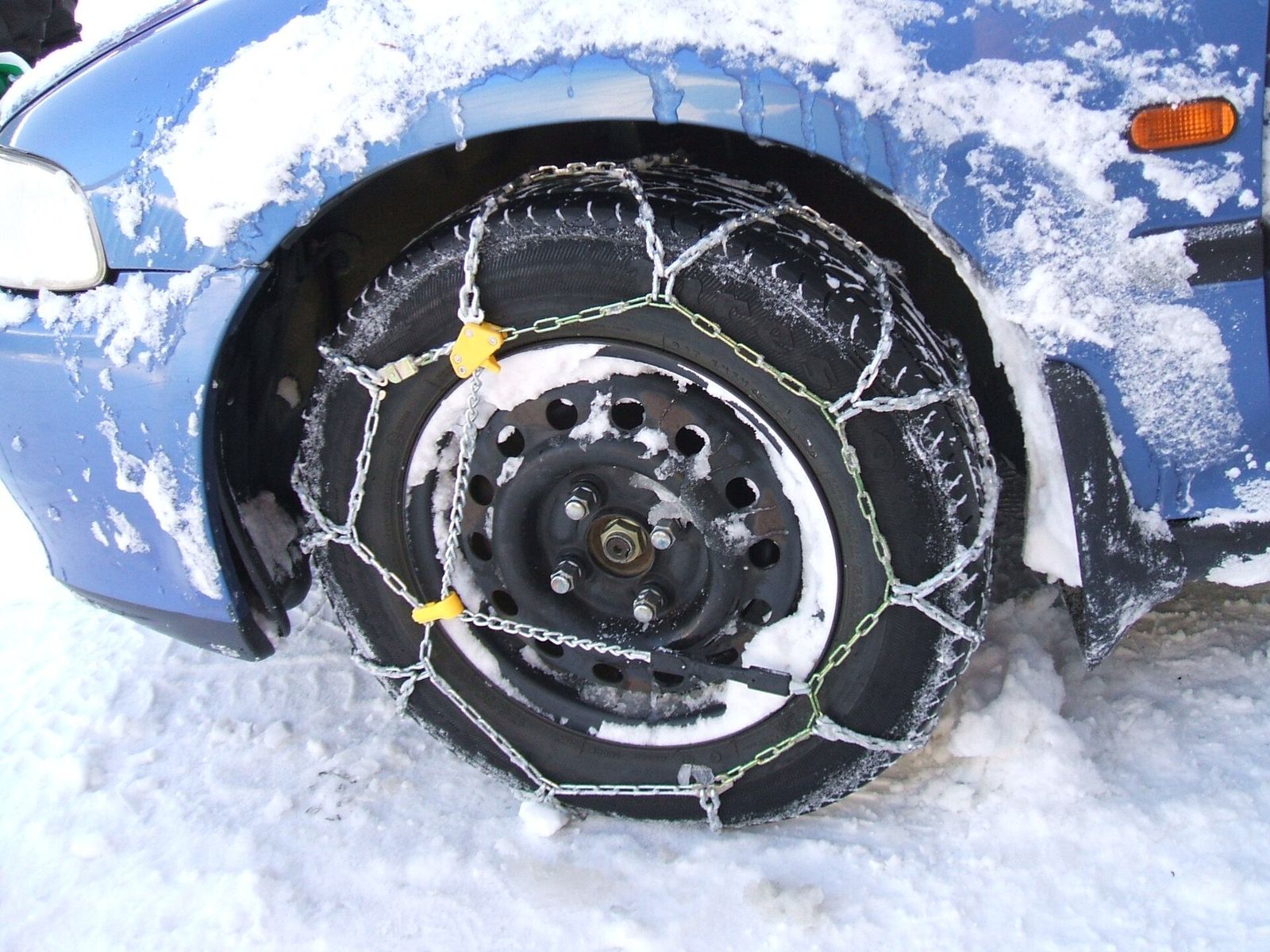
Good winter tyres handle most snowy roads, but steep mountain passes, deep fresh snow and packed ice can defeat even the best rubber. That's where tyre chains and snow socks come in: temporary traction devices you fit for the worst stretch and take off afterwards. Some roads require them by law, the wrong size can damage your car, and fitting them for the first time at the roadside in a blizzard is miserable. This guide explains the types, the rules in general terms, and how to fit and drive with them safely.
What chains and socks do
Both work by giving the tyre something to grip with where rubber alone slides:
- Chains are metal links or cables that lie across the tread. They bite into packed snow and ice and dig in for traction when climbing, braking and turning.
- Snow socks are textile covers that slip over the tyre. The fabric grips snow and ice better than rubber, partly by wicking away the thin film of water that makes ice slippery.
Neither replaces winter tyres. They're for short, difficult sections, not for whole journeys. Our guide to all-season, all-weather and winter tyres explains the tyres you should have on the car in the first place.
When they're required, in general terms
Rules vary widely, so treat this as an overview and check local law before you travel:
- Mandatory-chain signs. In much of Europe, a round blue sign showing a tyre wrapped in chains means chains are compulsory on that road, usually on at least two drive wheels, whatever tyres you have.
- Carry rules. Some countries and mountain regions require you to have winter tyres or carry chains (or approved socks) through the winter season, even when the road is clear.
- Chain controls. Some US states use graded chain controls on mountain highways. At the lower levels, vehicles with snow-rated tyres or four-wheel drive may be exempt; at the highest level, chains are required on everything.
- Canada. Rules for passenger cars focus mostly on winter tyres on designated highways. Chain-up requirements apply mainly to commercial vehicles, but carrying traction devices on mountain routes is sensible. Rules vary by province or state; check the current rules before you go.
- Rental cars. Many rental contracts forbid fitting chains, or limit where the car can be driven in winter. Check the contract, and ask whether the car comes with chains or socks.
The main types compared
| Type | How it works | Strengths | Drawbacks |
|---|---|---|---|
| Link chains (ladder or diamond pattern) | Steel links across the tread | Strongest grip and most durable; diamond patterns ride more smoothly | Heavier, need more clearance, fiddlier to fit |
| Low-profile and cable chains | Thinner links, or steel cables with rollers | Fit cars with tight clearance; lighter | Less bite in deep snow; wear faster |
| Self-tensioning chains | Built-in tensioner takes up slack as you drive | Quicker to fit; no need to stop and re-tighten | Bulkier and more expensive |
| Outside-mounted systems | Grip arms attach from the outer face of the wheel, often via an adapter | Nothing goes behind the tyre; good for zero-clearance cars | Expensive; may need wheel-specific parts |
| Snow socks | Textile cover pulled over the tyre | Light, quick to fit, quiet and gentle on alloy wheels | Wear quickly on bare road; less grip on ice and in deep snow; not accepted everywhere |
Snow socks: where they fit in
Socks are best thought of as an occasional-use option: they're easy to fit, need almost no clearance and are ideal for getting out of a snowy car park or over a short snowy stretch. Chains are the better choice for frequent use, long climbs, deep snow and ice.
The legal position is mixed. In parts of Europe, socks that meet the European standard EN 16662-1 are accepted where chains are required, but not everywhere, and some roads may still demand chains. If socks are your plan, check the rules of each country and region on your route.
Sizing and wheel clearance
Chains and socks are sized to the tyre, using the size printed on the sidewall (for example 205/55 R16). The number must match exactly. If you fit a different-sized winter set, buy traction devices for that size, not for your summer tyres.
Clearance matters just as much. Chains need space between the tyre and the suspension, brake lines and wheel arch, and many modern cars, especially those with large wheels and low-profile tyres, have very little. A chain that hits these parts can cause serious damage.
Before you buy, read the owner's manual. It states whether chains are permitted on your tyre size, which type is allowed and which wheels they go on. Some cars allow only low-profile chains, socks or outside-mounted systems, and a few allow nothing at all on certain wheel sizes.
In North America, chains marked SAE Class S are designed for vehicles with restricted clearance, and many manuals specify them. In Europe, link size is usually quoted in millimetres, with thinner, low-profile chains (often around 7 mm) made for tight wheel arches.
Which wheels they go on
- Front-wheel drive: on the front wheels.
- Rear-wheel drive: on the rear wheels.
- Four-wheel or all-wheel drive: follow the manual. Many specify the front axle; some recommend all four.
Always fit them in matched pairs on the same axle, never on one wheel. On a steep, icy descent, chains on all four wheels (where the car allows it) give the most control.
Fitting chains step by step
Instructions differ between designs, so follow yours. The general sequence is:
- Practise at home in the dry before winter, and time yourself.
- Stop somewhere safe: a designated chain-up area or a wide, flat spot well off the road, never on a bend or in a traffic lane. Put on hazard lights, a high-visibility vest and gloves, and set the parking brake.
- Lay the chain out and untangle it, with the fasteners and tensioner facing outwards.
- Drape it over the tyre from the top, with the inner cable or hoop tucked behind the tyre, and join the inner fastening.
- Pull the chain over the outer face, spread it evenly across the tread and connect the outer fastening.
- Tension it with the tensioner, ratchet or cord provided.
- Drive a short distance, stop and re-tighten. Most chains settle after the first few hundred metres; self-tensioning designs do this for you.
Socks are simpler: pull the sock over the top of the tyre, roll the car forward or back half a turn, then pull the rest over. They centre themselves as you drive off.
A kneeling mat or old bin bag, a head torch and a small towel make the job far more bearable. Our winter car kit checklist covers what else to carry.
Driving with chains or socks
- Keep your speed down. A maximum of 50 km/h (about 30 mph) is common in chain makers' instructions and in European traffic law, and some chain-control areas post lower limits.
- Drive smoothly: gentle acceleration, early braking and no wheel spin.
- Stop at once if you hear slapping or banging. A loose or broken chain can damage the car within seconds.
- Take them off as soon as you reach clear road. Driving on bare tarmac wears chains and socks quickly, damages the road surface and reduces grip.
Care and storage
After use, rinse off road salt with fresh water and let chains dry fully before packing them away to prevent rust. Dry socks too, and check them for holes. Before each winter, look for broken links, worn tensioners and frayed cables, and keep the set in its case in the boot along with the gloves and mat.
The short version
- Chains and socks are for the worst stretches; they don't replace winter tyres.
- Check local law for mandatory-chain signs, carry rules and chain controls, and check your rental contract.
- Match the tyre size exactly and follow the owner's manual on clearance and permitted types.
- Fit them in pairs on the drive wheels, practise at home, and re-tighten after a short distance.
- Stay at or below about 50 km/h, and take them off on clear road.
Bloiq is reader-supported. Some links may earn us a commission; it never affects what we write. How we make money.
Cover photo: Domitori, CC BY-SA 3.0, via Wikimedia Commons