TPMS explained: direct vs indirect sensors and tyre warning lights
How tyre pressure monitoring works, direct vs indirect TPMS, what the warning lights mean, and what to know about sensors, batteries and winter wheels.
Most cars built in the last fifteen years or so warn you when a tyre is low. That warning comes from the tyre pressure monitoring system (TPMS), and it's easy to misunderstand: it doesn't replace regular pressure checks, the two main types work in very different ways, and the same amber symbol can mean either "low tyre" or "system fault". This guide explains how TPMS works and what to do when the light comes on.
Why cars have TPMS
Under-inflated tyres flex more, run hotter, wear faster, use more fuel and can lengthen braking distances, and a badly under-inflated tyre can fail. Because pressure drops gradually and a tyre can look normal when it's well below the recommended figure, drivers often don't notice.
In the United States, TPMS has been required on new passenger cars and light trucks since the 2008 model year, and the warning must come on when a tyre is 25% or more below the recommended cold pressure. The European Union made it mandatory on all new passenger cars from 2014, and many other markets have similar rules.
TPMS is a warning, not a gauge. On a car whose door placard says 35 PSI, a warning at 25% below means the tyre may already be down to about 26 PSI. Check pressures monthly with a gauge, with the tyres cold, and treat the light as a backstop.
Direct TPMS: a sensor in every wheel
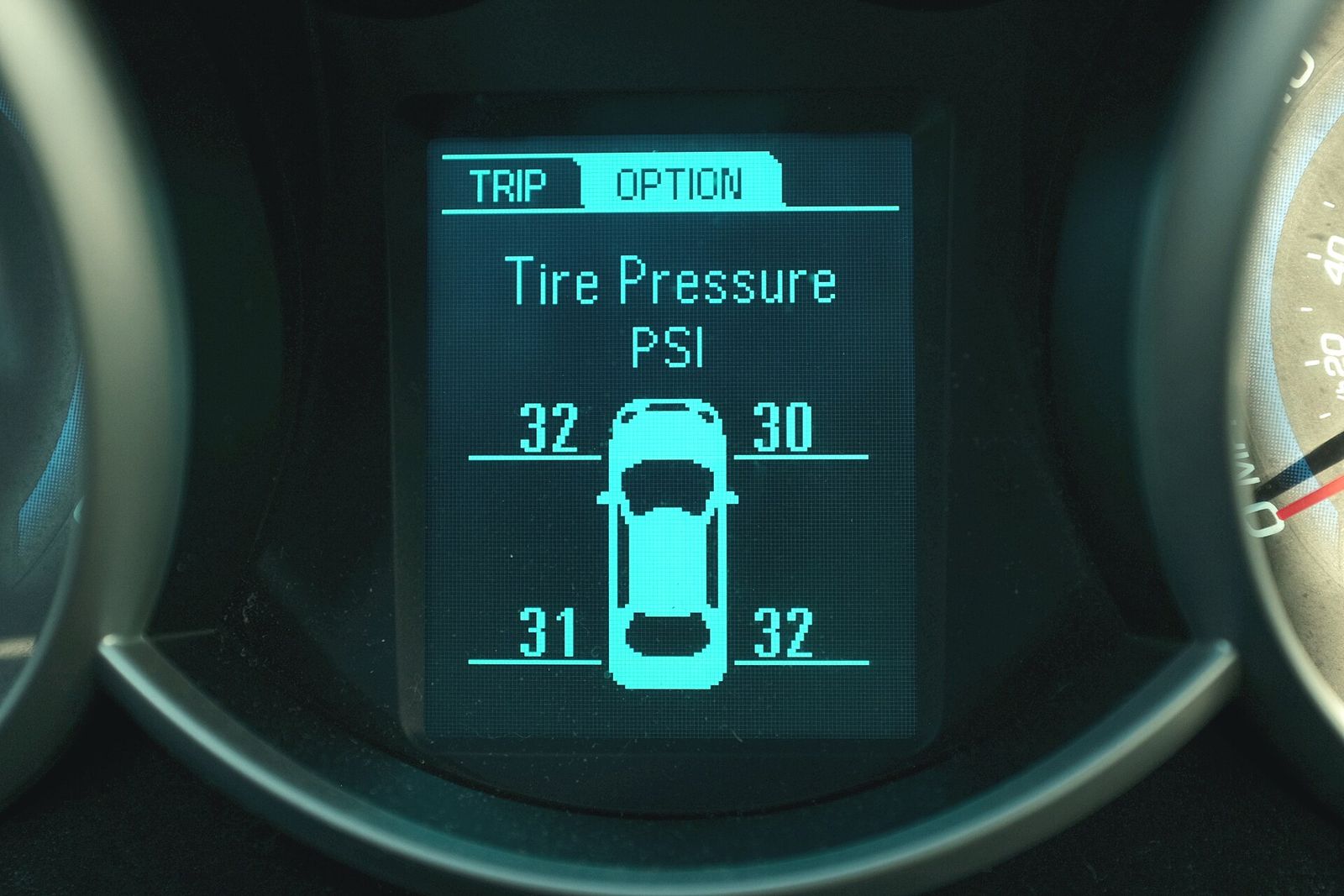
A direct system has a small battery-powered sensor inside each wheel, usually built onto the inner end of the valve stem (some older designs strap it to the rim). It measures pressure, and often temperature, and sends the reading by radio to a receiver in the car, typically at 315 MHz in North America and 433 MHz in Europe and many other markets. Each sensor has its own ID, so many cars can show the pressure of each tyre on the dashboard.
- Strengths: actual pressures, a quick and accurate warning, and on many cars a display of which tyre is low.
- Weaknesses: the sensors are an extra part to replace, their batteries are sealed in and eventually run out, and they can be damaged during tyre fitting.
Indirect TPMS: using the wheel-speed sensors
An indirect system has no pressure sensors. Instead, it uses the wheel-speed sensors of the anti-lock braking system. A tyre that loses pressure gets slightly smaller in rolling diameter, so it turns a little faster than the others. Newer systems also analyse the vibration of each wheel, which helps them notice several tyres losing pressure at once.
- Strengths: nothing extra in the wheels, no batteries, and no extra parts when you fit a second set of wheels.
- Weaknesses: it can't show actual pressures, it may need some driving before it warns, and it must be reset (calibrated) after you adjust pressures, rotate the tyres or fit new ones. Reset it at the wrong pressure and it learns the wrong baseline.
Direct vs indirect at a glance
| Direct TPMS | Indirect TPMS | |
|---|---|---|
| How it measures | Pressure sensor in each wheel | Wheel-speed (ABS) sensors |
| Shows actual pressures | Usually | No |
| Warning speed | Quick | Slower; may need some driving |
| After inflating or tyre work | Usually updates by itself; new sensors may need a relearn | Must be reset |
| Second set of wheels | Needs its own sensors | No extra parts; reset after swapping |
| Upkeep | Sensors and valve parts over time | Essentially none |
To find out which type you have, check the owner's manual. A screen showing four individual pressures means a direct system. A "TPMS reset" or "calibrate" option in the vehicle menu usually points to an indirect one, though some direct systems have a reset button too.
What the warning lights mean
The TPMS symbol is an amber cross-section of a tyre, shaped like a horseshoe, with an exclamation mark in the middle. Some cars show a text message instead.
- The light comes on and stays on: one or more tyres are low. Avoid hard braking and sharp steering, and check all four tyres as soon as you can stop somewhere safe. If a tyre is visibly flat or damaged, don't drive on it; fit the spare or call for assistance.
- The light flashes for a minute or so at start-up, then stays on: the system has a fault. Common causes are a sensor with a flat battery, a damaged sensor, or wheels fitted without sensors. Until it's repaired, the system can't warn you about low tyres.
- The light comes on on a cold morning, then goes out: the pressure is borderline. Air pressure falls in the cold, roughly 1 PSI for every 5–6 °C drop, and rises again as the tyres warm up while you drive. Top up to the placard pressure.
- The light stays on after you've inflated the tyres: some direct systems need a few minutes of driving to update, and indirect systems need a reset. If it persists, have the system checked.
Sensor batteries, servicing and replacement
Direct sensors commonly last around 5 to 10 years, depending on use and climate. The battery is sealed inside, so the whole sensor is replaced when it runs down. On an older car, if one sensor has failed, the others may not be far behind, and some owners replace them as a set when they next buy tyres.
- At every tyre change, tell the fitter that your car has sensors. Sensor makers commonly recommend a service kit (valve core, seal, nut and cap) each time a tyre is fitted, to prevent slow leaks.
- Aluminium valve stems on clamp-in sensors can corrode and seize; plastic caps are often recommended over metal ones.
- Replacement sensors come as original-equipment parts or as programmable aftermarket sensors that a shop configures for your car. Some can copy the old sensor's ID so the car accepts them straight away; others need a relearn.
- Relearn procedures vary: some cars find new sensors automatically after a short drive, some need a sequence in the vehicle menu or a handheld tool, and some need a scan tool plugged into the diagnostic port. Our guide to OBD2 scanners explains what those tools can do.
- Puncture sealant can foul a sensor. If you've used it, tell the tyre shop so they can clean or replace the sensor. Some sealants are labelled as safe for TPMS sensors.
Winter wheels and spare tyres
If you switch to winter tyres on a second set of wheels, a direct system needs sensors in those wheels too. Without them, the warning light stays on all winter and you won't be warned if a tyre goes down. Ask whether the new sensors need programming or a relearn each time the wheels are swapped. Indirect systems simply need a reset after each swap, which is a real advantage if you change wheels twice a year. In some countries, a TPMS warning light can fail a roadworthiness inspection, so check the current rules. For choosing the tyres themselves, see our guide to all-season, all-weather and winter tyres.
Many compact spare tyres have no sensor, so the light may come on while one is fitted. That's expected; get the regular tyre repaired and refitted promptly.
Aftermarket TPMS kits
Older cars, motorhomes, caravans, trailers and motorcycles often have no TPMS. Aftermarket kits add one:
- Cap sensors screw onto the valve stems in place of the dust caps. They're easy to fit and move between vehicles, but they're exposed to knocks and theft, and you remove them to add air.
- Internal sensors sit inside the wheel like factory sensors and need a tyre shop to fit them.
- Displays range from a small screen on the dashboard to a phone app. Check how the sensor batteries are replaced, which alarm thresholds you can set, and whether the system handles as many wheels as you need, since a tow vehicle and trailer together can have eight or more.
On trailers, an alarm for rapid pressure loss or high tyre temperature is especially useful, because a failing trailer tyre is hard to feel from the driver's seat.
The short version
- TPMS warns when a tyre is already well below the recommended pressure; it doesn't replace a monthly check with a gauge.
- Direct systems show real pressures but need sensors and, eventually, new batteries; indirect systems need no extra hardware but must be reset after any tyre work.
- A steady light means low pressure; a light that flashes, then stays on means a system fault.
- Tell the tyre fitter about your sensors, and plan for sensors on any winter wheel set.
- Set pressures cold, to the placard on the driver's door frame, with a reliable gauge or inflator; see our portable tyre inflator guide.
Bloiq is reader-supported. Some links may earn us a commission; it never affects what we write. How we make money.
Cover photo: WillisMoon, CC BY 4.0, via Wikimedia Commons