Engine air filters and cabin filters: types, carbon and when to change
What engine air filters and cabin air filters do, paper versus reusable filters, what activated carbon adds, and how to judge replacement intervals.
Most cars have two air filters that do very different jobs. The engine air filter protects the engine from dust. The cabin air filter cleans the air you breathe inside the car. Both are cheap, simple parts that are easy to forget, and both are often oversold with claims about horsepower or "hospital-grade" air. This guide explains what each one does, how the main types differ and how to decide when to change them.
Two filters, two jobs
| Engine air filter | Cabin air filter | |
|---|---|---|
| What it protects | The engine's cylinders, valves and sensors | The people inside the car, and the heater and air-conditioning system |
| Where it usually is | In a plastic airbox under the bonnet (hood) | Behind the glovebox, under the dashboard or under the cover at the base of the windscreen |
| What it traps | Dust, sand, grit, insects, leaves | Dust, pollen, soot, and with carbon, some odours and gases |
| Signs it needs changing | Visibly clogged, sluggish response in some cases | Weak airflow from the vents, musty smells, windows slow to demist |
Nearly every car has an engine air filter. Cabin filters have been common for a couple of decades, but some older or basic models don't have one, or have only an empty slot. The owner's manual will tell you.
Engine air filters: what they do
An engine burns a huge volume of air: thousands of litres every minute at motorway speed. Without a filter, fine dust would act like grinding paste on cylinder walls, piston rings and valves, and could foul the airflow sensor that helps the engine control system meter fuel.
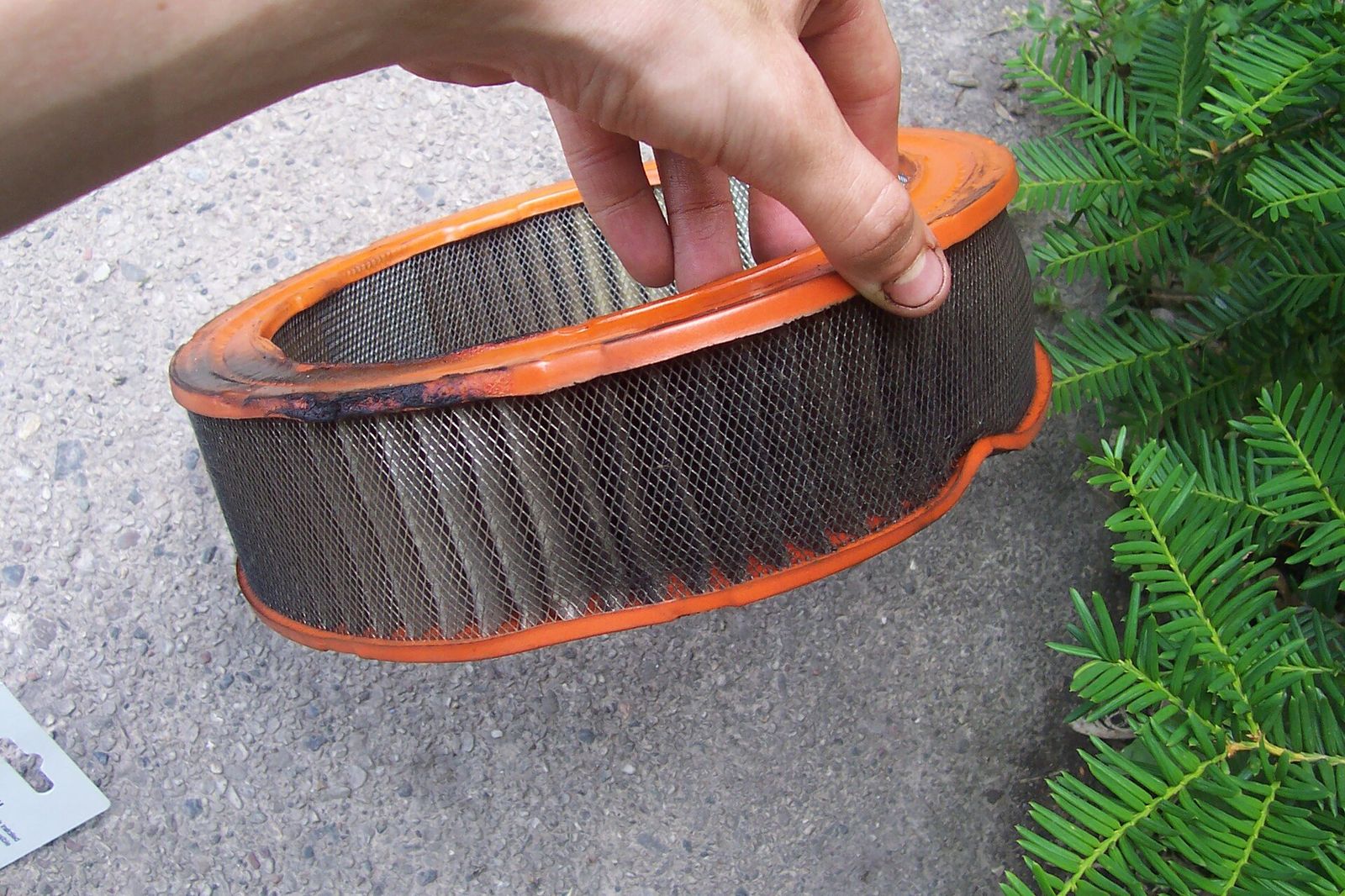
The filter sits in the airbox between the air intake and the engine. Most are a flat panel of pleated filter media in a rubbery frame; older and some larger engines use a round element. Pleating packs a large filtering area into a small space, which lets air through easily while trapping particles.
On a modern fuel-injected engine, a dirty filter mainly costs some performance, especially acceleration at full throttle; the engine management usually compensates so that fuel economy changes little. A heavily blocked filter is still worth avoiding, and a torn or badly seated filter is worse than a dirty one, because it lets unfiltered air straight in.
Paper, synthetic or reusable
Engine air filters come in a few main types:
- Paper (cellulose) filters are the standard fitted at the factory. They filter well, cost little and are thrown away when dirty.
- Synthetic or blended media use man-made fibres, sometimes mixed with cellulose. They can hold more dust before restricting airflow and cope better with damp.
- Oiled cotton-gauze filters are reusable: you wash them and re-oil them with a specific oil. They flow freely, but filtration depends on getting the oiling right. Too much oil can be drawn into the intake and contaminate the airflow sensor.
- Foam filters, often oiled, are common on off-road vehicles, motorcycles and small engines, where they handle heavy dust well when kept clean.
- Dry reusable synthetic filters can be cleaned without oil, following the maker's instructions.
Performance claims deserve caution. On an unmodified engine, an aftermarket panel filter is unlikely to make a noticeable difference in power, and some free-flowing designs trade a little filtration for airflow. For most drivers, a good-quality filter of the correct size is the sensible choice. Check that it fits the airbox exactly, with the seal seated all round, and remember that some warranties are particular about intake changes.
Cabin air filters: particle, carbon and more
Air coming through the vents passes through the cabin filter first. Cabin filters come in three broad kinds:
- Particle filters use pleated non-woven media, often electrostatically charged, to catch dust, pollen and soot.
- Activated carbon filters add a layer of carbon granules or carbon-impregnated fabric. Carbon has an enormous internal surface that adsorbs gases: it can reduce odours, and some exhaust gases from traffic, in addition to trapping particles.
- Enhanced filters add further layers, such as antibacterial or anti-allergen treatments, or finer media aimed at very small particles. Some are tested to standards such as ISO 16890, which grades filters by how well they capture fine particles of different sizes. Treat claims of specific percentages with some caution, and check which standard they refer to.
What activated carbon can and can't do
Carbon is useful if you drive in heavy traffic, through tunnels or near farms and industry, or if smells bother you. But its capacity is limited: once its surface is saturated, it stops adsorbing. That's why carbon filters need changing on schedule even when they still look fairly clean, and why a carbon filter that once kept out traffic fumes may stop doing so long before it looks dirty.
Carbon also makes the filter slightly denser, so a few designs reduce airflow a little. It's generally a good upgrade for most drivers, particularly people with allergies or asthma, but it doesn't make the cabin airtight. Recirculation mode keeps more outside air out for short spells, though it can let windows fog and air go stale if left on for long.
Replacement intervals in general terms
The right interval is the one in your owner's manual or service schedule, and it varies a lot between cars. As a rough guide:
- Engine air filters are often scheduled for replacement every few tens of thousands of kilometres, and some long-life designs go further.
- Cabin air filters are often changed about once a year or at a comparable distance, and carbon filters often on the shorter side.
Rule of thumb: dusty roads, heavy city traffic, towing or long seasons of pollen all mean "change it sooner". Manufacturers usually list a shorter "severe conditions" interval for exactly these cases.
For allergy sufferers, a fresh cabin filter just before the main pollen season makes sense. Between services, a quick look can tell you a lot: an engine filter caked in dust or a cabin filter full of leaves needs changing, whatever the mileage. Colour alone isn't always a reliable guide, because some filter media darken without being blocked.
Changing them yourself
Both filters are among the easiest jobs on a car, though access varies.
- Engine air filter: open the airbox clips or screws, note which way the old filter sits, lift it out and wipe loose debris from the box without letting it fall into the intake duct. Fit the new filter so the seal sits flat, then close the box fully. A clip left open can let in unfiltered air.
- Cabin filter: often behind the glovebox, which unclips or drops down. Look for an airflow arrow on the filter's frame and fit it the right way round. On some cars, the filter is under the plastic cover beneath the windscreen, or requires removing a small panel.
Don't try to clean a disposable paper filter with compressed air. It can tear the media or open up the pores, letting more dust through.
Musty smells and other related problems
A musty smell when you switch on the air conditioning often comes from moisture and growth on the evaporator behind the filter, not from the filter alone. A new filter helps, and running the fan without air conditioning for a few minutes before parking can help the system dry out. If the smell persists, a garage can clean the system. A blocked drain under the car can also cause damp and odours.
While you have the bonnet open, it's a good moment for other routine checks; our guides to motor oil, engine coolant and spark plugs explain what to look for. For a clean cabin, see our guide to car vacuums.
The short version
- Your car has an engine air filter and probably a cabin air filter: two different parts.
- A good-quality paper or synthetic engine filter of the right size suits most drivers; reusable filters need correct cleaning and oiling.
- Choose an activated carbon cabin filter if odours, traffic fumes or allergies matter to you.
- Follow the service schedule, and change both sooner in dusty, polluted or high-pollen conditions.
- Check the seal and the airflow arrow when fitting.
Bloiq is reader-supported. Some links may earn us a commission; it never affects what we write. How we make money.
Cover photo: Ahanix1989 at English Wikipedia, Public domain, via Wikimedia Commons