Car batteries explained: flooded, EFB, AGM and lithium compared
How flooded, EFB, AGM and lithium car batteries differ, what CCA, amp-hours and reserve capacity mean, and what start-stop cars need from a replacement.
A car battery used to be a simple purchase: find one that fits and bolt it in. Today the same shelf holds flooded, EFB and AGM batteries, each with a row of ratings on the label, and a car with start-stop can be fussy about which one it gets. This guide explains the battery types, what the numbers mean and how to choose a replacement that suits your car and climate.
What the 12 V battery does
In a petrol or diesel car, the battery's main job is to deliver a very large current for a few seconds to turn the starter motor. Once the engine runs, the alternator powers the car and recharges the battery. The battery also runs the electronics when the engine is off and smooths out the electrical system while driving.
Hybrids and electric cars have a 12 V battery too. It doesn't crank an engine, but it powers the computers, locks and lights, and a flat one can still leave the car unable to start.
Nearly all of these batteries are lead-acid: six cells of lead plates in sulphuric acid, giving about 12.6 V when fully charged. The types differ in how the plates are built and how the acid is held.
The four types
Flooded (standard wet) batteries have plates sitting in liquid acid. They're the least expensive and work well in older and simpler cars. Most are now sealed and "maintenance-free", though some still have caps for topping up with distilled water. They dislike being deeply or repeatedly discharged.
EFB (enhanced flooded battery) is a tougher version of the flooded design, with reinforced plates and additives that help it accept charge quickly and survive many more engine starts and partial discharges. It was developed for entry-level start-stop systems.
AGM (absorbent glass mat) batteries hold the acid in fibreglass mats pressed between the plates. They're sealed and spill-proof, resist vibration, recharge quickly and cope best with repeated cycling. That makes them the usual choice for start-stop cars with energy recovery under braking, and for cars with heavy electrical loads. They cost more and are sensitive to overcharging, so the car's charging system must be designed for them.
Lithium (usually LiFePO4) 12 V batteries are far lighter and tolerate deep cycling well. They're fitted by a few manufacturers and used in motorsport, but they need a built-in battery management system, have limits on charging in freezing temperatures and cost considerably more. For most cars they aren't a drop-in replacement; fit one only if it's approved for your vehicle.
| Flooded | EFB | AGM | Lithium | |
|---|---|---|---|---|
| Acid | Free liquid | Free liquid | Held in glass mat | None (lithium cells) |
| Start-stop use | No | Basic systems | Yes, including energy recovery | Only where approved |
| Tolerance of cycling | Lowest | Better | Better still | Highest |
| Weight | Heavy | Heavy | Heavy | Much lighter |
| Relative cost | Lowest | Moderate | Higher | Highest |
CCA, amp-hours and reserve capacity
Cold cranking amps (CCA) measure starting power in the cold. Under the common SAE test, it's the current a new, fully charged battery can deliver at −18 °C (0 °F) for 30 seconds while staying at or above 7.2 V. Other standards, such as EN and DIN, use different test conditions, so their figures for the same battery differ. Compare batteries using the same standard, which is normally printed beside the number.
Don't confuse CCA with cranking amps (CA), sometimes called marine cranking amps, which are measured at 0 °C and are always the larger number.
Amp-hours (Ah) describe capacity: how much energy the battery stores. The figure is normally measured over 20 hours, so a 60 Ah battery can supply about 3 A for 20 hours before it's considered flat.
Reserve capacity (RC) is given in minutes: how long a fully charged battery at room temperature can supply 25 A before its voltage falls to 10.5 V. It indicates how long the battery could keep essential systems running if the alternator failed, and how well it copes with accessories used while the engine is off.
Rule of thumb: match the original battery's type and size, and choose a CCA rating at least as high as the original. A higher CCA does no harm, but the battery still has to fit.
Size, terminals and fit
A battery has to match the tray, the clamp and the cables. Three things matter:
- Case size. North America uses BCI group sizes, European cars use EN/DIN case codes, and many Asian cars use JIS sizes. The vehicle handbook or the label on the old battery tells you which.
- Terminal layout. Positive on the left or the right, and the terminal style. Get it wrong and the cables may not reach.
- Hold-down and venting. Some batteries are clamped by a lip at the base. Batteries mounted in the boot or under a seat usually need a vent tube connected.
What start-stop cars need
A start-stop car restarts its engine dozens of times on a city trip, and the battery runs the lights, fans and electronics each time the engine is off. Many of these cars also charge the battery mainly while slowing down, and deliberately keep it partly charged so it can absorb that energy. A standard flooded battery wears out quickly under this treatment.
- Replace like with like. A car supplied with an AGM battery should get an AGM. Battery makers generally say an EFB can be replaced with another EFB or upgraded to an AGM, but never downgraded. Check the vehicle manufacturer's guidance.
- Expect a battery sensor. Many modern cars monitor the battery through a sensor on the negative terminal and adjust charging as it ages.
- Registration may be needed. On many such cars a new battery has to be registered with the car's computer so that charging starts afresh. Skipping this can shorten the new battery's life or leave start-stop disabled. Garages do this routinely, and some diagnostic tools can too, as our OBD2 scanner guide explains.
Why batteries fail, and how to check yours
Most car batteries last somewhere around three to five years, but the range is wide. The main causes of early failure are:
- Heat, which speeds up corrosion inside the battery. Hot climates are harder on batteries than cold ones; cold weather simply exposes the weakness, because a cold battery delivers less power just when a cold engine needs more.
- Short trips, which never fully recharge the battery. A battery left partly charged builds up lead sulphate on its plates and loses capacity.
- Deep discharge, such as leaving the lights on or leaving a car parked for weeks.
- Vibration from a loose hold-down clamp.
A multimeter gives a quick check. With the car left to rest for a few hours, about 12.6 V or more means fully charged, around 12.2 V is roughly half charged, and 12.0 V or less is deeply discharged. Voltage shows the state of charge, not the battery's health, so a battery that reads well but cranks slowly needs a proper test with a battery tester, which most garages can do.
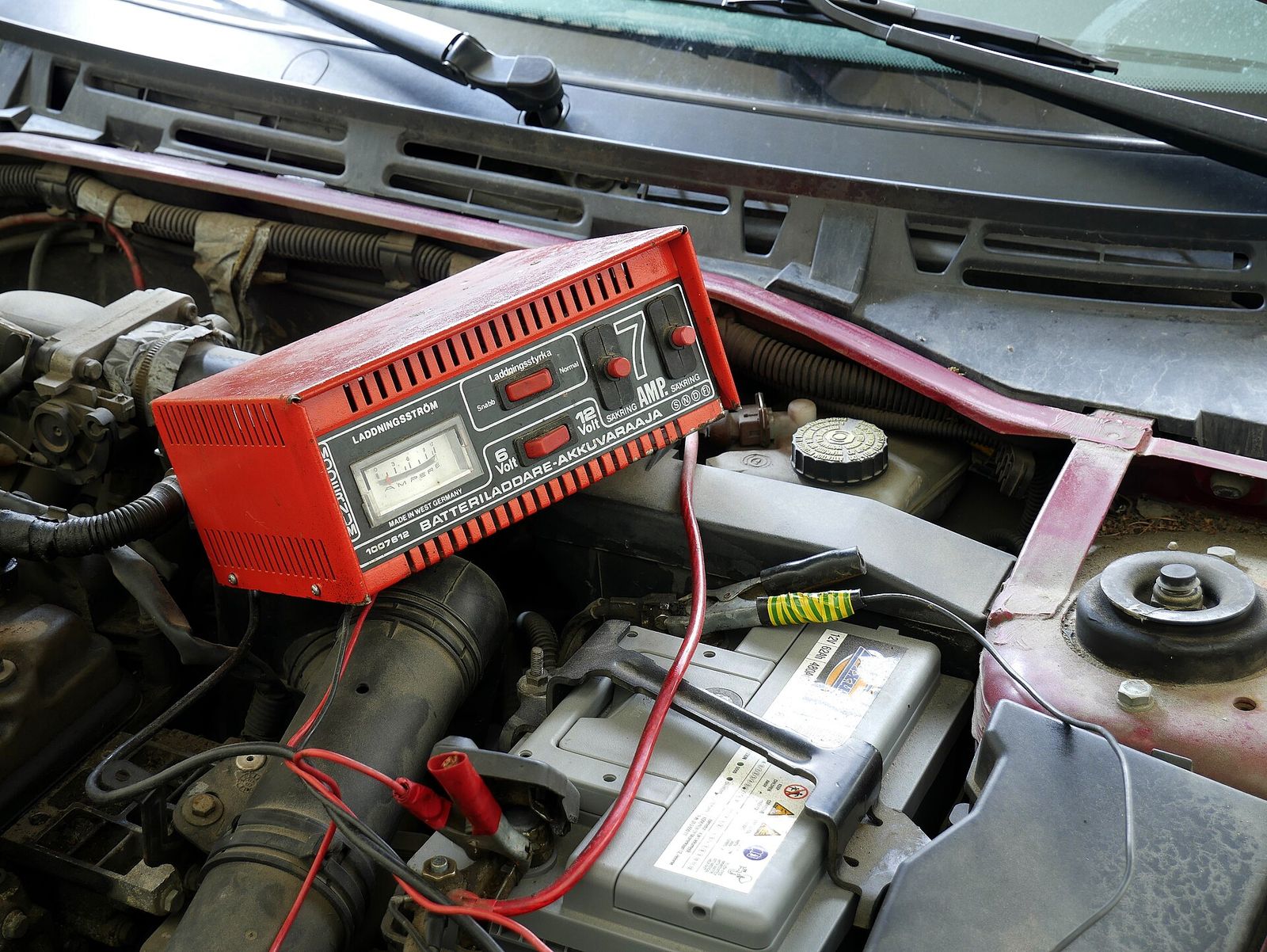
If your car sits unused for long periods, a smart charger or maintainer with the right mode for your battery type prevents most storage-related failures. A portable jump starter is a useful backup, particularly in a winter car kit.
Replacing a battery safely
Car batteries are heavy, contain corrosive acid and can give off explosive hydrogen gas. If you fit one yourself, follow the vehicle handbook and these basics:
- Wear eye protection and gloves, and keep sparks and flames away.
- Disconnect the negative terminal first and reconnect it last.
- Keep metal tools from bridging the terminals, or the positive terminal and the car body.
- Tighten the hold-down clamp and reconnect any vent tube.
- Expect to reset the clock, windows and other settings on some cars; the handbook explains how.
Lead-acid batteries are among the most widely recycled consumer products. Return the old one to the seller or a recycling point; never put it in household waste.
The short version
- Match the technology: AGM for AGM, and EFB or AGM for EFB. Standard flooded is for cars without start-stop.
- Match the case size and terminal layout given in the handbook.
- Choose CCA at least equal to the original, compared under the same standard.
- Keep amp-hours close to the original, especially on cars with a battery sensor.
- Check the manufacturing date and pick a fresh battery; they slowly discharge on the shelf.
- Ask whether your car needs the battery registered after fitting.
- Recycle the old battery.
Bloiq is reader-supported. Some links may earn us a commission; it never affects what we write. How we make money.
Cover photo: Santeri Viinamäki, CC BY-SA 4.0, via Wikimedia Commons