Bench grinders: wheel sizes and grits, tool rests and safe setup
How to choose a 6 or 8 in bench grinder, which wheel and grit suit sharpening or shaping, how to set the tool rest and guards, and how to fit and use wheels safely.
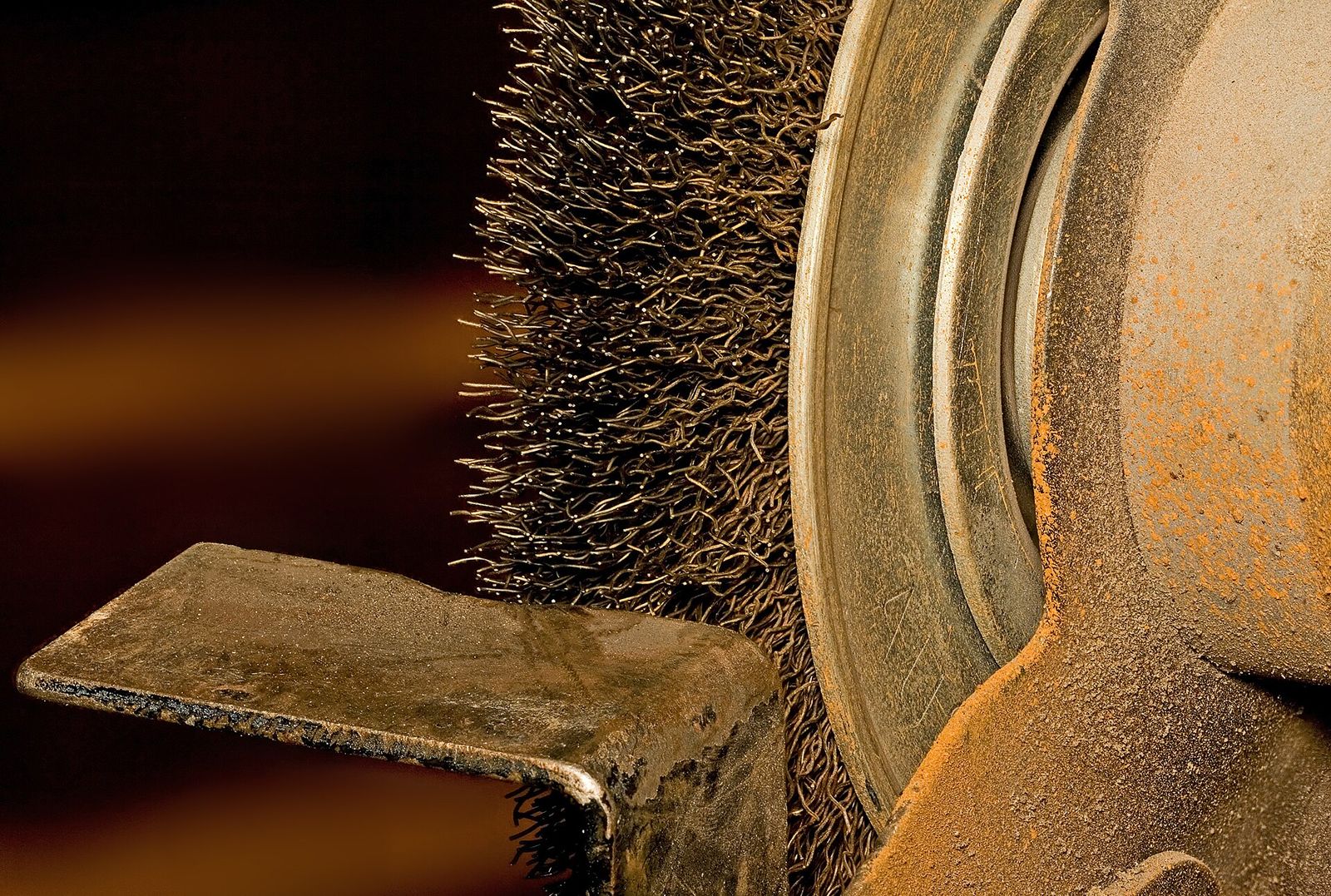
A bench grinder is a simple machine: a motor with a wheel on each end of the shaft. Bolted to a bench, it restores chisels, plane irons, drill bits, axes and mower blades, shapes and deburrs metal, and with a wire wheel strips rust from bolts and brackets. The machines differ less than the wheels you fit and how carefully you set them up, so this guide covers sizes and speeds, wheels and grits, tool rests and guards, and the habits that keep a grinder safe.
What a bench grinder is for
- Sharpening and reshaping edge tools: chisels, plane irons, lathe tools, drill bits, scissors, axes, garden tools.
- Shaping and deburring metal: rounding off sharp corners, cleaning up cut ends, grinding a bolt to length.
- Cleaning and finishing: wire wheels for rust and paint, and buffing wheels with polishing compound.
It's the wrong tool for aluminium, brass and other soft metals on a standard wheel, and for wood or plastic: they clog the wheel. Thin kitchen knives are usually better sharpened on whetstones or a slow wet grinder, because a fast dry wheel can overheat a fine edge in seconds. Our chef's knife guide covers knife steels.
Sizes and speeds
Bench grinders are named after the largest wheel they take:
| Size | Typical user | Notes |
|---|---|---|
| 6 in (150 mm) | Occasional DIY, small workshops | Compact and inexpensive; smaller wheels and less power |
| 8 in (200 mm) | Woodworkers, turners, keen DIYers | Larger wheel gives a flatter hollow grind and lasts longer |
| 10 in (250 mm) and up | Metal shops | Heavy, powerful, usually on a pedestal stand |
Speed: most standard grinders run at about 3,450 rpm on 60 Hz mains (around 2,950 rpm on 50 Hz). Slow-speed grinders run at roughly half that, about 1,725 rpm on 60 Hz. The lower speed generates less heat, which is why many woodworkers and turners prefer it for sharpening. Variable-speed models cover both.
Also check the wheel width (typically 20–25 mm, about 3/4 to 1 in), the arbor size, which sets which wheels fit (adapter bushings are common), how sturdy the base and tool rests are, and whether the motor is an induction type, which is usually quieter and longer-lived.
Wheels: abrasive types and grits
The wheels that come with a grinder are often grey aluminium oxide, one coarse and one medium. They're fine for rough work but tend to run hot on hardened tool steel, so many owners swap at least one.
| Wheel | Best for |
|---|---|
| Grey or brown aluminium oxide | General grinding, shaping mild steel, garden tools |
| White (or pink) aluminium oxide | Sharpening carbon and high-speed steel; cuts cooler |
| Green silicon carbide | Carbide-tipped tools, cast iron, stone |
| CBN (cubic boron nitride) | Sharpening hardened steel and high-speed steel; runs cool and keeps its shape |
| Diamond | Carbide; not recommended for steel |
Grit works as on sandpaper: lower numbers are coarser. Around 24–36 removes metal fast for heavy shaping, 60 is a general-purpose middle, and 80–120 gives a finer edge for sharpening. A common pairing is a coarse wheel on one side and a fine white or CBN wheel on the other.
Wheel markings follow a standard code, for example "A 60 K V": abrasive (A for aluminium oxide, C for silicon carbide), grit, grade (a letter for hardness, softer towards A) and bond (V for vitrified). The usual rule is a softer grade for hard steel, because the wheel sheds dull grains and cuts cooler, and a harder grade for softer metals.
CBN wheels are a steel disc coated with abrasive. They cost more, but they don't shrink as they wear and don't need dressing.
Tool rests and guards
The tool rest supports the work and sets the grinding angle. It's the part most worth upgrading on an inexpensive grinder, where rests are often small and flexible.
Rule: keep the gap between the tool rest and the wheel no wider than about 3 mm (1/8 in), and the gap between the wheel and the top guard (the spark deflector or tongue) no wider than about 6 mm (1/4 in). Readjust both as the wheel wears, and only with the grinder switched off and the wheel stopped.
A wider gap at the rest can let small work be pulled in and jammed between the rest and the wheel, which can break the wheel. Clamp the rest firmly after every adjustment.
- Larger, flatter rests with a precise angle setting make repeatable bevels much easier.
- Sharpening jigs hold chisels, plane irons and drill bits at a fixed angle; turners often use a sliding arm with a pocket for gouges.
- Eye shields on the guards are useful, but they don't replace safety glasses.
- Keep the wheel guards on. They're there to contain fragments if a wheel breaks.
Dressing and truing the wheel
Over time a wheel clogs (loads) with metal, glazes over with dull grains, or wears grooved and out of round. A wheel dresser cuts away the surface to expose fresh, sharp abrasive and restore a flat face. Star-wheel dressers are inexpensive and fast for coarse wheels; diamond dressers, single-point or cluster, give a finer, truer face. Dress whenever the wheel cuts slowly, burns the work or vibrates. Never dress a CBN wheel this way.
Fitting a new wheel safely
- Check the speed rating: the maximum rpm printed on the wheel must be at least the grinder's speed.
- Ring test vitrified wheels: hang the clean, dry wheel on a finger or rod and tap it gently with a wooden or plastic handle. A clear ring suggests it's sound; a dull thud can mean a crack, and the wheel should be discarded. Discard any wheel that has been dropped.
- Use the blotters (paper washers) between the wheel and the flanges, use matching flanges, and tighten the nut only enough to hold the wheel.
- Stand to one side when starting a new wheel, and let it run at full speed for about a minute before use, with nobody in line with it.
Using a bench grinder safely
- Eye and face protection: safety glasses at minimum, and a face shield for heavy grinding and wire wheels, which throw bristles.
- Nothing loose: no loose sleeves, cuffs, jewellery or long hair near the wheel; loose gloves can be caught too.
- Grind on the face of the wheel. Ordinary straight wheels aren't designed for side pressure.
- Keep tools cool. Dip carbon-steel tools in water often. A blue tinge means the edge has lost its hardness and needs grinding back past it. Don't quench carbide tips, which can crack.
- Sparks start fires: keep sawdust, rags and solvents well away, and have an extinguisher nearby. Our angle grinder guide covers spark and dust control in more detail.
- Bolt it down to a solid bench or stand. See our guide to workbenches and vises.
- Buffing: work on the lower part of the wheel, below its centre, so the wheel pulls the work away from you, and hold the work firmly.
- Let it stop completely before leaving it, and unplug it before changing wheels or adjusting the rests.
Wet grinders and belt grinders
If you mostly sharpen woodworking tools and knives, consider a low-speed wet grinder, which turns a large stone slowly through a water bath: it can't overheat an edge, at the cost of slower metal removal. Belt grinders and belt sanders are popular with knife makers and metalworkers for shaping and flat grinding; some combination machines pair a grinding wheel with a sanding belt. For sharpening drill bits, see our drill bits guide.
The short version
- An 8 in grinder suits most workshops; a slow-speed model is kinder to edge tools.
- Fit a coarse wheel for shaping and a fine white aluminium oxide or CBN wheel for sharpening.
- Match the wheel's speed rating to the grinder, ring test vitrified wheels and use the blotters.
- Keep the tool rest within 3 mm (1/8 in) of the wheel and the top guard within 6 mm (1/4 in).
- Dress the wheel when it glazes, keep tools cool and wear eye and face protection.
- Never grind aluminium or other soft metals on a standard wheel.
Bloiq is reader-supported. Some links may earn us a commission; it never affects what we write. How we make money.
Cover photo: Noodle snacks, CC BY-SA 3.0, via Wikimedia Commons