Chef's knives explained: steel, hardness, Western vs Japanese styles
How steel type and Rockwell hardness affect a chef's knife, how Western and Japanese blades differ, what to look for in a handle and how to sharpen and hone.
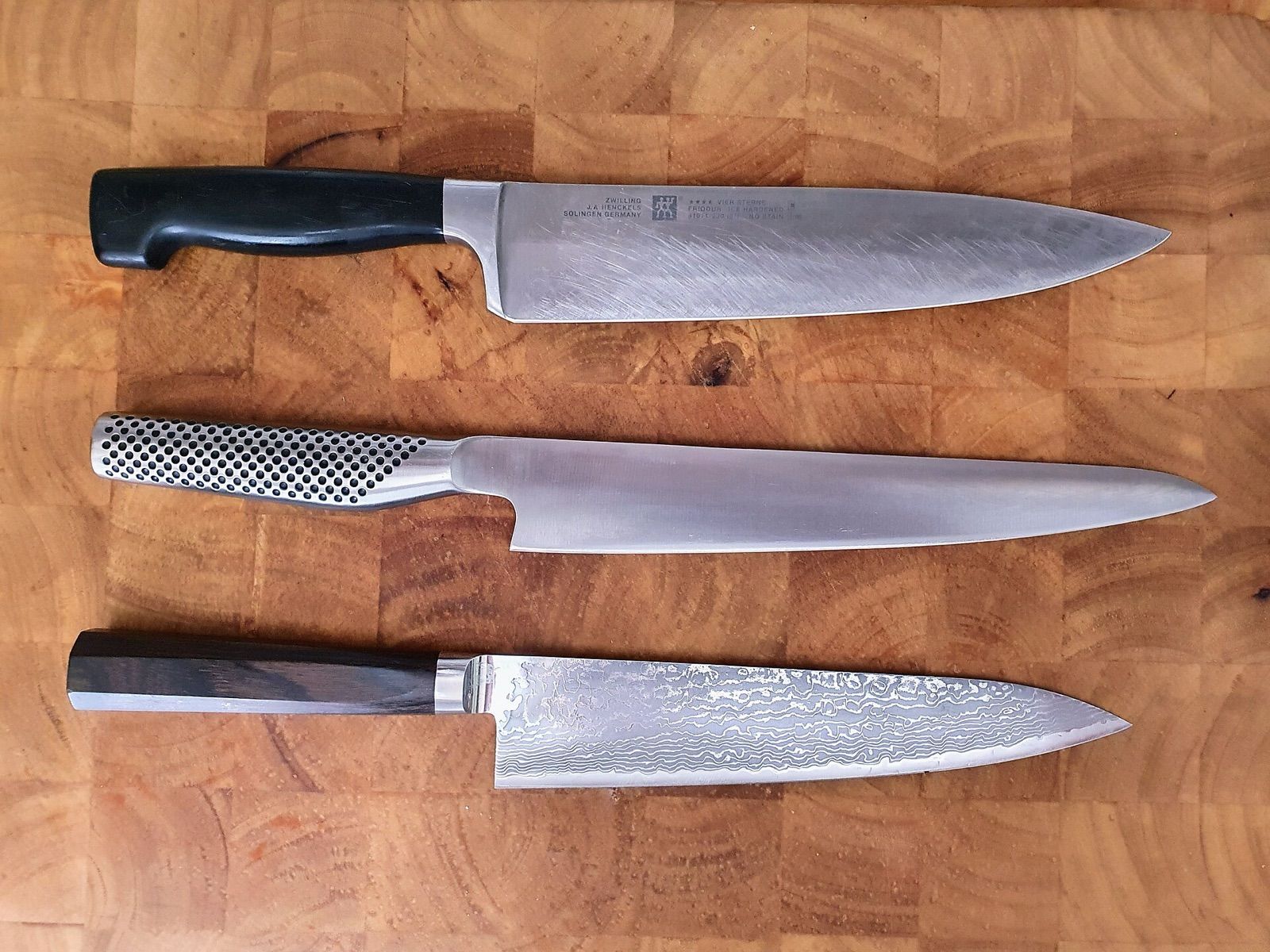
A good chef's knife handles most of the cutting in a kitchen, from dicing onions to carving a roast. Knife marketing, though, is full of steel codes, hardness numbers and Damascus patterns that are hard to interpret. This guide explains what those terms mean, how Western and Japanese knives differ in use, and how to keep any knife sharp.
Blade length and shape
The most common chef's knife length is about 20 cm (8 inches), with 18–24 cm covering most home cooks. Shorter blades feel nimble in small hands and on small boards; longer blades slice large vegetables and roasts in one stroke but need more space.
The profile (the curve of the edge) affects how you cut:
- A curved edge with plenty of belly suits a rocking motion, keeping the tip on the board.
- A flatter edge suits push-cutting and pull-cutting, where the whole blade meets the board.
Western (German-style) chef's knives
The traditional Western chef's knife is relatively thick and heavy, with a pronounced curve and often a bolster, a thick collar of steel where the blade meets the handle. It is typically made from a tough, fairly soft stainless steel and sharpened to a wider edge angle, often somewhere around 15–20 degrees per side.
The result is a forgiving, durable knife that tolerates bones, frozen foods and occasional misuse better than a thin blade, and is easy to keep in working order with a honing steel. The trade-off is that it doesn't glide through food quite as easily as a thinner, harder blade.
A full bolster that runs down to the heel of the edge can make sharpening the back of the blade difficult over time. Many modern knives use a half bolster or none.
Japanese chef's knives
The Japanese equivalent of the chef's knife is the gyuto. Compared with a German-style knife, it is typically:
- thinner and lighter, cutting with less resistance;
- flatter, favouring push and pull cuts over rocking;
- made from harder steel, sharpened to a more acute angle, often about 10–15 degrees per side.
The santoku is a popular shorter alternative, usually 16–18 cm, with a flatter edge and a rounded-down tip. It suits people who prefer a compact knife for vegetables, meat and fish.
Most gyuto and santoku knives sold internationally are double-bevel (sharpened on both sides), like Western knives. Traditional single-bevel Japanese knives are specialised tools that need different sharpening skills.
The downside of thin, hard blades is that they are more prone to chipping if twisted, used on bones or frozen food, or cut on hard surfaces.
Steel and hardness
Knife steel is often described by its hardness on the Rockwell C scale (HRC):
- Around 54–58 HRC: typical for many Western stainless knives. Tougher and less likely to chip; the edge rolls more readily but is easy to restore with a honing steel.
- Around 58–61 HRC: common for many Japanese stainless knives. A good balance of sharpness and durability.
- Around 61–65 HRC: harder carbon steels and powdered stainless steels. Keeps a very keen edge for a long time but needs more careful handling and sharpening.
The main steel families:
- Stainless steels resist rust and staining and suit most home cooks.
- Carbon steels can take and hold an extremely sharp edge and are easy to sharpen, but they rust if left wet and develop a grey or blue patina with use. They need drying straight after washing.
- Clad (san-mai) blades sandwich a hard core steel between softer outer layers, sometimes stainless outside a carbon core.
Damascus patterns on modern knives are usually created by layering steels on the outside of the blade. They can look beautiful, but the performance depends on the core steel at the edge, not the pattern.
Forged versus stamped matters less than it used to. Many good knives are made both ways; blade geometry, heat treatment and fit and finish count for more.
Handles
- Western handles are usually riveted onto a full tang (the steel runs through the handle), with synthetic or wooden scales. They feel solid and put more weight towards the hand.
- Japanese (wa) handles are often octagonal, oval or D-shaped, made from wood, and fitted onto a hidden tang. They are lighter, which shifts the balance towards the blade. D-shaped handles are made for either right- or left-handed use, so check before buying.
The best handle is one that feels secure in a pinch grip, with your thumb and index finger gripping the blade just in front of the handle, which gives the most control. If possible, hold a knife before buying and notice whether it feels comfortable and balanced for you.
Honing and sharpening
These are different jobs:
- Honing straightens an edge that has rolled over with use, without removing much metal. It is done with a honing rod, often called a steel. Steel rods suit softer Western knives. Harder Japanese blades are better served by a smooth ceramic rod, used lightly, or by simply stropping; grooved steel rods can chip them.
- Sharpening removes metal to form a new edge once honing no longer brings it back.
Sharpening options:
- Whetstones give the most control. A medium stone of around 1,000 grit handles routine sharpening; finer stones (3,000–6,000) polish the edge; coarse stones repair chips.
- Guided systems hold the knife at a fixed angle and are easier for beginners.
- Pull-through and electric sharpeners are quick, but some remove metal aggressively and may not match the angle of Japanese knives. Check the sharpener suits your knife.
- Professional sharpening services are a good option if you'd rather not do it yourself.
A sharp knife needs less force, so it is less likely to slip than a dull one.
Care and storage
- Hand-wash and dry immediately. Dishwashers can dull edges, damage handles and cause chipping.
- Use wood or plastic cutting boards. Glass, stone and ceramic boards dull and chip edges quickly.
- Store knives safely: in a block, on a magnetic strip, or with a blade guard in a drawer, never loose.
Good knives and good pans go together; our guide to cookware materials covers the other half of the kitchen toolkit.
The short version
- Start with a 20 cm chef's knife or a santoku if you prefer a shorter blade.
- Choose Western for toughness and easy maintenance, Japanese for thin, precise cutting.
- Treat hardness as a trade-off: harder keeps its edge longer but chips more easily.
- Choose stainless for low maintenance, carbon only if you'll dry it every time.
- Pick a handle that feels secure in a pinch grip.
- Hone regularly, sharpen when honing stops working, and never use the dishwasher.
Bloiq is reader-supported. Some links may earn us a commission; it never affects what we write. How we make money.
Cover photo: T. Bjornstad, CC BY-SA 4.0, via Wikimedia Commons