Cookware materials compared: stainless, non-stick, cast iron and more
How stainless steel, non-stick, cast iron, carbon steel and copper pans differ in heat, care and durability, and how to tell whether cookware works on induction.
The material a pan is made from decides how quickly it heats, how evenly it cooks, how much care it needs and how long it lasts. No single material is best at everything, which is why many experienced cooks own a mix. This guide explains how the common materials behave, what each one is good for, and how to check whether a pan will work on an induction hob.
Two properties that matter most
- Conductivity is how quickly and evenly heat spreads through the metal. High conductivity means fewer hot spots and a pan that responds quickly when you turn the heat up or down.
- Heat capacity (thermal mass) is how much heat the pan stores. Heavy pans hold their temperature when you add cold food, which helps with searing, but take longer to heat and cool.
Copper and aluminium conduct heat very well. Cast iron and stainless steel conduct it relatively poorly, but cast iron makes up for it with mass.
Comparison at a glance
| Material | Heat response | Care | Works on induction? | Good for |
|---|---|---|---|---|
| Clad stainless steel | Even (thanks to its core), moderately responsive | Low; usually dishwasher-safe | Usually, if the outer layer is magnetic | Searing, sauces, all-round use |
| Non-stick (PTFE or ceramic) | Depends on the base metal | Gentle; hand-wash recommended | Only with a magnetic base | Eggs, fish, pancakes |
| Cast iron | Slow to heat, holds heat well | Seasoning; keep dry | Yes | Searing, frying, baking, braising |
| Enamelled cast iron | Slow, holds heat well | Easy; avoid chipping | Yes | Stews, braises, bread |
| Carbon steel | Faster than cast iron, holds heat well | Seasoning; keep dry | Yes | Stir-frying, searing, crêpes |
| Copper | Very fast and even | Polishing; lining can wear | No, unless it has a magnetic base | Sauces, sugar work, precise cooking |
Stainless steel
Stainless steel is durable, doesn't react with acidic foods and usually survives the dishwasher. On its own it is a poor conductor, so good stainless pans have a layer of aluminium or copper:
- Fully clad (often called tri-ply or 5-ply) pans bond the conductive core through the base and up the sides, heating evenly all over.
- Encapsulated or disc-base pans have a thick conductive disc on the bottom only. They can be very good for boiling and simmering, but the sides heat less evenly.
Food cooking surfaces are often 18/10 stainless (18% chromium, 10% nickel), which resists corrosion but is not strongly magnetic. For induction, the outer layer needs to be a magnetic grade of stainless steel.
Food can stick to stainless steel. Preheating the pan before adding oil, and letting meat release naturally before turning it, helps a lot.
Non-stick
Non-stick pans have a coating over an aluminium or stainless base. There are two main types:
- PTFE coatings are very slippery and long-lasting when treated well. The chemical PFOA, once used in their manufacture, has been phased out by major manufacturers. PTFE is considered stable at normal cooking temperatures, but it breaks down when badly overheated, for example when an empty pan is left on high heat. The fumes can cause flu-like symptoms in people and are known to be dangerous to pet birds, so avoid heating an empty pan on high.
- Ceramic (sol-gel) coatings contain no PTFE. They are slippery when new but often lose their non-stick quality sooner than PTFE.
To extend the life of any non-stick pan: cook on low to medium heat, use wooden or silicone utensils, hand-wash, and avoid aerosol cooking sprays, which can leave a sticky residue. Expect to replace non-stick pans after a few years of regular use, or once the coating is visibly worn or damaged.
Cast iron
Cast iron is heavy, inexpensive and very durable. It heats slowly and not especially evenly, but once hot it holds its temperature, which makes it excellent for searing, shallow frying and oven baking.
Bare cast iron is protected by seasoning, layers of oil baked onto the surface. Seasoning builds up with use, gives a reasonably non-stick surface over time, and protects against rust. Keep it dry after washing and wipe it with a little oil. Long simmering of acidic dishes such as tomato sauce can wear the seasoning and give a metallic taste.
Enamelled cast iron is coated in glass enamel, so it needs no seasoning and handles acidic dishes well, which makes it popular for casseroles and braises. The enamel can chip if knocked or overheated when empty, so follow the manufacturer's heat guidance.
Cast iron can scratch glass-ceramic hobs: lift it rather than sliding it.
Carbon steel
Carbon steel is mostly iron with a small amount of carbon. It behaves much like cast iron, needing seasoning and working on induction, but it is thinner and lighter, so it heats faster and is easier to toss and handle. It's the traditional material for woks, crêpe pans and many restaurant frying pans.
Very thin flat-bottomed pans can warp if heated quickly on high, especially on a burner smaller than the pan. Care is the same as for cast iron: dry it, oil it and avoid long acidic simmering until the seasoning is well established.
Copper
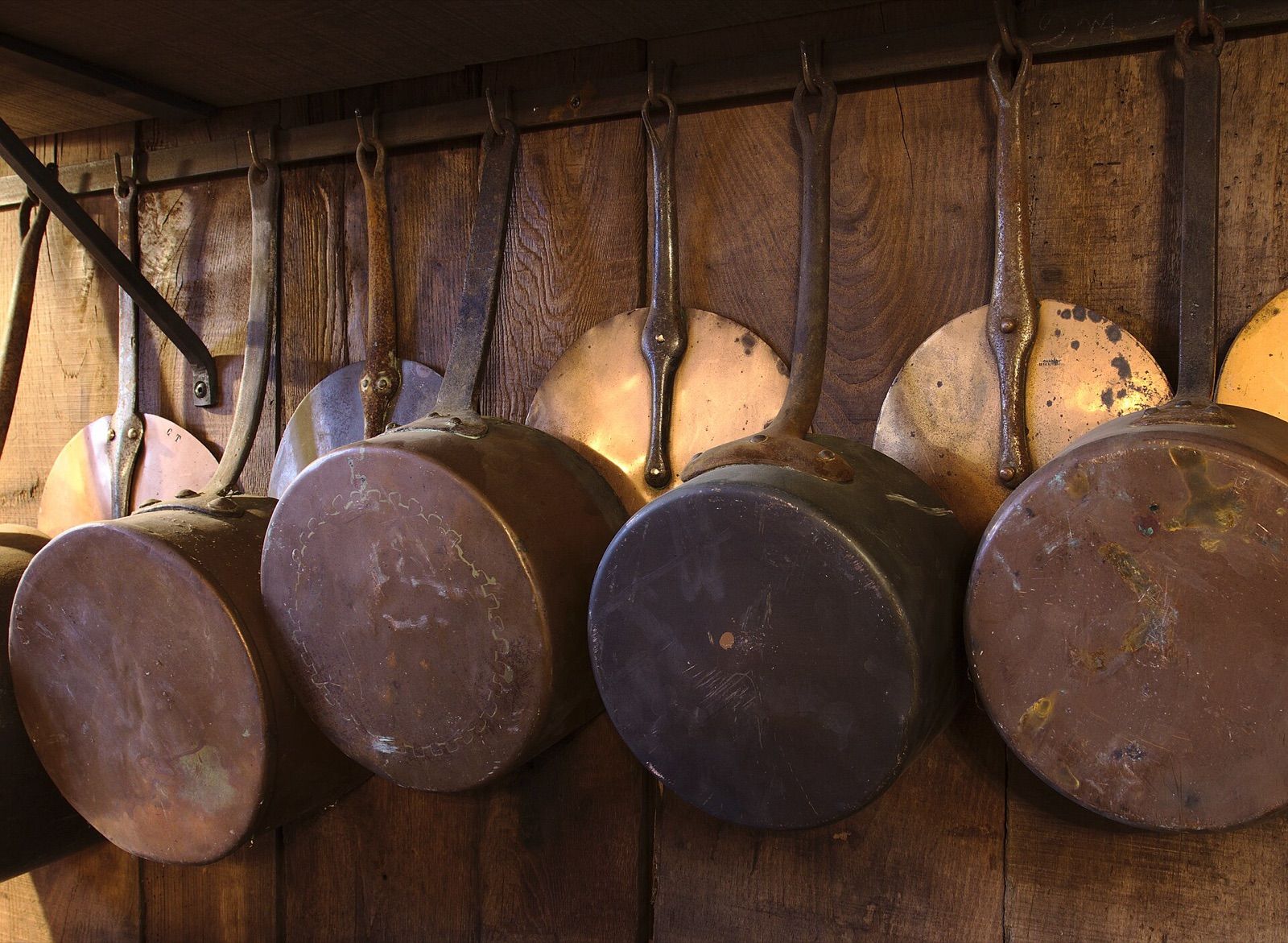
Copper conducts heat better than any other common cookware metal, so it responds almost instantly to changes in heat and cooks very evenly. That precision is prized for sauces, caramel and delicate dishes.
Copper reacts with acidic foods, so cooking pans are lined:
- Tin linings are traditional and naturally fairly slick, but tin melts at around 230 °C, so these pans must never be heated empty. Worn tin can be professionally re-tinned.
- Stainless steel linings are more durable and need no re-lining.
Unlined copper is reserved for specific uses such as jam and sugar work, following established recipes. Copper is expensive, heavy when thick, and needs polishing if you want to keep its shine. It doesn't work on induction unless the pan has a bonded magnetic base.
Aluminium
Plain and hard-anodised aluminium pans are light, affordable and conduct heat well. Bare aluminium can react with acidic foods and discolour; hard-anodised aluminium has a harder, less reactive surface. Neither works on induction without a bonded magnetic base plate.
How to check induction compatibility
Induction hobs heat pans through magnetism, so the pan's base must be ferromagnetic:
- Magnet test: if a fridge magnet sticks firmly to the flat underside, the pan will almost certainly work. A weak pull may mean poor performance.
- Induction symbol: many pans are marked with a coil-shaped symbol.
- Flat base: a warped or domed bottom heats poorly and may not be detected.
Cast iron, carbon steel and most magnetic-based stainless steel pans work. Copper, aluminium, glass and ceramic pans don't, unless they have a magnetic base plate. Our induction cooktop guide explains more.
The short version
- For an all-rounder, choose clad stainless steel.
- Keep one non-stick pan for eggs and fish, and treat it gently.
- Add cast iron or carbon steel for searing and high-heat cooking.
- Choose enamelled cast iron for braises and acidic dishes.
- Choose copper for precision if budget and upkeep allow.
- For induction, do the magnet test and check the base is flat.
Bloiq is reader-supported. Some links may earn us a commission; it never affects what we write. How we make money.
Cover photo: Stanzilla, CC BY-SA 4.0, via Wikimedia Commons