Range hoods: ducted vs recirculating, airflow, noise and sizing
How to choose a cooker hood: ducted or recirculating, how much airflow you need, why capture area matters more than power, and what noise ratings mean.
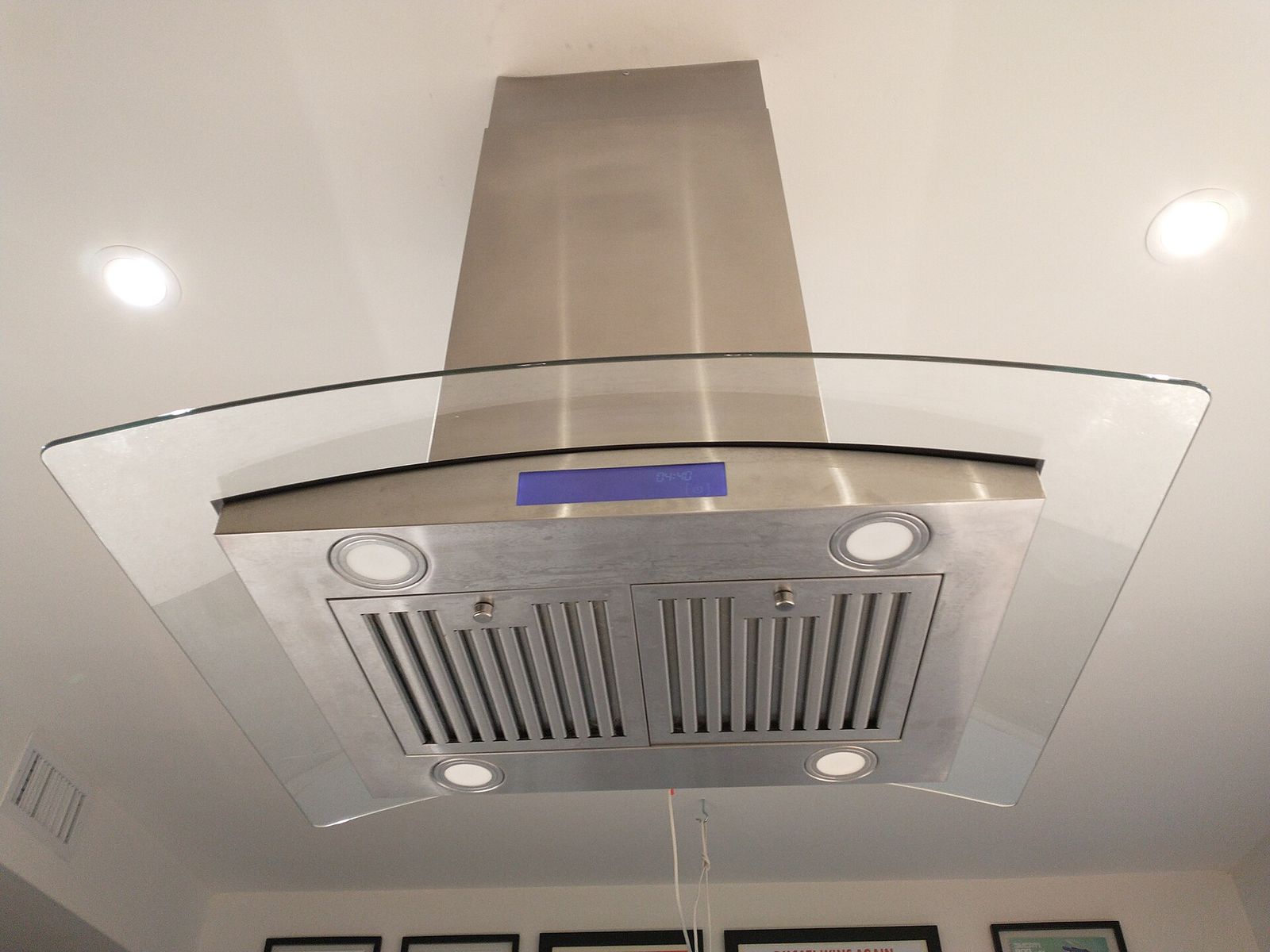
A range hood (cooker hood or extractor) does more than stop the kitchen smelling of last night's curry. It removes grease, steam, heat and, over a gas hob, combustion gases before they spread through the home and settle on cupboards and ceilings. The headline airflow figure is only part of the story: how the hood vents, how well it covers the hob and how loud it is at the setting you'll really use matter just as much. This guide explains each in turn.
Ducted vs recirculating: the biggest decision
A ducted (extracting) hood pulls air through grease filters and pushes it outside through a duct in an outside wall or the roof. A recirculating (ductless) hood pulls air through grease filters and then a carbon (charcoal) filter, which absorbs odours, and blows it back into the kitchen.
| Ducted | Recirculating | |
|---|---|---|
| Removes grease | Yes | Yes (grease filters) |
| Removes odours | Yes | Partly (carbon filter, while it's fresh) |
| Removes steam and heat | Yes | No |
| Removes combustion gases from gas hobs | Yes | No |
| Installation | Needs a duct route to outside | Anywhere with a socket or spur |
| Running costs | Clean grease filters | Clean grease filters and replace carbon filters |
Ducted is the better choice whenever you can route a duct, especially over gas or for heavy frying, wok cooking and searing. Recirculating hoods make sense in flats, rented homes and kitchens with no practical way outside. Many hoods can be installed either way, so check before you buy.
If you go ductless, budget for carbon filters. Standard ones are typically replaced every few months with regular cooking, and some "long-life" or regenerable filters can be refreshed in an oven or dishwasher. Some recirculation kits use plasma or ceramic filters designed to last longer.
Hood types
- Wall-mounted chimney hoods: a canopy against the wall with a decorative flue above.
- Island hoods: hang from the ceiling above an island hob. They catch less smoke than wall hoods because there's no wall to guide it, so they need to be bigger and stronger.
- Under-cabinet and visor hoods: fit beneath a wall cupboard; slim and space-saving.
- Integrated and telescopic hoods: hidden within the cabinetry, with a front panel that slides out.
- Canopy inserts (power packs): a motor and filter unit built into a custom hood or chimney breast.
- Downdraft and hob-integrated extraction: pull fumes down through or beside the hob. They suit island designs with no overhead hood but struggle with tall pans, whose steam rises above their reach.
- Over-the-range microwaves: common in North America; a microwave with a built-in fan. Their extraction and capture area are usually modest. See our microwave types guide.
Capture area: size the hood to the hob
Fumes rise in a plume that widens as it climbs. A hood can only extract what it captures, so width and depth matter more than raw power.
- Width: at least as wide as the hob, and ideally a little wider. A common recommendation is several centimetres (about 3 in) extra on each side, especially for gas.
- Depth: a hood that covers the front burners or zones captures much more than a shallow one that only covers the back.
- Island hoods: go wider still, because cross-draughts push the plume sideways.
- Height: manufacturers specify a mounting height above the hob, commonly somewhere around 65–75 cm (roughly 26–30 in), and often a higher minimum over gas. Lower captures better, but don't go below the stated minimum.
Rule of thumb: a well-sized hood at a moderate setting usually beats an undersized hood on full power. Choose the width first, then the airflow.
How much airflow you need
Airflow is quoted in cubic metres per hour (m³/h) in Europe and in cubic feet per minute (CFM) in North America. One CFM is about 1.7 m³/h.
Common ways to estimate it:
- By room volume (European approach): multiply the kitchen's volume in cubic metres by about 10–12 air changes per hour. A 4 × 3 × 2.5 m kitchen is 30 m³, which suggests roughly 300–360 m³/h of real airflow.
- By hob width (North American approach): around 100 CFM per 30 cm (1 ft) of hob width for a wall hood over an electric or induction hob, and more for island hoods.
- By gas output: for gas ranges, a widely quoted guideline is about 100 CFM per 10,000 BTU/h of total burner output.
Keep in mind:
- Rated airflow is measured with little resistance. Long ducts, bends and roof caps all reduce real airflow, so leave headroom.
- Bigger isn't always better. A very powerful hood is louder and pulls a lot of warm air out of the house. In some regions, building rules require make-up air (a way for replacement air to come in) above a certain airflow. Check the current rules, and get advice if the home has an open-flued boiler, fire or wood burner, because a strong hood can pull fumes back down their flues.
Ducting done right
A good hood on a poor duct run performs like a poor hood.
- Use the duct diameter the manufacturer specifies (often 150 mm or 6 in for domestic hoods) and don't reduce it.
- Prefer smooth rigid duct over flexible ribbed hose, which adds resistance and traps grease.
- Keep the run short, with as few bends as possible.
- Vent to the outside, never into a loft, attic or ceiling void.
- Fit an exterior cap with a backdraught flap to keep out cold air and pests.
Many recirculating hoods are bought because ducting seemed difficult. Ask an installer before you rule it out: a short run through an outside wall is often straightforward.
Noise ratings
Noise is the most common complaint about range hoods, and a hood that is too loud stays switched off.
- Decibels, dB(A): used in Europe and on the EU energy label, usually measured at the highest normal setting. Every 10 dB is perceived as roughly twice as loud.
- Sones: used in North America. The scale is linear, so 4 sones sounds about twice as loud as 2.
- Compare noise at the setting you'll use most, not just at minimum. A larger hood running on a low setting is often quieter than a small one on full.
- Some hoods have remote or inline motors, mounted in the duct or outside, which move much of the noise away from the kitchen.
Filters, controls and lighting
- Grease filters: aluminium mesh filters are light and dishwasher-safe. Stainless baffle filters channel air through angled slats, cope well with heavy cooking and are easy to clean. Clean either regularly: clogged filters cut airflow and are a fire risk.
- Controls: several speeds plus a short boost setting are typical. Useful extras include a run-on timer that clears the air after cooking, a filter-change reminder and automatic hob-linked operation, which some hob and hood pairs offer.
- Lighting: bright, even LED lighting over the hob is genuinely useful. Check whether the bulbs or modules can be replaced.
- Efficiency: in the EU, hoods carry an energy label covering energy use, extraction and grease filtering efficiency, and noise.
The short version
- Duct to the outside if you can, especially over gas. Recirculating hoods don't remove steam, heat or combustion gases.
- Choose a hood at least as wide as the hob, deep enough to cover the front, and mounted at the height the maker specifies.
- Size airflow by room volume or hob width, with headroom for duct losses.
- Use short, smooth ducting at full diameter, venting outside.
- Compare noise at everyday settings, not just the quietest one.
- Check make-up air rules and any flued appliances in the home.
- Budget for filter cleaning, and for carbon filter replacements if you go ductless.
For more on the hob itself, see our induction hob guide.
Bloiq is reader-supported. Some links may earn us a commission; it never affects what we write. How we make money.
Cover photo: Stilfehler, CC BY-SA 4.0, via Wikimedia Commons