Patio heaters: propane, natural gas or electric infrared?
How gas and electric patio heaters warm people, what heat output and coverage claims mean, how long a propane cylinder lasts, and the clearances that keep you safe.
A patio heater can add weeks to both ends of the outdoor season and make cool evenings comfortable. But heaters vary widely in how they produce warmth, how far that warmth really reaches and what they cost to run, and gas models in particular come with clearance and ventilation rules that matter for safety. This guide compares propane, natural gas and electric infrared heaters and explains how to read their specifications.
How patio heaters warm you
Outdoors, you can't heat the air in any useful way: warm air rises and blows away. Patio heaters work mainly by radiant heat, which travels in straight lines and warms people, furniture and floors it strikes, much like sunshine.
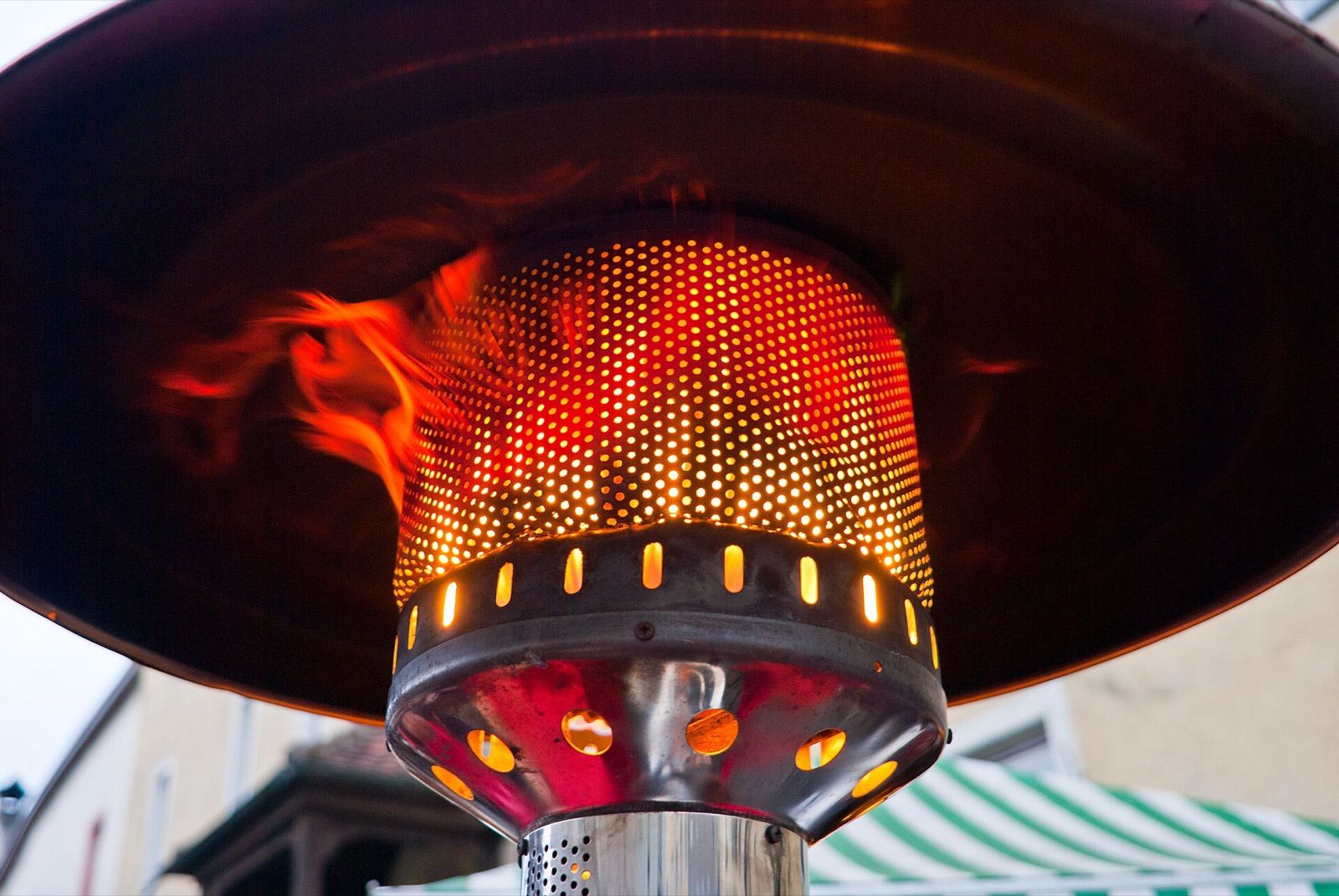
- Gas "mushroom" heaters burn gas inside a mesh emitter at head height and use a reflector hood to direct radiant heat downward in a circle. Much of the energy still goes into hot exhaust gases that rise and drift away.
- Electric infrared heaters use a heating element (halogen, carbon or ceramic) to emit infrared directly at whatever they face, with very little lost to the air.
Because radiant heat travels in straight lines, anything in the way (a table, an umbrella, another person) blocks it, and warmth falls off quickly with distance.
Propane heaters
Propane heaters run from a refillable cylinder and need no installation, so they can move around the patio or be stored for winter.
- Tall freestanding (mushroom) heaters are the most common. Full-size models are often rated somewhere around 40,000–48,000 BTU per hour (roughly 12–14 kW), and typically hold a standard barbecue-size cylinder in the base.
- Pyramid or flame-tower heaters burn inside a glass tube for a decorative flame. They tend to give less useful radiant heat per unit of gas than a mushroom design.
- Tabletop heaters use small disposable or refillable cylinders. They warm only a small area around the table.
Running time depends on the heater's output and cylinder size:
Runtime estimate: hours ≈ (propane in kg × 13.5) ÷ heater output in kW. Propane contains roughly 13–14 kWh of energy per kilogram (about 21,500 BTU per pound). A 9 kg (20 lb) cylinder in a 13 kW heater lasts roughly 9 hours at full output, and longer at lower settings.
Keep a spare filled cylinder if you entertain often.
Natural gas heaters
Natural gas heaters connect to a fixed gas line, so there are no cylinders to swap and running costs are often lower than propane, depending on local prices. The trade-off is that they can't be moved, and installation needs a qualified, licensed gas fitter, and often a permit. They suit patios you use regularly in the same layout, and can be freestanding on a fixed post or mounted on walls or ceilings, depending on the model.
Propane and natural gas heaters are not interchangeable. Convert only with the manufacturer's approved kit, installed by a qualified person.
Electric infrared heaters
Electric heaters produce no combustion gases, need no fuel deliveries and are generally the most efficient at putting heat where people sit. Wall- and ceiling-mounted models also save floor space.
- Power: plug-in models are limited by household circuits. In North America, standard 120 V outlets support roughly 1,500 W heaters; larger units need dedicated 240 V circuits. In regions with 230 V supplies, plug-in heaters commonly go up to around 2–3 kW. Hard-wired units need an electrician.
- Short-wave (often halogen) heaters glow brightly and heat people quickly; they cope better with breezes but can be dazzling. Medium- and long-wave (carbon and ceramic) heaters give a softer, less visible glow and gentler warmth, better suited to sheltered areas.
- Weather rating: check the IP (ingress protection) rating and whether it's approved for outdoor or damp locations. Plug into RCD (GFCI) protected outlets only.
- Running cost: multiply kilowatts by hours of use by your electricity rate.
Coverage: read claims cautiously
Coverage is often quoted as a heated circle several metres across. Those figures assume still air and describe where some warmth is felt, not where it's comfortable. In practice:
- Wind carries heat away from gas heaters and chills people quickly; windbreaks help more than a bigger heater.
- Height and angle matter for electric heaters; follow the manufacturer's mounting height and aim them at seating.
- Several smaller heaters placed around a seating area often work better than one big central one.
Sheltered spaces such as a covered pergola hold warmth better, but they also change the safety rules, particularly for gas. Our gazebo and pergola guide explains the structures themselves.
Safety and clearances
Clearances are the most important thing to get right. Every heater's manual lists minimum distances to walls, ceilings, awnings, umbrellas, plants and furniture. Follow those figures exactly; they vary by model and type.
Gas heaters (propane and natural gas):
- Use only outdoors in well-ventilated areas. Never use them indoors, in garages, tents, sheds, or enclosed or mostly enclosed patios, because of carbon monoxide and fire risk.
- Keep them well clear of umbrellas, awnings, overhangs and fabric; hot exhaust rises from the top of mushroom heaters.
- Look for a tilt (tip-over) switch that shuts off the gas if the heater falls, and a flame-failure device that cuts the gas if the flame goes out.
- Place freestanding heaters on level, firm ground, weight or anchor them as the manual advises, and don't use them in strong winds.
- Leak-test connections with soapy water at the start of each season and whenever you change a cylinder; growing bubbles mean a leak.
- Store propane cylinders outdoors, upright, never indoors or in a garage.
Electric heaters:
- Mount at the height and clearances specified, away from anything flammable.
- Don't run outdoor heaters from indoor extension leads; if an extension is unavoidable, use an outdoor-rated one of adequate gauge.
- Keep elements away from water spray unless the rating allows it.
Patio heaters are designed for outdoor use; for heating rooms, see our space heater guide.
All heaters: keep children and pets away from hot surfaces, never dry clothes or towels on or near a heater, let the heater cool completely before covering it, and turn it off when the area is empty.
The short version
- Propane for flexibility and no installation; natural gas for a fixed patio with frequent use; electric infrared for efficiency and covered spaces where it's permitted.
- Treat coverage claims as optimistic, and plan for wind.
- Estimate propane runtime from cylinder size and heater output.
- Check tilt shut-off, flame-failure protection and outdoor ratings.
- Follow the manual's clearances exactly, and never use gas heaters in enclosed spaces.
- For a more social source of warmth, compare options in our fire pit guide, and see our grill comparison for cooking outdoors into the evening.
Bloiq is reader-supported. Some links may earn us a commission; it never affects what we write. How we make money.
Cover photo: Hermann Hammer (User:Haneburger), CC0, via Wikimedia Commons