Grills compared: gas, charcoal, pellet and electric, and the BTU myth
How the four main grill types differ in flavour, convenience and control, why BTU ratings mislead, and which materials and grates last longest.
Every grill cooks food over heat, but how that heat is made changes almost everything else: how fast you can start cooking, how much the food tastes of smoke, how precisely you can control temperature and how much cleaning follows. Gas, charcoal, pellet and electric grills each have loyal fans for good reasons. This guide compares them, explains why the big BTU number on a gas grill tells you less than it seems, and covers the materials that decide whether a grill lasts three summers or fifteen.
The four types at a glance
| Gas | Charcoal | Pellet | Electric | |
|---|---|---|---|---|
| Start-up | A few minutes | Roughly 15–30 minutes | Around 10–20 minutes | A few minutes |
| Flavour | Clean, little smoke | Strong char and smoke | Gentle wood smoke | Clean, little smoke |
| Temperature control | Easy, instant | Takes practice | Automatic, precise | Easy |
| Best at | Everyday grilling | Searing, smoky flavour | Low-and-slow smoking, roasting | Balconies, small spaces |
| Needs | Propane or natural gas | Charcoal, ash disposal | Pellets and mains power | Mains power |
Gas grills
Gas grills run on propane from a refillable cylinder or on natural gas from a fixed supply line. They light instantly, heat quickly and let you set different zones by adjusting individual burners, which makes them the most convenient choice for weeknight cooking.
- Propane and natural gas are not interchangeable. Burner orifices and regulators differ. Convert a grill only with the manufacturer's approved kit, installed as instructed, and have natural gas lines installed by a qualified gas fitter.
- Burner count matters for zone cooking: three or more burners make it easy to have a hot side and a cooler side.
- Flavour comes mainly from fat and juices vaporising on the metal bars or plates over the burners, not from the gas itself.
- Features such as side burners, rear rotisserie burners and infrared sear burners add versatility and cost.
Charcoal grills
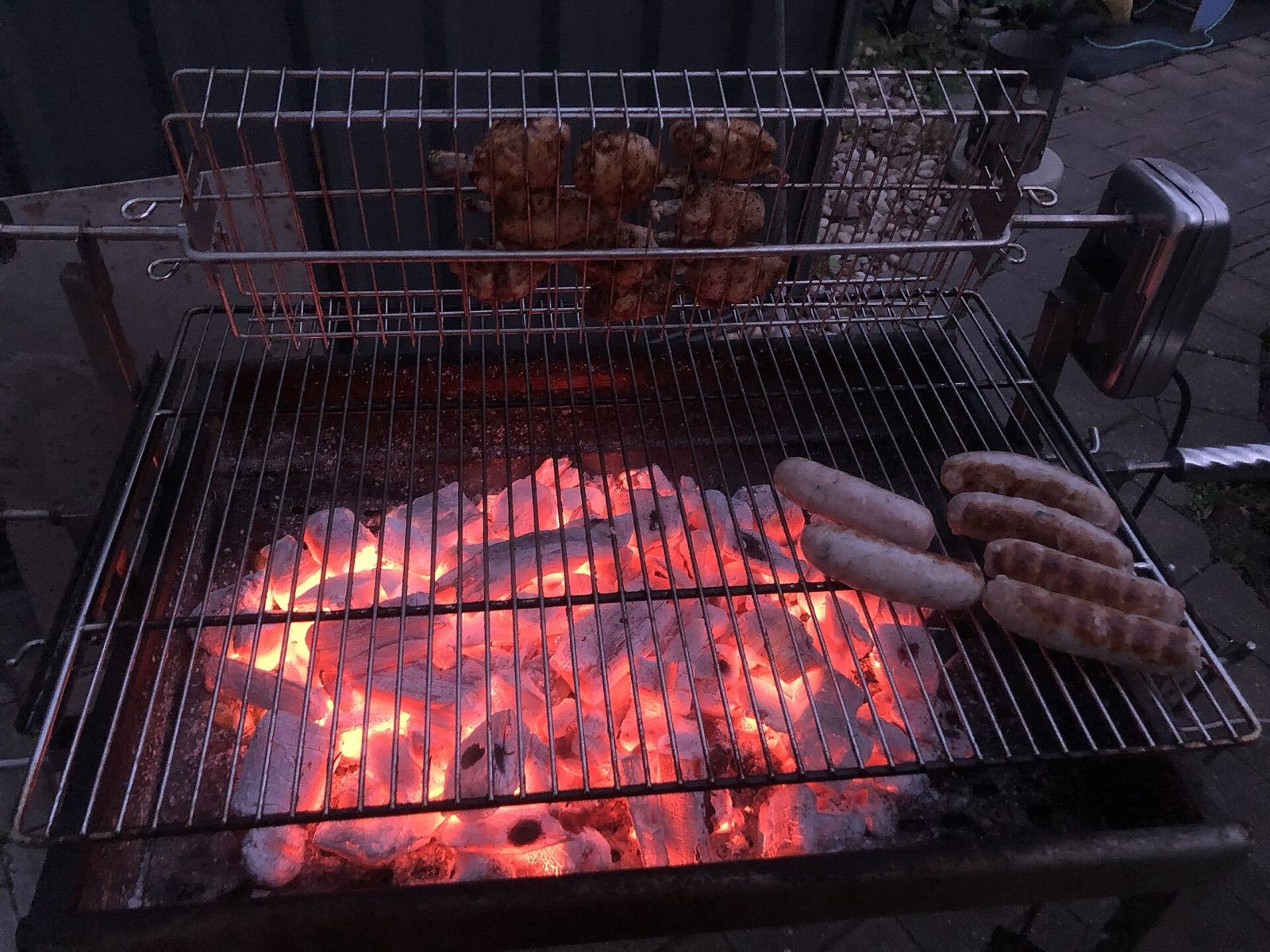
A well-stoked charcoal fire can sear harder than many gas grills and gives food the flavour many people associate with barbecue. Kettle grills are simple and affordable; barrel grills give more space; ceramic kamado grills hold heat extremely well and can grill, smoke and bake, but are heavy and can crack if dropped.
- Lump charcoal lights quickly, burns hot and leaves little ash, but pieces vary in size.
- Briquettes burn more evenly and for longer, which helps with long cooks.
- A chimney starter lights charcoal with newspaper or firelighters and avoids the chemical taste lighter fluid can leave.
- Two-zone cooking (coals piled on one side, food moved between direct and indirect heat) is the key technique for control.
Control comes from the vents: more air means more heat. It takes practice but rewards it.
Pellet grills
Pellet grills burn compressed hardwood pellets fed automatically from a hopper, with a digital controller holding the temperature you set. They excel at low-and-slow smoking and roasting, with a mild wood flavour and very little babysitting. Most need mains power, and many are less suited to hard searing than gas or charcoal. Our pellet grill guide explains how they work in detail.
Electric grills
Electric outdoor grills plug into a standard outlet. They produce no combustion fumes and no open flame, which makes them the practical option where building rules or local fire regulations restrict gas and charcoal on balconies and terraces. Check those rules before you buy any grill for an apartment or condo.
The limitation is heat: household outlets cap how much power a grill can draw, so electric grills generally sear less aggressively than gas or charcoal. Look for a lid, a thermostat you can set, and an outdoor rating.
The BTU myth
Gas grills are often sold on their total BTU rating, and bigger sounds better. But BTU per hour measures how much gas the burners consume, not how hot the grill gets or how well it cooks.
- A well-designed grill with a heavy lid, good heat distribution and thick grates can cook better on fewer BTUs than a thin, leaky grill with more.
- Totals often include side burners and rotisserie burners that don't heat the main cooking area.
- A high rating on a poorly built grill mainly means it uses propane faster.
Rule of thumb: divide the main burners' BTU rating (excluding side and rotisserie burners) by the primary cooking area in square inches. Many people use roughly 80–100 BTU per square inch as a reasonable range; far below that may struggle to sear, and far above it says little about quality. For metric ratings, 1 kW ≈ 3,412 BTU per hour.
Also check that the cooking area figure you compare is the primary grate, not the total including warming racks.
Materials and build quality
Stainless steel grades vary:
- 304 stainless contains more nickel and chromium and resists rust better; it's used on better grills.
- 430 stainless is cheaper and more prone to surface rust and discolouration outdoors.
- A magnet sticks firmly to 430 and usually only weakly or not at all to 304, but some cheap grades are also non-magnetic, so the magnet test is a hint rather than proof.
Cast aluminium fireboxes don't rust and hold heat reasonably well. Porcelain-enamelled steel is durable if the coating isn't chipped. Painted steel is the most budget-friendly and the most likely to rust.
Grates make a big difference to searing:
- Cast iron holds heat and sears well but needs oiling to prevent rust.
- Porcelain-coated cast iron resists rust, but chips if scraped with metal tools.
- Stainless rods are low-maintenance; thicker rods hold more heat than thin wire.
Other signs of build quality: a heavy lid that closes without gaps, sturdy wheels and frame, a grease tray that's easy to reach, and a long warranty on burners and firebox.
Safety basics
- Only grill outdoors, never in a garage, tent, porch or other enclosed space: charcoal and gas both produce carbon monoxide.
- Keep the grill well away from walls, railings, overhangs and anything flammable, following the manufacturer's clearance distances.
- Check gas connections at the start of each season: brush soapy water on the hose and fittings and open the cylinder valve. Growing bubbles mean a leak; shut off the gas and fix it before lighting.
- Store propane cylinders upright, outdoors, never in a house or garage.
- Clean grease trays regularly to prevent grease fires.
- Let charcoal ashes cool completely (it can take a day or more) and dispose of them in a metal container.
- Use a food thermometer to check meat is cooked safely.
The short version
- Gas for convenience, charcoal for flavour and searing, pellet for smoking, electric where flames aren't allowed.
- Ignore total BTU; look at build quality, lid fit and grates.
- Prefer 304 stainless, cast aluminium or heavy enamelled steel for longevity.
- Choose thick grates for good searing.
- Always grill outdoors with proper clearances, and leak-test gas each season.
- If you enjoy cooking outside, consider an outdoor pizza oven, and a patio heater or fire pit to extend the season.
Bloiq is reader-supported. Some links may earn us a commission; it never affects what we write. How we make money.
Cover photo: AlphaLemur, CC BY-SA 4.0, via Wikimedia Commons