Lawn mowers compared: battery, gas, corded and manual reel
How the four main types of walk-behind mower differ, which deck width suits your lawn, and when self-propelled drive and mulching are worth having.
Choosing a lawn mower used to mean choosing an engine size. Now the first question is what powers it: a battery, a gas (petrol) engine, a mains cable or your own legs. Each suits a different lawn and a different owner, and the features that sit on top (deck width, self-propelled drive and mulching) matter just as much once you are pushing the thing every week. This guide explains the trade-offs so you can match a mower to your garden rather than to the biggest number on the box.
The four types at a glance
| Manual reel | Corded electric | Battery | Gas (petrol) | |
|---|---|---|---|---|
| Typical lawn size | Small, flat | Small to medium | Small to large | Medium to large |
| Noise | Very quiet | Quiet | Quiet | Loud |
| Maintenance | Blade adjustment and sharpening | Minimal | Minimal; battery care | Oil, spark plug, air filter, fuel |
| Main limitation | Struggles with long or tough grass | Cable length and handling | Runtime per battery | Noise, fumes, upkeep |
These are broad guides, not rules. A large battery on a well-designed mower can handle lawns that once needed an engine, and a reel mower can keep a small, well-kept lawn in excellent condition.
Manual reel mowers
A reel (cylinder) mower has a set of spiral blades that sweep grass against a fixed bottom blade, cutting it cleanly like scissors. Many people find the result neater than a rotary mower, which tears grass with a spinning blade.
Reel mowers are light, silent and need no fuel or charging. The catch is that they work best on small, flat, regularly mown lawns. Long grass, tough weedy stems, twigs and bumpy ground all make them hard work, and a single stick can jam the blades. Keep the cutting cylinder adjusted and sharp, or the mower will fold grass over instead of cutting it.
Corded electric mowers
Corded mowers are usually light, inexpensive and simple: no fuel, no battery to wear out, and they start at the press of a lever. They suit small to medium lawns close to an outdoor socket.
The cable is the compromise. You have to mow in a pattern that keeps the cord behind you, and around trees and beds it gets tedious. Use an extension lead rated for outdoor use and heavy enough for the length, and plug in through RCD (GFCI) protection. Never mow over the cable; if you damage it, unplug before touching it.
Battery mowers
Battery mowers have taken over much of the market because they combine the convenience of electric with the freedom of gas. Most are quiet enough to use early in the morning, need very little maintenance and are easy to store.
Things to check:
- Voltage and amp-hours. Voltage roughly indicates the power class; amp-hours (Ah) indicate capacity. Multiply the two for watt-hours, the best single guide to runtime.
- Runtime claims. Manufacturers quote runtime or area per charge under favourable conditions. Thick, damp or long grass and self-propelled drive all shorten it.
- Second battery or larger battery. For bigger lawns, a spare battery or a higher-capacity one may be the difference between one session and two.
- Battery platform. Batteries usually fit only one brand's tools, so if you already own cordless tools, sticking with that system can save money. Our drill and impact driver guide explains voltage and amp-hours in more detail.
- Brushless motors are generally more efficient and longer-lived.
Store batteries indoors over winter, partly charged, away from frost.
Gas mowers
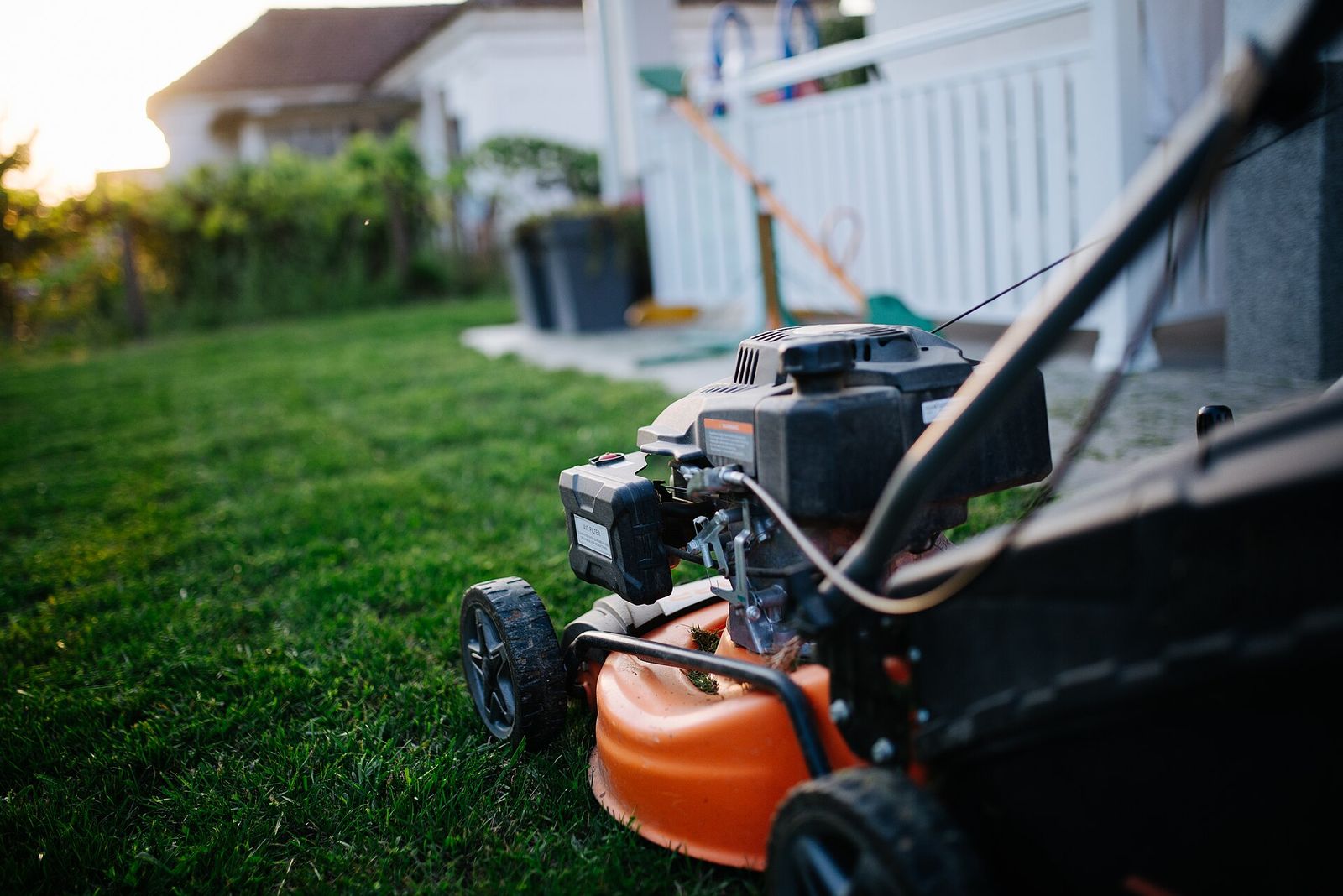
Gas mowers remain the choice for large lawns, rough ground and people who want to mow for as long as they like with a refill. Most walk-behind models use four-stroke engines, so the fuel goes in straight and the oil in a separate sump.
The trade-offs are noise, exhaust, weight and upkeep: oil changes, air filters, spark plugs and blade sharpening. Fuel left in the tank over winter can go stale and gum up the carburettor, so either run the tank dry at the end of the season or use a fuel stabiliser, as the manual recommends. Check whether the engine is approved for ethanol-blended fuel, and never run it in a closed garage or shed because of carbon monoxide.
Deck width and lawn size
Deck width is the width of the strip you cut in one pass. Wider decks mean fewer passes but a heavier, less nimble mower.
- About 30–38 cm (12–15 in): small lawns, tight spaces and narrow gates.
- About 40–46 cm (16–18 in): typical suburban gardens.
- About 50–56 cm (20–22 in): larger lawns; common on gas and larger battery models.
For lawns beyond roughly half an acre (about 2,000 m²), many people look at ride-on mowers or a robotic mower. Our robotic lawn mower guide explains how those work. Measure your gates and storage space before buying a wide deck.
Self-propelled drive
A self-propelled mower drives its own wheels, so you only steer. It's worth having on slopes, large lawns and for anyone who finds pushing a heavy mower tiring.
- Front-wheel drive is easy to turn (you tip the front up) but loses traction on hills and when the grass bag fills, because weight shifts to the rear.
- Rear-wheel drive grips better on slopes and with a full bag, and is the usual choice for hilly gardens.
- All-wheel drive offers the most traction on uneven or steep ground, at extra cost and weight.
Variable speed control makes a big difference in practice. On battery mowers, remember that drive uses energy and reduces runtime.
Mulching, bagging and side discharge
Many rotary mowers offer three ways to deal with clippings:
- Bagging collects clippings for a tidy finish; you have to empty the bag.
- Mulching cuts clippings into fine pieces and drops them back on the lawn, where they break down and return nutrients. A mulching plug or blade is usually needed.
- Side discharge throws clippings out the side, useful for long grass.
Mulching works best when you mow little and often. A widely used rule of thumb applies here and to lawn health generally:
The one-third rule: never remove more than about a third of the grass blade's height in one mow. Taller grass should be brought down in stages over several mows.
Also check the cutting height range and how it's adjusted. A single lever is quicker than setting each wheel separately.
Safety basics
- Clear the lawn of stones, toys, dog bones and sticks before mowing; a rotary blade can throw them hard.
- Wear sturdy closed shoes and long trousers, and use hearing protection with gas mowers.
- Keep children and pets indoors or well away while you mow.
- With walk-behind mowers, mow across a slope, not up and down, so the mower can't roll back over your feet. Avoid slopes that feel too steep to stand on securely.
- Before clearing a blockage or touching the blade, stop the engine and wait for the blade to stop, then remove the battery, unplug the cable, or disconnect the spark plug lead on gas models.
- Never disable the operator-presence bar that stops the blade when you let go.
The short version
- Match the type to your lawn: reel for small and flat, corded for small near a socket, battery for most gardens, gas for large or rough ground.
- For battery models, compare watt-hours and consider a second battery.
- Pick a deck width that suits the lawn and fits through your gate.
- Choose rear-wheel drive self-propelled models for slopes.
- Look for mulching if you'd rather not bag clippings, and mow often.
- Finish edges with a string trimmer, and consider mulching fallen leaves with the mower rather than reaching for a leaf blower.
Bloiq is reader-supported. Some links may earn us a commission; it never affects what we write. How we make money.
Cover photo: Shixart1985, CC BY 2.0, via Wikimedia Commons