Leaf blowers explained: CFM vs MPH, backpack models and battery life
What air volume and air speed ratings mean, handheld versus backpack blowers, how loud they really are, and how long batteries last at full power.
Leaf blowers are sold on two numbers, CFM and MPH, and it isn't obvious which one matters or why some cheap models seem to beat expensive ones on paper. A blower that's too weak will push leaves around in circles; one that's too big is heavy, loud and annoys the neighbours. This guide explains what the ratings mean, how the main types compare, what to expect from batteries and how to keep the noise down.
CFM and MPH: volume versus speed
Two numbers describe a blower's airflow:
- CFM (cubic feet per minute) is the volume of air the blower moves. More volume moves bigger piles of leaves across a wider area.
- MPH (miles per hour) is the speed of the air at the nozzle. Higher speed lifts leaves that are wet, matted or stuck in grass and gravel.
Neither number works alone. A narrow nozzle can produce impressive MPH with little CFM, which makes a blower good at dislodging single stuck leaves but slow at clearing a lawn. High CFM at low speed shifts dry leaves easily but struggles with wet ones. For most garden work, CFM is the better guide to how fast you'll finish, provided the air speed is reasonable.
In Europe you may see metric figures instead:
Conversions: 1 m³/min ≈ 35.3 CFM (and 1 m³/h ≈ 0.59 CFM); 1 m/s ≈ 2.24 mph (and 1 km/h ≈ 0.62 mph).
Some manufacturers also quote blowing force in newtons, which combines volume and speed into a single figure and is useful for comparing models from the same maker. Be aware that CFM can be measured in different places: at the fan housing or at the end of the tube. Figures taken at the housing look higher, so compare within the same test method where possible.
Rough airflow ranges
These are broad, typical ranges rather than specifications:
| Type | Typical use |
|---|---|
| Small corded or compact battery blowers | Patios, decks, paths, garage floors, light leaf cover |
| Mid-size battery handhelds (roughly 400–600 CFM) | Average suburban gardens |
| High-power battery handhelds and gas handhelds | Larger gardens, wet leaves |
| Backpack blowers (often 600 CFM and up) | Large properties, heavy autumn leaf fall |
| Wheeled (walk-behind) blowers | Very large areas, commercial grounds |
Handheld or backpack
Handheld blowers are the natural choice for most homes. They're quick to pick up, easy to store and fine for patios, paths and average lawns. Weight matters more than you'd think: you hold the whole machine at arm's length, and some high-power battery models get heavy once a large battery is fitted.
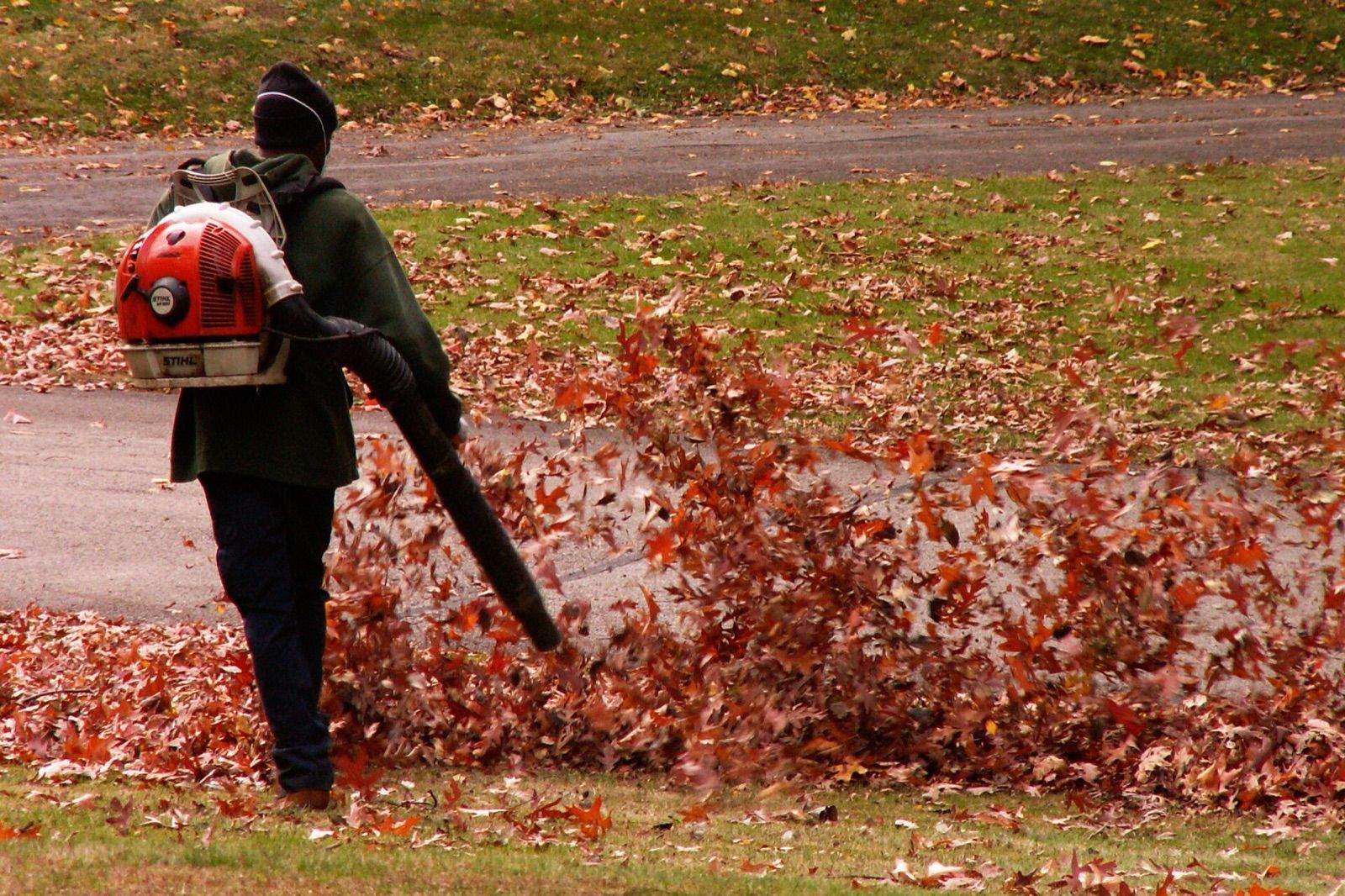
Backpack blowers put the engine or battery on your back with a harness and the tube in your hand. They carry more power comfortably for longer sessions, which suits large properties with many trees. They're bulkier to store and slower to pick up for a quick job.
Blower-vacuums can switch to suction, shredding leaves into a bag. The shredding reduces volume considerably, but vacuuming is slower than blowing, bags fill fast and wet leaves clog. They're most useful for small areas, beds and corners.
Battery runtime: read the fine print
Battery blowers draw a lot of power at full speed, so runtime varies enormously with the setting you use:
- On maximum or boost, many battery blowers run for only around 10–20 minutes on a typical battery.
- On low or medium, the same battery may last much longer, sometimes an hour or more.
Manufacturers often quote the longest runtime, measured on the lowest setting. Look for the runtime at the power level you'll actually use. Watt-hours (volts × amp-hours) give the best comparison of battery capacity, and a variable-speed trigger or speed dial helps you use only the power each task needs. For big autumn clean-ups, a second battery is often more useful than a bigger blower.
If you already own cordless tools, check whether the blower shares their batteries. Our drill and impact driver guide explains battery platforms.
Gas blowers
Gas blowers offer the most power and unlimited runtime with a fuel can. Most use two-stroke engines running on a fuel and oil mix. The trade-offs are weight, exhaust fumes, maintenance and noise. Some cities and regions restrict gas blowers or when they can be used, and some are phasing out sales of new small gas engines, so check your local rules before buying one.
Noise: why decibels are tricky
Noise ratings are given in decibels (dB(A)), but they're hard to compare:
- The measurement distance makes a large difference. Figures measured at 15 m (50 ft), common in North America, look much lower than the sound level at the operator's ear.
- In Europe, labels show the guaranteed sound power level (LWA), a different measurement that produces higher numbers.
- The decibel scale is logarithmic. An increase of about 10 dB sounds roughly twice as loud.
Battery blowers are generally quieter than gas models, particularly in low-frequency engine noise, which carries further. Whatever the type, wear hearing protection when using powerful blowers for long, and be considerate about early mornings and evenings.
Using a blower well
- Blow with the wind and work in strips towards a collection point, such as a tarp.
- Use lower speeds near beds and gravel so you don't blow soil and stones around.
- Wait for a dry day if you can: dry leaves move far more easily than wet ones.
- Consider alternatives: a mulching lawn mower can chop light leaf cover into the lawn, and leaving some leaves in beds provides shelter for insects and wildlife.
Safety basics
- Wear eye protection and hearing protection; blowers throw grit and debris.
- A dust mask helps in dry, dusty conditions, as blowers stir up dust, pollen and mould spores.
- Never point a blower at people, pets or open windows and doors.
- Refuel gas models outdoors with the engine off and cool.
The short version
- Use CFM as the main guide to clearing speed; make sure MPH is adequate for wet leaves.
- Compare metric and imperial figures carefully, and within the same test method.
- A handheld suits most gardens; choose a backpack blower for large properties.
- Check battery runtime at the power setting you'll use, and consider a second battery.
- Compare noise at the same distance, and check local rules on gas blowers.
- Wear eye and hearing protection, and pair the blower with a string trimmer on the same battery system if you can.
Bloiq is reader-supported. Some links may earn us a commission; it never affects what we write. How we make money.