Hedge trimmers: blade length, tooth gap, pole trimmers and safety
How blade length and tooth spacing decide what a hedge trimmer can cut, when a pole trimmer beats a ladder, and the safety rules that prevent common injuries.
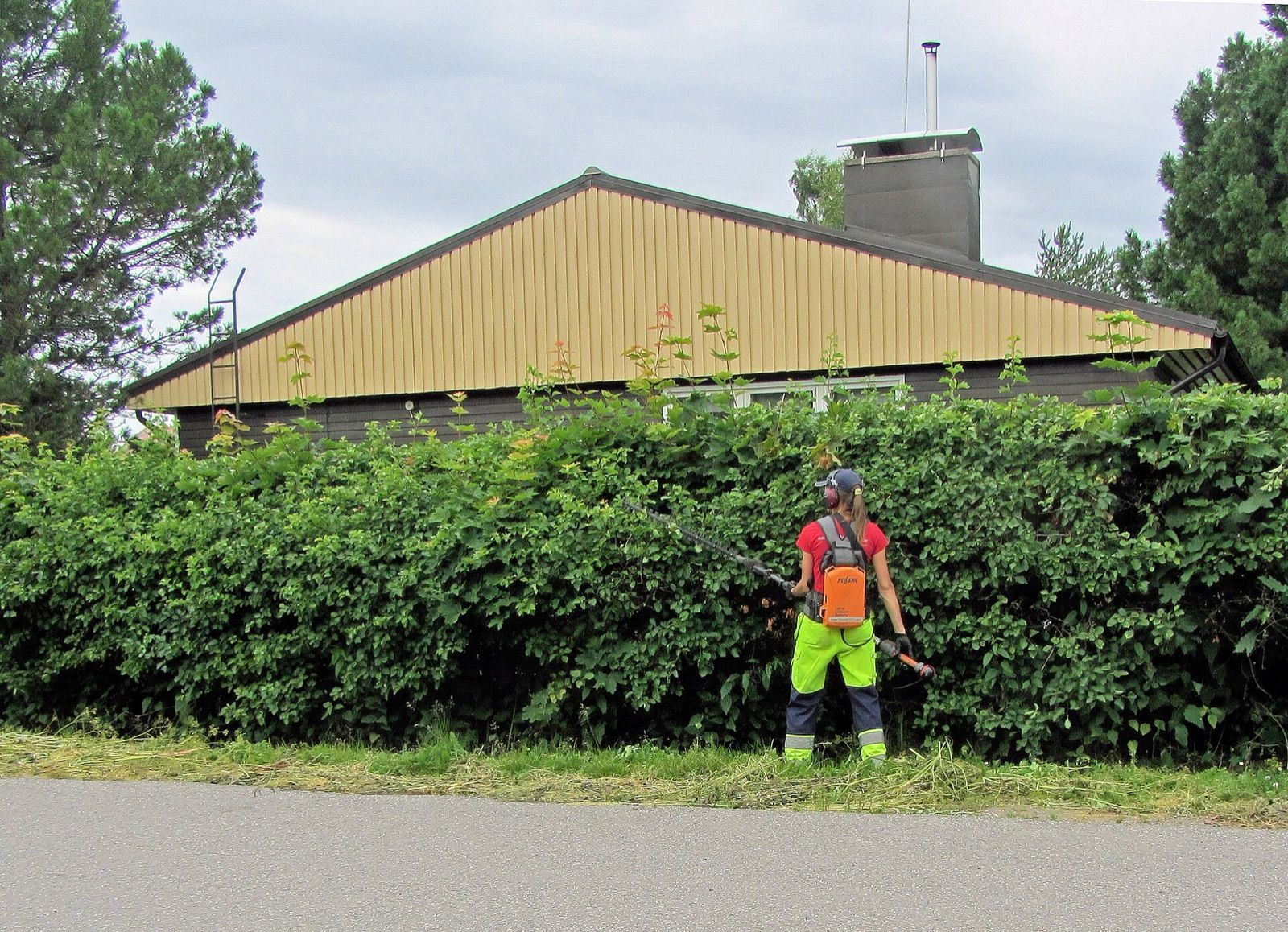
A good hedge trimmer makes a tedious job quick; the wrong one leaves ragged, torn stems, tires your arms and tempts you up a wobbly ladder. Two specifications on the box, blade length and tooth gap, tell you most of what you need to know about what a trimmer can handle. Add the choice of power source and whether you need a pole model, and you can narrow the field quickly. This guide explains each and finishes with the safety points that matter most.
How a hedge trimmer cuts
A hedge trimmer has two toothed steel blades lying on top of each other. One or both move back and forth rapidly, and stems caught between the teeth are sheared off, much as scissors cut paper. Because the teeth have to close around a stem to cut it, the space between them sets the thickest branch the trimmer can handle.
- Single-action trimmers move one blade against a fixed one. They're simpler and common on lighter models.
- Dual-action trimmers move both blades in opposite directions, which generally cuts more cleanly and with less vibration.
- Double-sided blades cut on both edges, so you can sweep back and forth. Single-sided blades cut on one edge, often with a guard that collects clippings, and suit shaping tops and flat faces.
Blade length
Longer blades cover more hedge per stroke and reach further across the top of a wide hedge, but they add weight and are harder to control for detailed shaping.
| Blade length | Typical use |
|---|---|
| Around 40–50 cm | Small hedges, shrubs, shaping and topiary |
| Around 50–60 cm | Typical garden hedges |
| Around 60–75 cm | Long, wide or tall hedges |
For most gardens, a blade in the middle of the range is a good compromise. If you'll be holding the trimmer at shoulder height for long periods, weight matters more than a few extra centimetres of blade.
Tooth gap: what it can actually cut
Tooth gap (sometimes called cutting capacity) is the space between the teeth. Typical figures run from around 15 mm on light electric trimmers to 25–30 mm or more on heavy-duty and gas models.
Rule of thumb: treat the listed tooth gap as a maximum. Trimmers cut comfortably at somewhat less than that, and hardwood stems, dry growth and dull blades reduce the practical capacity further.
Regular trimming mainly cuts the current season's soft growth, which is usually thin. A wide gap matters if you cut back overgrown hedges or woody shrubs such as hawthorn, beech or privet that have been left for a year or two. For branches thicker than the trimmer can take, use loppers or a pruning saw; forcing thick wood into the teeth jams and damages the blade.
Power sources
Corded electric trimmers are light and inexpensive, and suit small gardens near a socket. The main risk is cutting the cable, which is a common accident. Drape it over your shoulder, keep it behind you, and plug in through RCD (GFCI) protection.
Battery trimmers are now the usual choice for homeowners: quiet, free of cables and fumes, and with enough power for most hedges. Compare battery capacity in watt-hours (volts × amp-hours) for runtime, and consider sharing batteries with other tools such as a string trimmer or leaf blower.
Gas trimmers give the most power and runtime for long or overgrown hedges, but they're heavier, louder and vibrate more. Most use two-stroke engines that need a fuel and oil mix.
Pole hedge trimmers
A pole hedge trimmer puts the cutting head on an extending shaft, often with an articulating head that can be angled to cut the top of a hedge while you stand on the ground. They're the safest way to reach tall hedges without climbing, and they're handy for the far side of wide hedges.
The trade-off is leverage: holding a cutter at the end of a long pole tires your arms quickly, and precise shaping is harder. Look for:
- Total reach that suits your tallest hedge, allowing for your own height.
- An adjustable, lockable head angle.
- A shoulder strap or harness to carry the weight.
- Balance: some battery models place the battery at the rear to offset the head.
Many attachment-system tools offer a pole hedge trimmer head alongside a trimmer, edger and pole saw.
Other features worth checking
- Rotating rear handle, making vertical cuts more comfortable.
- Blade stop time: the blade should stop quickly when you release the switch.
- Hand guard between the front handle and the blade.
- Tip guard, a small plate at the end of the blade that protects the blade tip and reduces jolts when it touches a wall or the ground.
- Weight with battery fitted, which is the figure that matters.
Safety essentials
Most hedge trimmer injuries come from cut cables, hands near the blade and falls from ladders.
- Hedge trimmers are designed for two-handed operation: both hands must be on the handles for the blade to run. Never disable this.
- Wear safety glasses, sturdy gloves and, with gas or powerful battery models, hearing protection.
- Stay off ladders where you can. Use a pole trimmer instead. If you must work at height, use a stable platform or a purpose-made tripod ladder on firm ground, and never over-reach. Our ladder guide covers ladder types and safe use.
- Check the hedge first for wire fencing, garden lights, cables and hidden objects.
- Keep well away from overhead power lines; utilities commonly advise staying at least 3 m (10 ft) away, and farther for high-voltage lines. Call the utility if branches are near a line.
- Stop the trimmer and remove the battery or unplug before clearing jams.
- Check for nesting birds before trimming in spring and summer. In many places, including the UK and Canada, it's illegal to disturb or destroy active nests of protected species, and wildlife groups recommend avoiding major hedge cutting during the main breeding season.
Care and maintenance
- Brush off clippings and sap after use, and wipe the blades with a resin solvent if they gum up.
- Apply a light lubricant spray to the blades before storage.
- Fit the blade cover for storage and transport.
- Have blades sharpened when they start tearing rather than cutting; ragged cuts brown and heal slowly.
The short version
- Pick a blade length that suits your hedge size; mid-range suits most gardens.
- Check the tooth gap, and expect real capacity to be a little less.
- Battery for most homes, corded for small hedges, gas for long or overgrown ones.
- Use a pole trimmer rather than a ladder for tall hedges.
- Wear eye protection and gloves, and keep clear of power lines and nesting birds.
- Leave thick branches to loppers, a pruning saw or, for bigger work, a chainsaw used with proper protective gear.
Bloiq is reader-supported. Some links may earn us a commission; it never affects what we write. How we make money.
Cover photo: Anneli Salo, CC BY-SA 4.0, via Wikimedia Commons