Headlamps and camping lanterns: lumens, beam distance and batteries
What lumens, candela and beam distance really tell you, how to choose batteries for the cold, why red light matters, and what IPX4, IPX7 and IPX8 mean.
After dark at a campsite you need two kinds of light: a beam that goes where you look, and a soft glow that fills the tent or the picnic table. A headlamp does the first, a lantern the second. The boxes are covered in big lumen numbers, but brightness alone tells you surprisingly little. This guide explains the figures that matter, how to choose batteries, and what the waterproof ratings mean.
Lumens, candela and beam distance
Three numbers describe a light, and they measure different things:
- Lumens are the total amount of light the lamp puts out, in every direction.
- Candela is the intensity at the brightest point of the beam. A tightly focused beam has high candela even with modest lumens.
- Beam distance is how far away the beam still gives a usable amount of light.
Many manufacturers test to the ANSI/PLATO FL1 standard, which defines these figures. Under FL1, beam distance is where the light falls to 0.25 lux, about the brightness of a full moon on open ground. It is calculated from candela, so a light's reach depends on how focused the beam is, not just on its lumens.
Rule of thumb: FL1 beam distance in metres is about twice the square root of the candela. Four times the candela only doubles the reach.
In practice, a flood beam spreads light widely for close work, such as cooking, reading or packing a bag. A spot beam throws light down a trail. Many headlamps combine both, or let you switch between them.
How much light you need
These are rough guides, not rules:
| Activity | Typical useful output |
|---|---|
| Inside a tent, reading, cooking | 20–100 lumens, wide flood |
| Walking around camp, finding the toilet block | 100–200 lumens |
| Hiking a trail at night | 200–400 lumens, with some spot |
| Night running, route-finding off trail, searching | 400 lumens or more, good throw |
The highest setting is rarely the one you use most. On many compact lamps it steps down after a few minutes to stop the lamp overheating, and it drains the battery quickly. Look at the brightness and runtime of the middle setting, because that is what you will live with.
Runtime figures and regulated output
FL1 measures runtime until output drops to 10% of its initial level. A lamp can therefore be listed with a long runtime while spending most of it far dimmer than its starting brightness. Better makers publish a graph or say how long the lamp holds a steady output.
Regulated lamps hold a constant brightness until the battery is nearly flat, then drop to a low reserve mode. Unregulated lamps dim gradually as the battery runs down. Regulation is easier to plan around; gradual dimming gives you more warning.
Other headlamp features worth having:
- A lock-out mode, so the lamp can't switch on in your pack and drain itself.
- A tilting lamp body, so you can aim the beam down at your feet without bending your neck.
- A low first mode, so you aren't dazzled when you switch on in the dark.
- A rear battery pack and top strap on heavier, high-output lamps. They balance the weight and stop the lamp bouncing.
- Reactive or adaptive brightness, which dims automatically when you look at something close, such as a map. It saves power but can flicker against reflective surfaces.
Red light and colour
A red light mode lets your eyes stay adapted to the dark, and it doesn't dazzle the people around you or wake the rest of the tent. It is the polite choice at a shared campsite and in mountain huts. Some lamps also offer green or blue modes, which some anglers and hunters prefer; for most people red is enough.
Colour temperature matters too. Neutral-white light (about 4000–5000 K) shows colours and terrain more naturally than very cold blue-white light. Warmer light is more pleasant around camp and tends to attract fewer insects. A high colour rendering index (CRI) helps you read terrain, maps and first-aid kits accurately.
Batteries: disposable, rechargeable or both
| Battery | Strengths | Weaknesses |
|---|---|---|
| Alkaline AA/AAA | Sold almost everywhere, long shelf life | Lose a lot of capacity in the cold; can leak if left inside |
| NiMH rechargeable AA/AAA | Reusable, better than alkaline in the cold | Slightly lower voltage, so some lamps run dimmer |
| Lithium primary AA/AAA | Light, long shelf life, work well in cold weather | Disposable, more expensive |
| Built-in lithium-ion (USB-C) | Convenient, high output, often with a charge indicator | When it's flat you need power; the battery may not be replaceable |
| Removable 18650 or 21700 cells | High capacity, swappable, easy to carry spares | Larger and heavier; need a proper charger |
Hybrid headlamps take either a rechargeable pack or standard AAA cells. They are a sensible choice for long trips and travel.
All batteries deliver less in the cold. In winter, keep the lamp or a spare battery in an inside pocket, and keep it there overnight. If you carry a power station or power bank, USB-C charging makes topping up easy. Airlines have rules for spare lithium batteries, which usually have to go in hand luggage, so check the current rules before you fly.
Waterproofing: IP ratings and drop tests
Waterproofing is usually stated as an IP code. The second digit is water resistance (an X in the first place means dust was not tested):
- IPX4: withstands splashing from any direction. Fine for rain.
- IPX6: withstands powerful jets of water.
- IPX7: survives temporary immersion, tested at 1 metre for 30 minutes.
- IPX8: survives longer or deeper immersion, to a depth the manufacturer states.
For hiking and camping, IPX4 is the practical minimum; choose IPX7 or IPX8 for paddling, caving or anything that may end up in a river. FL1 also includes an impact resistance figure: the height in metres from which the light survived drops onto concrete.
Camping lanterns
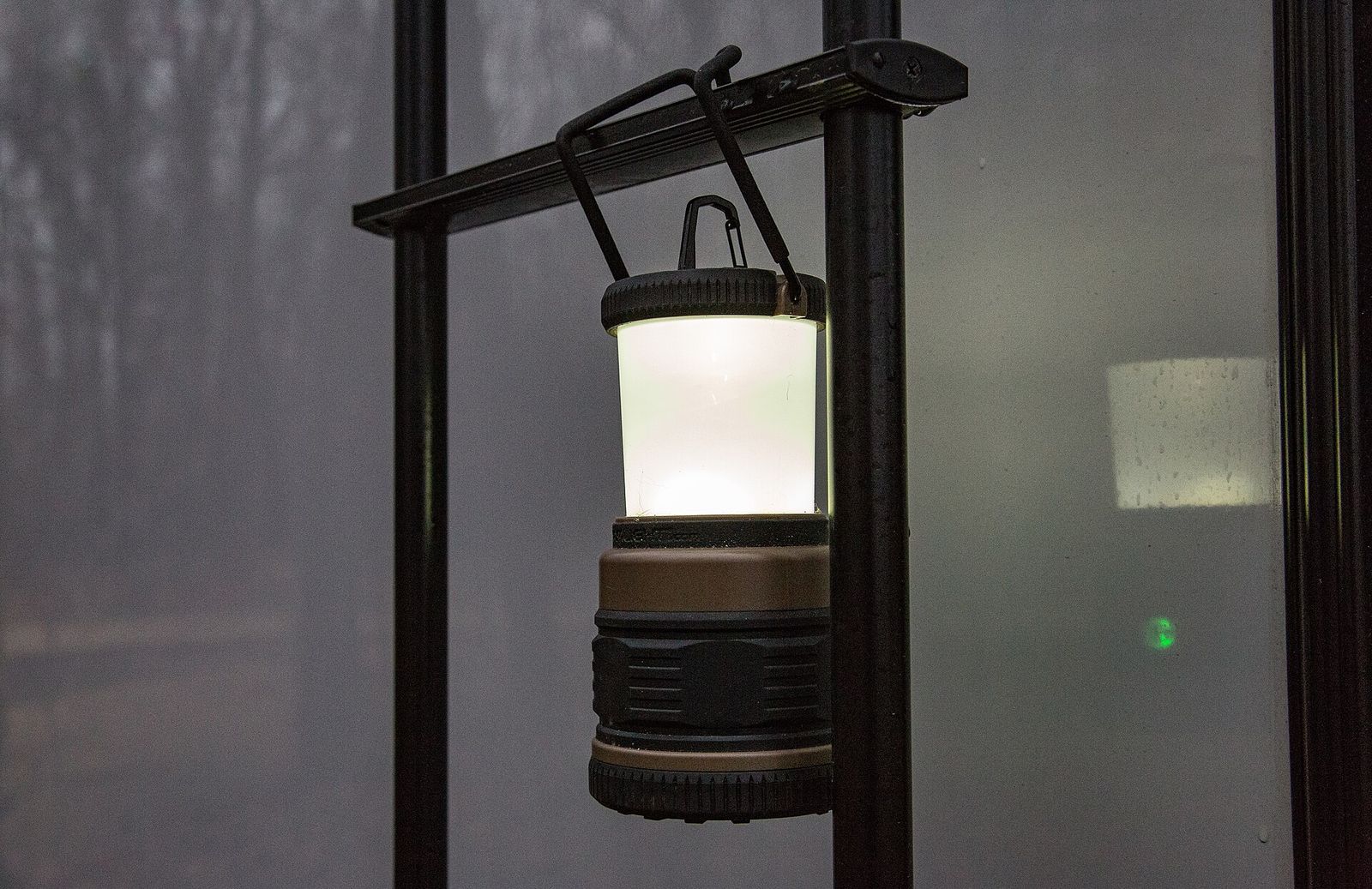
A lantern spreads light all around rather than projecting a beam. That suits tents, tables and cooking areas, where a headlamp would blind everyone you look at.
- Output. About 100–300 lumens lights a tent or a table; more is useful for a group camp or a power cut at home. Several brightness levels and a warm setting make a lantern far more pleasant.
- Shape. Collapsible lanterns pack small. A hook or loop at the top lets you hang the lantern from the ridge of a tent, which spreads the light better than standing it on the floor. A diffuser stops the bare LEDs from glaring.
- Power. The battery options are the same as for headlamps. Some lanterns double as a power bank for a phone; others charge from a small solar panel, which is slow but useful on longer stays.
- Fuel lanterns (gas or liquid fuel) give a lot of warm light, but they get very hot and burn oxygen. Never use a fuel-burning lantern, stove or heater inside a tent or any enclosed space: they can produce carbon monoxide, which is invisible and odourless. LED lanterns are the safe choice indoors. See our camping stoves guide for the same rule with stoves.
For lighting a garden or path at home rather than a campsite, see our guide to outdoor and solar lighting.
The short version
- Judge beam distance and the middle setting, not just peak lumens.
- Red light keeps your night vision and keeps the peace at camp.
- Lithium or NiMH batteries handle cold better than alkaline; hybrid lamps give you a fallback.
- IPX4 covers rain; choose IPX7 or IPX8 near water.
- Carry both: a headlamp for tasks and a hanging LED lantern for the tent, and never a fuel lantern indoors.
Bloiq is reader-supported. Some links may earn us a commission; it never affects what we write. How we make money.
Cover photo: Tony Webster, CC BY 2.0, via Wikimedia Commons