Outdoor and solar lighting: lumens, colour, sensors and batteries
How bright outdoor lights should be, which colour temperature to choose, how motion sensors and IP ratings work, and what solar lights can and can't do in winter.
Outdoor lighting has several jobs: helping you find the path and the front door, deterring intruders, and making a garden pleasant after dark. Getting it right comes down to a few specifications, namely brightness, colour, weather rating and how the light switches on, and to understanding the real limits of solar power. This guide explains each, so you can choose lights that do their job without dazzling the neighbours.
Brightness: lumens, not watts
Lumens measure how much light a fixture gives out. With LEDs, watts tell you only how much power the fixture uses. Rough ranges for common uses:
| Use | Typical brightness |
|---|---|
| Path, step and marker lights | Tens of lumens up to about 100–200 |
| Accent and spot lights on plants | About 100–400 |
| Porch and entrance lights | About 400–800 |
| Motion-activated security lights | About 700 up to several thousand |
| Floodlights for driveways and large yards | Often 2,000 or more |
More isn't better. Very bright lights create harsh shadows and glare that make it harder to see, and annoy neighbours. Several softer lights spaced out usually work better than one powerful floodlight.
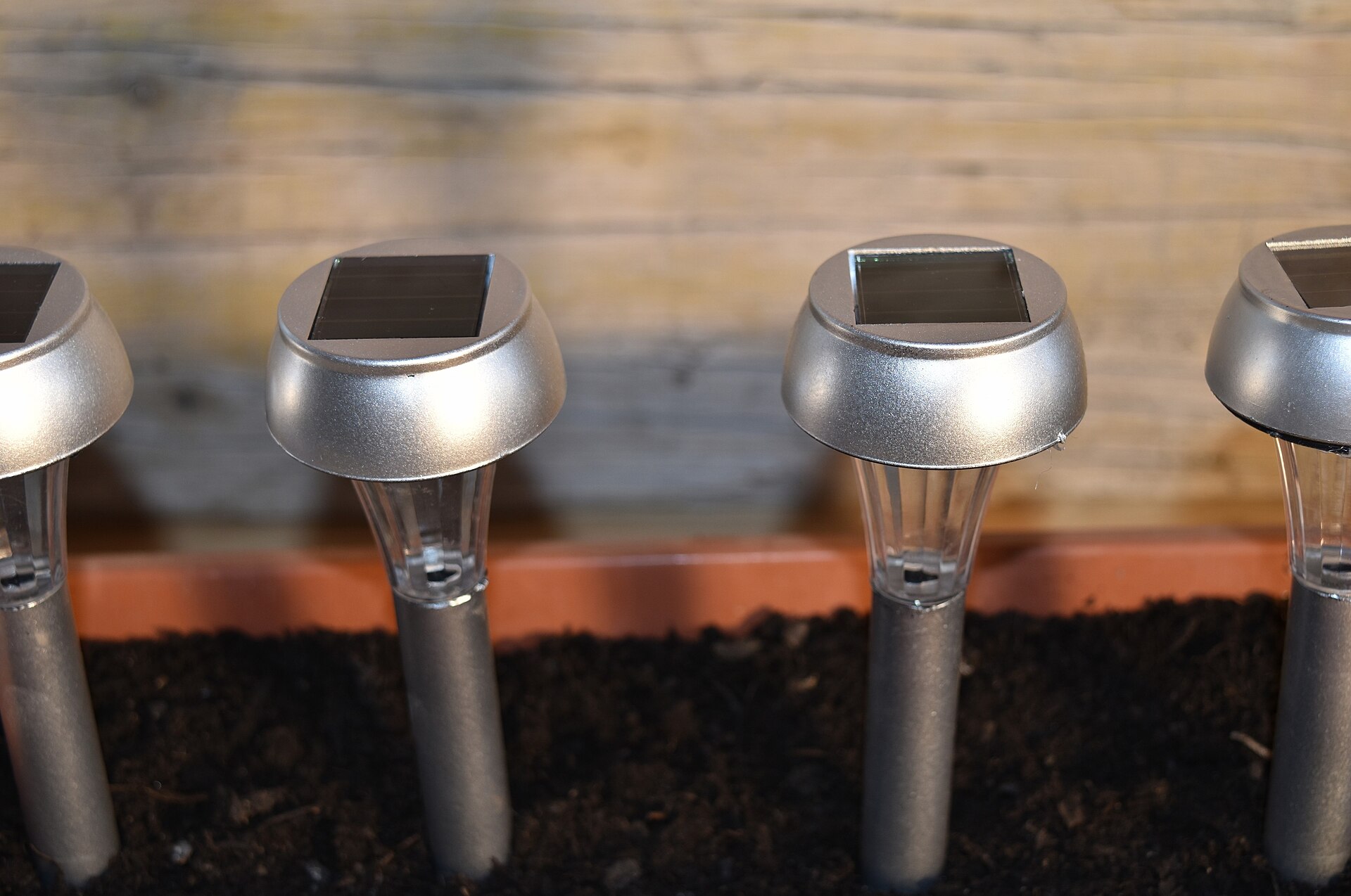
Solar path lights are often much dimmer than mains-powered ones, with some giving only a few lumens. They mark a route rather than light it.
Colour temperature and colour rendering
Colour temperature is given in kelvin (K):
- 2,700–3,000 K (warm white): a cosy, yellowish light similar to traditional bulbs. The usual choice for gardens, patios and entrances.
- 4,000 K (neutral white): crisper; common in security and utility lighting.
- 5,000–6,500 K (cool or daylight white): bluish and stark. Useful for work areas but harsh in a garden.
Dark-sky organisations recommend warm light, generally 3,000 K or lower, because blue-rich light scatters more in the night sky and affects insects, birds and other wildlife more. Near sea-turtle nesting beaches, local rules often require special amber lighting.
CRI (colour rendering index) tells you how natural colours look under the light, on a scale up to 100. A CRI of 80 or more looks natural enough for most outdoor uses; higher values make plants and stonework look richer.
Weather ratings: IP codes
The IP (ingress protection) code has two digits: the first for dust and solid objects, the second for water.
- IP44: protected against splashing water. Fine for sheltered spots such as under a porch roof.
- IP65: dust-tight and protected against water jets. A good choice for fully exposed walls and gardens.
- IP67: can withstand temporary immersion; useful for ground-level lights where puddles form.
- IP68: designed for continuous immersion, for ponds and fountains, to the maker's stated depth.
In North America you may also see "damp location" (sheltered from direct rain) and "wet location" (exposed to rain) listings.
Motion sensors and dusk-to-dawn controls
Passive infrared (PIR) sensors detect the heat of a person or animal moving through their field of view. They are the most common type on security lights and work best when people walk across the sensor's view rather than straight towards it. Their range is typically several metres to around a dozen metres.
Microwave (radar) sensors detect movement by reflected signals. They can be more sensitive, including through thin materials, but can be triggered by moving branches or passing cars. Some lights combine both.
Useful settings:
- Sensitivity or range, to avoid picking up the street or the neighbour's garden.
- Time-on, from seconds to several minutes.
- Lux (light-level) setting, so the sensor only works after dusk.
- Dual-brightness mode, where the light glows dimly all night and brightens on movement.
Photocells turn lights on at dusk and off at dawn; timers or smart controls can turn them off at a set hour to save energy.
Solar lights: what the panel and battery can do
A solar light charges a battery from a small panel during the day and runs the LED after dark. The panel and battery set the limits.
- Direct sun matters. Panels need several hours of direct sunlight. Shade from trees, walls or eaves, or a dirty panel, cuts charging sharply. Models with a separate panel on a cable let you put the panel in the sun and the light in the shade.
- Winter is the hard season. Short days, low sun and cloud mean much less charge, especially at higher latitudes. Expect shorter runtimes and dimmer output from late autumn to early spring.
- Runtime claims such as "up to 12 hours" usually assume a full charge on a sunny day and the lowest brightness setting.
- Batteries: small stake lights often use rechargeable AA or AAA nickel-metal hydride cells; larger lights typically use lithium-ion or lithium iron phosphate packs. Batteries lose capacity over time, so replaceable batteries extend a light's life. Lithium batteries generally shouldn't be charged below freezing, and better lights include protection for this.
- Solar security lights work well for occasional motion-triggered use but can run flat after several nights of frequent triggering and poor sun.
Rule of thumb: solar works best for low-power accent, path and occasional security lighting in sunny spots. Where you need bright, reliable light every night all year, a low-voltage or mains-powered system is the dependable choice.
For larger solar setups that power more than a garden light, see our guide to portable power stations and solar panels.
Low-voltage and mains lighting
Low-voltage (typically 12 V) landscape lighting runs from a transformer plugged into an outdoor outlet. Cables can usually be buried shallowly, and systems are straightforward to extend. Size the transformer for the total wattage of the fixtures with some spare capacity. A common guideline is not to load it beyond about 80% of its rating. On long runs, voltage drop makes far lights dimmer, so use heavier cable or split the lights across several runs.
Mains-voltage lights (120 V or 230 V, depending on where you live) are the norm for wall lights and floodlights on the house. New outdoor circuits, junction boxes and buried cables must meet local electrical codes, often need RCD or GFCI protection, and in many places must be installed or inspected by a qualified electrician.
Being a good neighbour
- Choose fully shielded fixtures that point light down rather than sideways or up.
- Aim security lights at your own property, and keep motion sensor ranges tight.
- Use timers or motion sensors so lights aren't on all night unnecessarily.
- Some municipalities have lighting bylaws limiting glare and light trespass; check them before installing floodlights.
The short version
- Paths and garden accents: warm white (around 2,700–3,000 K), low lumens, IP65 or better; solar is fine in sunny spots.
- Entrances: around 400–800 lumens, warm or neutral white, on a dusk sensor or timer.
- Security: motion-activated lights aimed carefully, with adjustable range and time-on.
- Solar: expect less light and runtime in winter; put panels in full sun and pick replaceable batteries.
- Wired systems: size low-voltage transformers with headroom, and use an electrician for mains circuits.
Bloiq is reader-supported. Some links may earn us a commission; it never affects what we write. How we make money.
Cover photo: Marco Centenaro (classe 1980), CC BY-SA 4.0, via Wikimedia Commons