Wheelbarrows and garden carts: one wheel or two, tubs and tyres
How to choose between a one-wheel barrow, a two-wheel barrow and a garden cart, with steel versus poly tubs, puncture-proof tyres and what capacity really means.
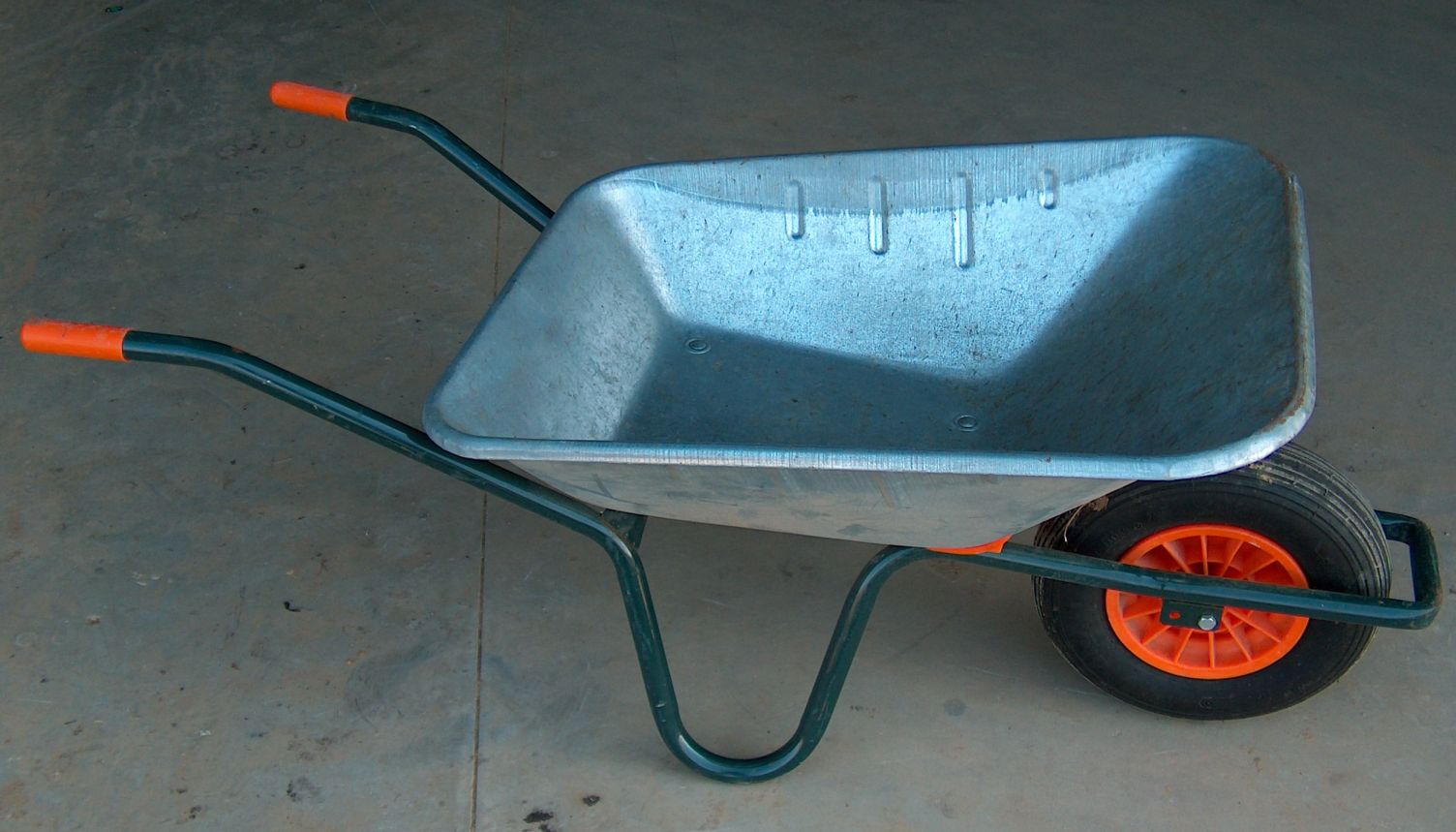
A wheelbarrow looks like the simplest thing in the shed, but the wrong one makes every load of soil, mulch or paving harder than it needs to be. The number of wheels, the tub material, the tyre and the size all change how a barrow handles on your ground. This guide explains the choices, so you can match the barrow or cart to your garden and to the loads you actually move.
One wheel, two wheels or a cart
| Type | Strengths | Weaknesses | Best for |
|---|---|---|---|
| One-wheel barrow | Turns tightly, fits narrow paths and planks, tips precisely | Needs balance; heavy loads can tip sideways | Building work, narrow gardens, uneven ground |
| Two-wheel barrow | Stable, less balancing, easier for beginners | Wider, harder to turn and to tip on slopes | Flat gardens, bulky light loads, users who find balancing hard |
| Four-wheel cart (pulled) | Carries the whole load, so no lifting | Needs firm, fairly level ground; can't follow narrow paths | Pots, bags, logs and tools around larger gardens |
| Dump cart | Tilting tub empties without lifting | Bulky to store | Mulch, compost and soil on larger plots |
| Large-wheel balanced cart | Load sits over the axle; rolls well on rough grass | Big to store; less suited to heavy rubble | Leaves, prunings and allotment work |
One-wheel barrows remain the standard for builders for good reason. You can steer them along a plank, around trees and through a gate, and tip the load exactly where you want it. The trade-off is that your arms and back take part of the weight and keep it balanced.
Two-wheel barrows stand steady when you stop and won't fall sideways on a turn, which suits people who find a one-wheel barrow tiring. They are harder to tip on a slope, as one wheel lifts, and they need a wider path.
Garden carts carry the whole load on their wheels, so you pull rather than lift. Flatbed carts with fold-down mesh sides take pots and bags; dump carts have a poly tub that tilts to empty. Many can be towed behind a ride-on mower or garden tractor, which helps on large properties. They don't do well on narrow paths, soft ground or steps.
Steel or poly tubs
- Steel tubs, galvanised or painted, are the choice for rubble, stone, broken paving and mixing mortar or concrete. They resist sharp edges and heat. Galvanised steel resists rust far better than painted steel. Painted tubs rust wherever the paint chips, and any steel tub will dent.
- Poly (plastic) tubs are lighter, don't rust and are easy to clean, which suits soil, compost, mulch and green waste. Dried concrete pops out of them easily too. Rocks and sharp tools scratch and gouge them. Thin, lower-grade plastics can turn brittle after years in strong sun or crack when hit in freezing weather, so store a poly barrow out of the sun if you can.
Tub shape matters as much as material. Deep, contractor-style tubs with a pronounced front lip hold more and tip cleanly. Shallow, wide tubs suit garden waste and are easier to load with a fork.
Capacity: volume isn't the same as load
Wheelbarrows are sized by volume: in litres in the UK and Europe (typically about 65–120 L), and in cubic feet in North America (typically 4–6 cu ft; 1 cu ft is about 28 litres). Two caveats:
- Struck or heaped? Some figures are the volume filled level with the rim, and some are heaped. Check which, or the "same size" barrows may differ a lot.
- Weight limits. Many barrows also list a maximum load in kilograms, which matters more than volume for heavy material.
Rule of thumb: volume tells you what fits; the material's weight tells you what you can safely push. Wet soil, gravel and sand weigh roughly 1.5–2 tonnes per cubic metre, and wet concrete about 2.4, so 100 litres of any of them is 150–240 kg. Fill a barrow only half to two-thirds with heavy materials.
Light, bulky loads such as leaves, prunings and mulch are where a big tub or a cart pays off. If you shred prunings first, they take up far less space; see our guide to garden shredders and chippers.
Tyres: pneumatic, solid or flat-free
- Pneumatic (air-filled) tyres roll most easily, cushion the load and float best over soft ground and grass. They can puncture or slowly lose air, especially after months in the shed. A tube with sealant, or a tubeless tyre, reduces the problem.
- Solid rubber tyres never go flat, but they ride harshly, transmit every bump, and sink more in soft soil.
- Flat-free tyres, usually filled with polyurethane foam, are a middle ground. They don't puncture and are kinder over bumps than solid rubber, though heavier than a pneumatic tyre and not quite as cushioned.
A wider tyre spreads the load and sinks less on lawns and wet ground. A larger wheel diameter rolls over roots and kerbs more easily. Wheels on ball bearings turn more freely and last longer than plain bushings. Many barrow wheels are a standard size, so a flat-free replacement can often be fitted later if punctures become a nuisance.
Frame, handles and fit
- Frame. Tubular steel frames with braces between the legs and tub resist twisting. Check that bolts are galvanised or stainless, and that the legs have stabiliser feet or a front tray stop so the barrow doesn't tip forward when you dump a load.
- Handles. Wooden handles absorb vibration and are easy to replace; steel handles don't rot. Rubber grips reduce blisters. Some two-wheel barrows use a single loop handle, so you can push with one hand or with both at any height.
- Height and length. Long handles give more leverage, but handles that sit too low make you stoop. If possible, hold the handles with straight arms and see whether the barrow lifts comfortably.
- Assembly. Most barrows come flat-packed. A clear diagram and a full set of fixings save frustration, and tightening everything again after the first few loads keeps the frame solid.
Loading and moving safely
These are standard manual-handling habits:
- Load the heavy part over the wheel, towards the front of the tub. The wheel then carries most of the weight, not your arms.
- Lift with your legs and keep your back straight; don't twist while lifting.
- Keep the load level and push on a straight line where you can. On slopes, take loads up face-on rather than across.
- Go around steps and kerbs where possible, or use a ramp or plank fixed so it can't slip.
- Make more, smaller trips with heavy materials. The tub will hold more than you should push.
Storage and care
Store barrows upright or upside-down out of the rain so water can't sit in the tub. Hang them on a wall bracket if floor space is short. Wash out cement and fertiliser promptly, as both attack steel. Check tyre pressure at the start of each season, and oil the wheel bearings now and then. If you're planning a bigger garden project, our guides to raised garden beds and composting cover the jobs a barrow usually ends up doing.
The short version
- One wheel for manoeuvrability, building work and narrow gardens; two wheels for stability; a cart for pulling large, light loads over firm ground.
- Steel tubs for rubble and concrete; poly tubs for soil, compost and garden waste.
- Check whether capacity is struck or heaped, and respect the weight limit; heavy materials fill only part of the tub.
- Pneumatic tyres ride best; flat-free tyres end punctures at the cost of some comfort.
- Try the handle height and look for a braced frame and rust-resistant fixings.
Bloiq is reader-supported. Some links may earn us a commission; it never affects what we write. How we make money.
Cover photo: MarkusHagenlocher, CC BY-SA 3.0, via Wikimedia Commons