Car audio upgrades: speakers, amps, subwoofers and what to change first
Head units, coaxial and component speakers, amplifier power ratings, subwoofer types and sound deadening explained, with a sensible order for upgrading car audio.
Factory car audio systems are built to a budget, and a car is a difficult place for sound: hard glass, soft seats, road noise and speakers mounted in thin doors near your ankles. The good news is that well-chosen upgrades can make a large difference, and you don't have to replace everything. This guide explains what each component does, which specifications matter and where your money makes the biggest difference.
Start with what you have
Before buying anything:
- Check the source. Low-bitrate streams and Bluetooth from an older phone can sound thin. Try a high-quality stream or a wired connection.
- Reset the settings. Flat equaliser, balance and fader centred, and any "surround" or loudness effects off; then adjust gently.
- Find the weak point. Distortion at moderate volume often means the speakers or the head unit's built-in amplifier are the limit. Buzzing and rattles point to loose trim or door panels.
- Know your system. Branded "premium" factory systems often have their own amplifier, unusual speaker impedances and built-in equalisation. Upgrading them usually needs different parts from a basic system.
Head units
The head unit (the radio or infotainment unit) is the source and control centre. Replacing it can add:
- CarPlay and Android Auto; see our guide to wireless CarPlay and Android Auto adapters and screens;
- better equalisers, time alignment and crossovers;
- preamp outputs (RCA) for amplifiers. Higher preamp voltage (several volts) gives a cleaner signal to an amplifier.
Standard sizes are single-DIN (about 180 × 50 mm) and double-DIN (about 180 × 100 mm). In many newer cars the head unit is integrated with climate controls, vehicle settings and cameras, making replacement difficult or impossible. The alternative is to keep the factory unit and add a line-output converter or a DSP (digital signal processor) that accepts its speaker-level signal.
Speakers
Replacing factory speakers is often the most noticeable single upgrade.
- Coaxial speakers have a tweeter mounted in front of the woofer. They're simple drop-in replacements.
- Component speakers separate the woofer, tweeter and crossover. Mounting the tweeter higher, on the door or dashboard, raises the "sound stage" towards ear level and usually improves clarity, but installation takes more work.
Specifications that matter:
- Size and mounting depth: common sizes include 6.5 in (16.5 cm), 6 × 9 in, 5.25 in and others. Check what fits your car, including depth behind the mounting surface and clearance for the window glass. Adapter brackets are often needed.
- Sensitivity (dB at 1 W/1 m): higher sensitivity plays louder from the same power, which matters if you're keeping a low-powered factory head unit.
- Power handling (RMS): the continuous figure is the meaningful one; ignore "peak" or "max" numbers.
- Impedance: most aftermarket car speakers are 4 ohms, but some factory systems use other values; a mismatch can cause low output or strain an amplifier.
The front speakers matter most, since they create the sound stage in front of you; rear speakers mainly fill in for rear passengers.
Sound deadening
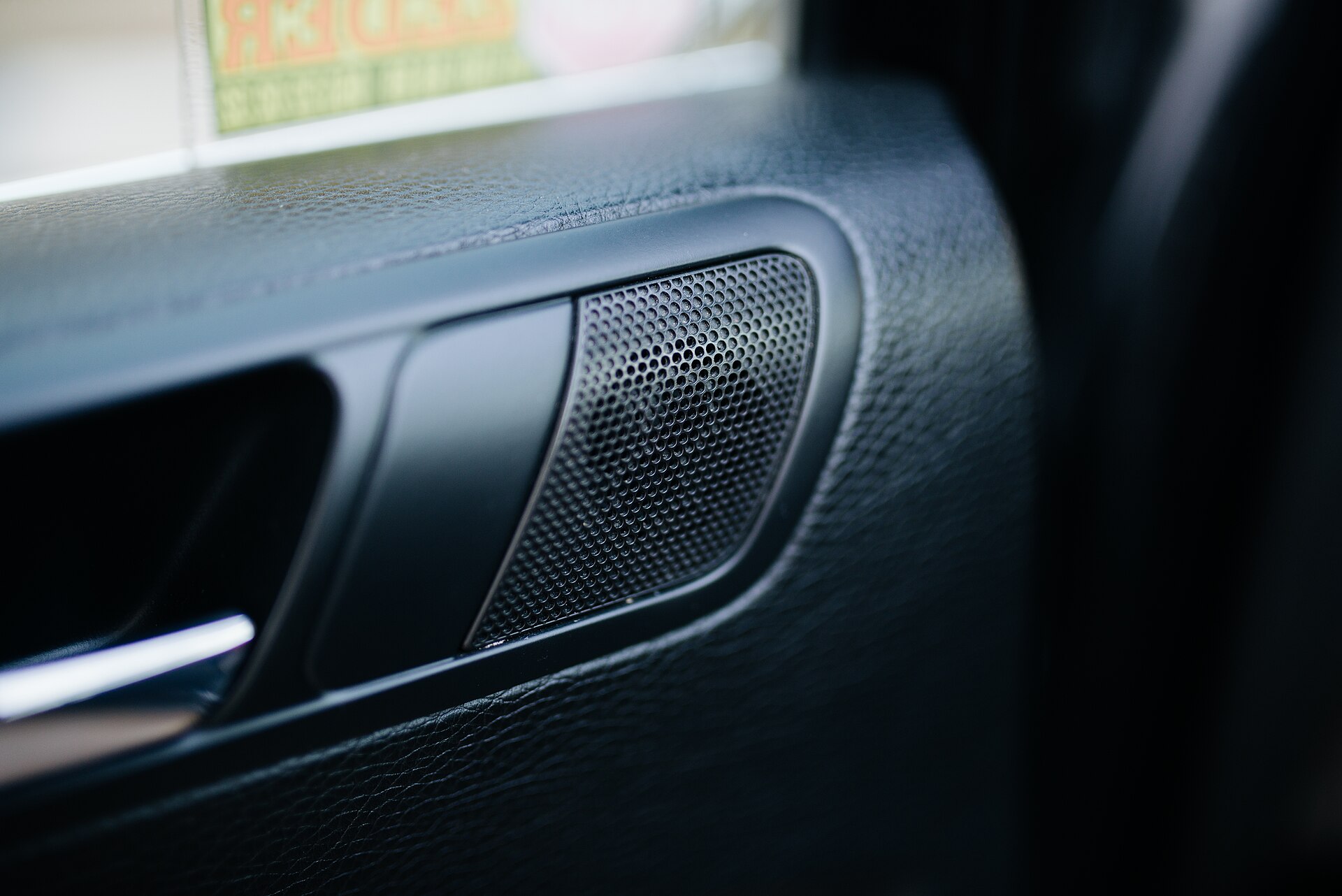
Car doors are thin metal with large holes, and they vibrate and leak sound. Damping material applied to the door skin and sealing the large access holes behind the door card:
- reduces rattles and resonance;
- noticeably improves mid-bass from door speakers;
- lowers road noise slightly.
It's time-consuming but inexpensive compared with the difference it can make, and it's easiest to do while the door panels are off for new speakers.
Rule of thumb: front component speakers plus door deadening usually improve a car's sound more than any single piece of electronics.
Amplifiers
A factory head unit's built-in amplifier delivers modest real power. An external amplifier gives speakers more clean power, so they play louder without distortion.
- Channels: a 4-channel amp for front and rear speakers, a mono amp for a subwoofer, or a 5-channel amp for both.
- Power ratings: compare RMS power per channel at the speaker impedance you'll use. Ratings measured to the CTA-2006 (formerly CEA-2006) standard are more comparable than headline "max" figures.
- Class D amplifiers are efficient and compact, which suits the limited space in modern cars.
- Gain is not a volume control. It matches the amplifier to the source; setting it too high causes clipping, which can damage speakers.
Wiring and electrical safety:
- Use a power cable of the right gauge for the amplifier's current draw.
- Fit an inline fuse close to the battery, commonly within about 45 cm (18 in), to protect the cable against a short circuit.
- Keep the ground cable short, bolted to clean, bare chassis metal.
- Route power cables away from signal cables to avoid noise and alternator whine.
- Disconnect the battery before wiring, following the owner's manual, as some cars need settings restored afterwards.
- Very powerful systems may strain the car's electrical system; a healthy battery matters, and see our guide to car battery chargers and maintainers.
Subwoofers
Small door speakers can't reproduce deep bass well. A subwoofer handles the lowest frequencies and lets the other speakers concentrate on the midrange.
| Type | Character | Space needed |
|---|---|---|
| Powered (under-seat or compact) | Built-in amplifier; easy install; adds depth rather than volume | Very little |
| Sealed enclosure | Tight, accurate bass | Moderate |
| Ported enclosure | Louder, deeper bass for the power | Larger |
| Bandpass | Very loud over a narrow range | Large |
A subwoofer must be matched to its enclosure volume as the maker specifies, and its voice coil wiring must match the amplifier's stable impedance. For most people who simply want fuller sound, a powered subwoofer is the easiest upgrade.
DSPs and tuning
A digital signal processor lets you set equalisation, crossovers and time alignment, which delays closer speakers so sound from all of them reaches the driver at the same moment. In modern cars with complex factory systems, a DSP is often the key to a good result. Tuning takes skill; many installers offer it as a service.
A sensible upgrade order
- Source quality and settings: free.
- Front speakers and door deadening.
- A powered subwoofer for fuller bass.
- An amplifier to drive the new speakers properly.
- A DSP or new head unit for control and features.
Safety and practical notes
- Protect your hearing. Long exposure to loud sound can permanently damage hearing; keep the volume at a level where you can still hear sirens and horns.
- Noise bylaws can apply to loud car audio; rules vary by province/state; check local law.
- Take care when removing trim and door panels; clips break easily, and airbag wiring must not be disturbed.
- Keep factory parts if the car is leased or you might want to restore it before selling.
For home listening, see our guides to soundbar channels and Bluetooth speakers.
The short version
- Check source and settings first.
- Front speakers plus deadening give the biggest gain for most cars.
- Compare RMS and CTA-2006 ratings, not peak power.
- A powered subwoofer is the easy route to fuller bass.
- Fuse amplifier power close to the battery, and consider a DSP in modern cars.
Bloiq is reader-supported. Some links may earn us a commission; it never affects what we write. How we make money.
Cover photo: Shixart1985, CC BY 2.0, via Wikimedia Commons