Home / Travel / Austria · Day trips
Day trips from Vienna: Bratislava, the Wachau, Melk Abbey and Baden
How to reach Bratislava, the Wachau valley and Melk Abbey, Baden, the Vienna Woods and Lake Neusiedl from Vienna, what to see in each and how long to allow.
Vienna is a city you could fill a week with, but a day out of town shows a different side of Austria: vineyard terraces above the Danube, a great baroque abbey, spa towns where Beethoven spent his summers, and a second capital city an hour down the river. Good regional trains make almost every trip easy without a car. Here's how the main options compare, and how to fit them around a city stay.
The quick comparison
Travel times are rough guides from central Vienna and don't include waiting for connections.
| Trip | Typical travel time | Best for |
|---|---|---|
| Bratislava | About 1 hour by train; longer by river boat in season | A second capital, a compact old town, a castle |
| Wachau valley and Melk Abbey | About 1–1.5 hours by train | Baroque abbey, Danube scenery, wine villages |
| Baden bei Wien | About 30 minutes by regional train | Spa town, parks, Beethoven |
| Vienna Woods: Heiligenkreuz and Mayerling | About 1 hour by train and bus | Monastery, forest, Habsburg history |
| Lake Neusiedl | About 1 hour by train | A wide steppe lake, wine, birdlife, cycling |
| Carnuntum | About 1 hour by train | Roman ruins and reconstructions |
| Semmering Railway | About 1.5 hours by train | A historic mountain railway |
Bratislava: a second capital on the Danube
The capital of Slovakia lies only about 60 km downstream, closer to Vienna than any other pair of European capitals except Rome and the Vatican. Its compact old town is easy to walk in a few hours: St Michael's Gate, the Old Town Hall, narrow lanes of cafés and small squares, and St Martin's Cathedral, where the kings and queens of Hungary were crowned for almost three centuries. Above the river, the square, white Bratislava Castle with its four corner towers gives wide views across the Danube and into Austria and Hungary.
Getting there: regional trains run frequently and take about an hour. In the warmer months, fast river boats also run between the two cities along the Danube; check the current season and timetable.
Also see: the ruins of Devín Castle on a crag where the Morava meets the Danube, a short bus ride from the centre.
What to know: Slovakia and Austria are both in the Schengen area, but carry your passport or national ID card. Slovakia uses the euro.
How long to allow: a full day, or a relaxed half day for the old town alone.
The Wachau valley and Melk Abbey
West of Vienna, the Danube flows through the Wachau, a narrow valley of terraced vineyards, apricot orchards, castle ruins and small villages between Melk and Krems. The Wachau Cultural Landscape was inscribed on the UNESCO World Heritage List in 2000.
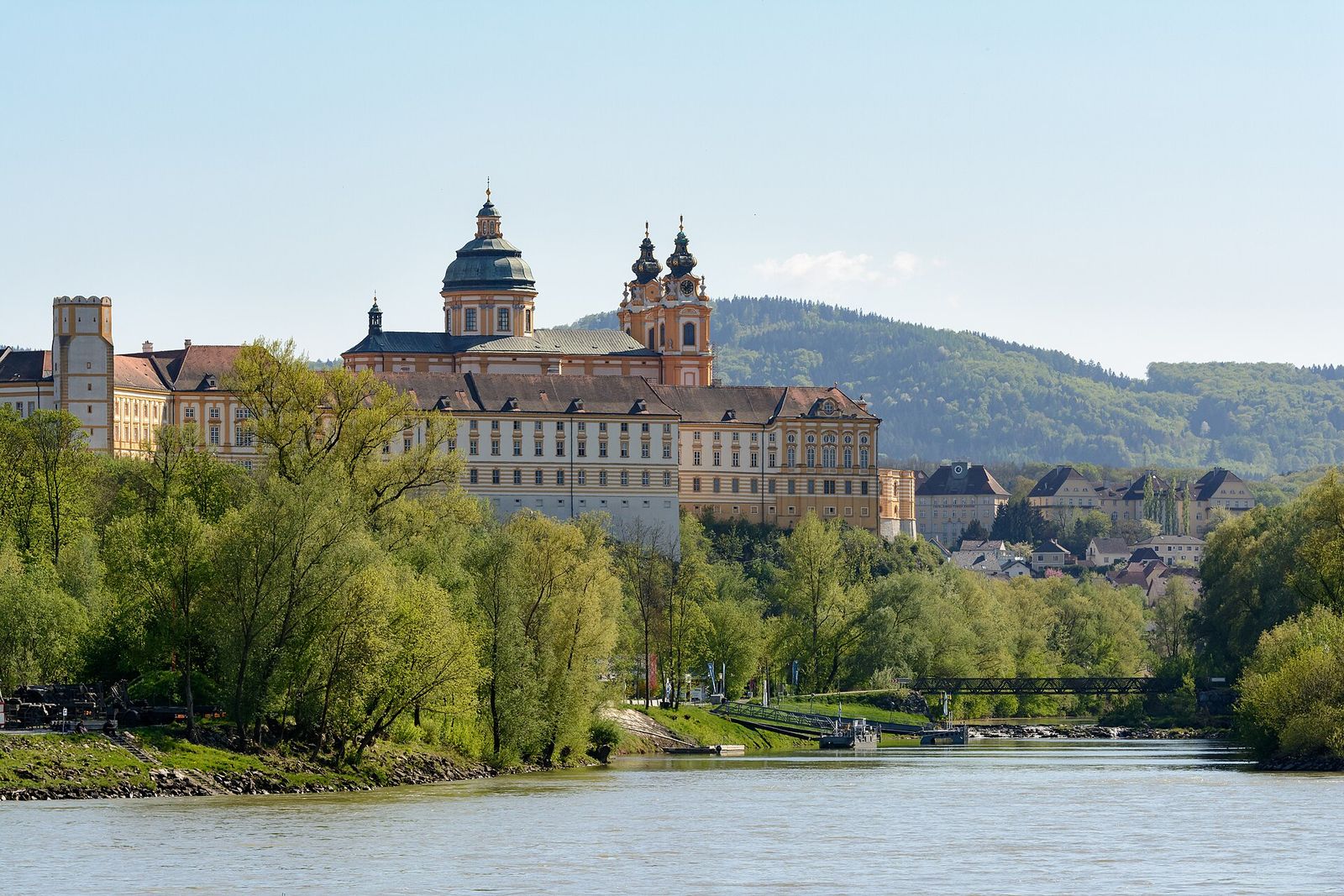
Melk Abbey dominates the western end. A Benedictine community has lived here since the 11th century, and the present abbey, rebuilt in the early 18th century to designs by Jakob Prandtauer, is one of the great works of Austrian baroque. Highlights include the library, the marble hall and the richly gilded abbey church. Visits are self-guided or by guided tour depending on the season; check the official site.
Further downstream: - Dürnstein, with its blue-and-white baroque abbey tower by the river and the ruins of the castle where Richard the Lionheart was held prisoner in 1192–93. - Spitz and Weißenkirchen, wine villages known for Grüner Veltliner and Riesling. - Krems, a historic town at the eastern end, with Göttweig Abbey on the hill across the river.
Getting there: trains run to Melk and to Krems in about an hour or a little more. A classic loop is train to Melk, boat downstream to Dürnstein or Krems, and train back. River boats run roughly from spring to autumn; check the timetable. The flat Danube cycle path is another popular way to see the valley, with bikes available for hire in the main towns.
How long to allow: a full day.
Baden bei Wien: a spa town in the vineyards
Baden, just south of Vienna, has warm sulphur springs that have been used since Roman times. The Habsburg court spent summers here, and the town is full of Biedermeier villas and neoclassical buildings. In 2021 it became part of the UNESCO site The Great Spa Towns of Europe.
Walk through the Kurpark on the slopes above the centre, visit the rose garden in Doblhoffpark in early summer, and look for the Beethovenhaus, where Beethoven stayed while working on his Ninth Symphony. Thermal baths are open to visitors.
Getting there: about 30 minutes by regional train, or longer by the local tram-train that runs from near the State Opera.
How long to allow: half a day, or a full day combined with the Vienna Woods.
The Vienna Woods: Heiligenkreuz and Mayerling
The forested hills of the Wienerwald begin on the edge of the city. Heiligenkreuz Abbey, founded in 1133, is one of the oldest Cistercian monasteries in the world still in use, with a Romanesque nave and a Gothic cloister. The monks' sung prayer is part of daily life there, and visitors are welcome at services as well as on guided tours.
Nearby Mayerling is where Crown Prince Rudolf and Mary Vetsera died in 1889. The former hunting lodge was turned into a Carmelite convent, with a small exhibition about the events.
Getting there: by train to Baden, then a local bus; services are less frequent at weekends, so check the timetable. Organised tours and a car make this combination easier.
How long to allow: half a day to a full day.
Lake Neusiedl and Carnuntum
Lake Neusiedl (Neusiedler See), to the south-east, is a shallow steppe lake shared with Hungary and fringed by a wide belt of reeds. The cross-border landscape is a UNESCO World Heritage Site. The wine village of Rust is known for the storks that nest on its chimneys in spring and summer. The flat cycle routes and the national park are good for birdwatching. Trains reach Neusiedl am See in about an hour.
Carnuntum, east of Vienna on the Danube, was a major Roman city and military camp. The archaeological park has reconstructed Roman houses and baths built using ancient techniques, an amphitheatre and the Heidentor, a ruined triumphal monument. It's about an hour by train. The park is seasonal, so check opening times before you go.
The Semmering Railway
Completed in 1854, the Semmering Railway was one of the first true mountain railways, climbing through tunnels and over stone viaducts into the Alps. It became a UNESCO World Heritage Site in 1998. Take a regional train along the line, then walk one of the trails that follow the railway between viewpoints. Allow a full day.
Longer trips: Salzburg, Graz and Budapest
Salzburg and Graz are each roughly two and a half hours away by fast train, and Budapest a little more. All three are possible as a long day, but they deserve a night. If you're heading to Budapest, our 3-day Budapest itinerary and guide to where to stay in Budapest will help. Salzburg also features in our day trips from Munich.
Practical tips for day trips
- Buy a ticket for the whole journey. Vienna's city tickets cover the city only, so trips beyond the city boundary need a ticket to your destination. Regional day tickets and combined tickets that include entry to sights are sometimes offered; check the current options.
- Check which station you leave from. Trips start from different stations, so look at the departure station when you plan.
- Start early in summer and at weekends, when Melk, Dürnstein and the river boats are busiest.
- Check seasonal schedules. River boats, Carnuntum and some abbey tours run a reduced programme or close outside the main season.
- Bring your ID for Bratislava and anything else across a border.
- Plan your city days around the trips. Our 3-day Vienna itinerary covers the essentials, and our guide to where to stay in Vienna compares neighbourhoods; a base near the Hauptbahnhof or a U-Bahn line to it saves time each morning.
Choose the Wachau for scenery and baroque grandeur, Bratislava for a second city, and Baden or the Vienna Woods for an easy, unhurried day.
Bloiq is reader-supported. Some links may earn us a commission; it never affects what we write. How we make money.
Cover photo: Uoaei1, CC BY-SA 4.0, via Wikimedia Commons