Home / Travel / Germany · Day trips
Day trips from Munich: Neuschwanstein, Salzburg, the Zugspitze and lakes
How to reach Neuschwanstein, Salzburg, the Zugspitze, the Bavarian lakes and the Dachau memorial from Munich, what to see in each and how long to allow.
Munich sits within sight of the Alps, and its rail network fans out to mountain villages, clear lakes, royal palaces and, across the border, one of Austria's loveliest baroque cities. Almost every classic trip works by train, so a car is optional. The hard part is choosing, and knowing which trips need tickets booked ahead. Here's how the main options compare.
The quick comparison
Travel times are rough guides from Munich Hauptbahnhof and don't include waiting for connections.
| Trip | Typical travel time | Best for |
|---|---|---|
| Neuschwanstein and Füssen | About 2 hours, plus a short bus ride | Fairy-tale castles, Alpine foothills |
| Salzburg | 1.5–2 hours | Baroque old town, Mozart, a hilltop fortress |
| Zugspitze and Garmisch-Partenkirchen | About 1.5 hours, plus a mountain railway or cable car | High-mountain views |
| Starnberger See and Ammersee | 30–50 minutes by S-Bahn | Easy half days, lakeside walks, a monastery |
| Tegernsee | About 1 hour | Lake and mountain scenery |
| Chiemsee and Herrenchiemsee | About 1 hour, plus a boat | A royal palace on an island |
| Dachau Memorial Site | 30–45 minutes by S-Bahn and bus | History and remembrance |
| Nuremberg, Regensburg or Augsburg | 30 minutes to 1.5 hours | Historic cities |
Neuschwanstein and Hohenschwangau
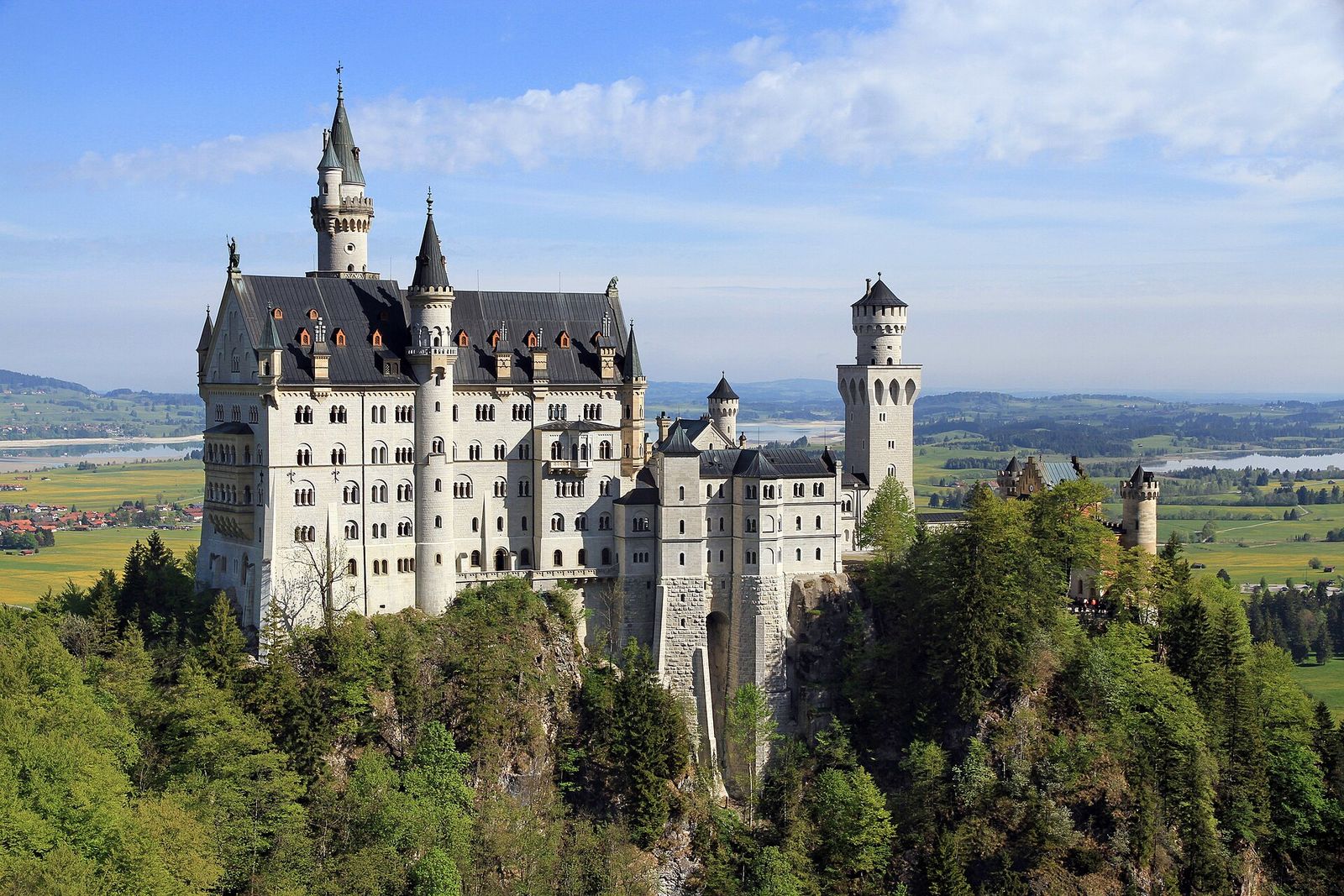
Neuschwanstein, the turreted castle that King Ludwig II began building in 1869, is the most famous sight in Bavaria. Ludwig died in 1886 with the work unfinished, and only part of the interior was ever completed. In 2025 the castle was added to the UNESCO World Heritage List together with his other palaces at Linderhof and Herrenchiemsee and his mountain lodge on the Schachen.
Getting there: take the train to Füssen, then a local bus to the village of Hohenschwangau, below the castle. From there it's a steep walk of roughly 30–40 minutes up to Neuschwanstein; horse-drawn carriages and a shuttle bus cover part of the way when they're running.
What to know: the interior can only be seen on a guided tour with a timed entry, and tickets for busy days sell out, so book on the official ticket site well ahead. The Marienbrücke, the footbridge over the Pöllat Gorge with the classic view of the castle, can close in winter or for maintenance.
Also see: Hohenschwangau Castle, the yellow castle where Ludwig spent much of his childhood (also visited by guided tour); the Alpsee lake beside it; and the old town of Füssen.
How long to allow: a full day. Organised coach tours are an alternative if you'd rather not manage the connections.
Salzburg: Mozart and the baroque
Salzburg, just across the Austrian border, has a baroque old town that is a UNESCO World Heritage Site. Walk from the cathedral and its grand squares along Getreidegasse, where Mozart was born, then climb or take the funicular up to the Hohensalzburg Fortress for views over the rooftops and the mountains. Across the Salzach river, the Mirabell Gardens will be familiar to fans of The Sound of Music, and themed tours visit other film locations.
What to know: you're crossing an international border. Both countries are in the Schengen area, but carry your passport or national ID card. The old town is roughly a 20-minute walk or a short bus ride from the station. The summer festival makes the city very busy in July and August.
How long to allow: a full day.
The Zugspitze and Garmisch-Partenkirchen
At 2,962 m (9,718 ft), the Zugspitze is Germany's highest mountain, and its summit sits right on the border with Austria. From Garmisch-Partenkirchen, a cogwheel railway climbs through a tunnel to the glacier plateau below the summit, where a short cable car finishes the climb. Alternatively, a cable car rises from the shore of the Eibsee lake straight to the top. Many visitors go up one way and come down the other.
What to know: the summit is often in cloud. Check the official webcams and the forecast on the morning you go, and take warm layers in any season, as it's cold and can be icy. Combined tickets covering the train from Munich and the mountain are sometimes offered; check the current options.
Also see: the painted houses of Garmisch-Partenkirchen, and the Partnach Gorge, a narrow ravine with a path cut into the rock, reached on foot from the Olympic ski stadium. The gorge path can close after heavy rain or in icy conditions.
How long to allow: a full day, starting early.
Lakes close to the city
- Starnberger See: the S-Bahn reaches Starnberg in about half an hour. Walk the lakeside promenade or take a boat. On the eastern shore at Berg, a cross standing in the water marks the spot where Ludwig II was found dead in 1886.
- Ammersee: take the S-Bahn to Herrsching, about 50 minutes, then walk up the wooded Kiental valley, roughly an hour, to Andechs Abbey, a Benedictine monastery on a hill with a pilgrimage church and a long brewing tradition.
- Tegernsee: about an hour by regional train. The lake is ringed by mountains, with boat trips and a cable car up the Wallberg for wide views.
- Chiemsee: the largest lake entirely within Bavaria, about an hour away at Prien. Boats cross to the Herreninsel, where Ludwig's New Palace of Herrenchiemsee was modelled on Versailles, complete with its own Hall of Mirrors, and to the Fraueninsel, a small island with a Benedictine convent and a fishing village. Allow a full day.
Lake boats run a reduced timetable outside summer, so check the schedule before you set off.
Dachau Concentration Camp Memorial Site
Dachau was one of the first concentration camps, opened by the Nazi regime in 1933. More than 200,000 people from across Europe were imprisoned here and in its subcamps, and tens of thousands died. The memorial site preserves the roll-call square, reconstructed barracks and the former maintenance building, which houses the main exhibition.
Getting there: the S-Bahn to Dachau, then a local bus to the memorial. Guided tours and audio guides are available; check the official site for times.
What to know: most visitors find it a sobering experience, and the memorial advises that it isn't suitable for younger children. Behave as you would at any place of remembrance.
How long to allow: half a day.
Historic cities by fast train
- Nuremberg (about an hour): a walled medieval city with an imperial castle, Gothic churches and the house of the painter Albrecht Dürer. For 20th-century history, there's a documentation centre at the former Nazi Party Rally Grounds and the courtroom of the Nuremberg trials. Its Christmas market is one of Germany's most famous.
- Regensburg (about 1.5 hours): a UNESCO-listed old town on the Danube, with a 12th-century stone bridge and a Gothic cathedral.
- Augsburg (30–45 minutes): founded by the Romans, with a grand Renaissance town hall and the Fuggerei, a social housing settlement from the early 16th century that is still lived in today.
Practical tips for day trips
- Look at regional day tickets. Bavaria's regional day ticket covers regional trains and many local buses across the state, including the lines to Füssen, Garmisch and the lakes, and it becomes better value the more people share it. It isn't valid on long-distance fast trains, and on weekdays it usually can't be used before mid-morning. Check the current conditions, including whether it covers your journey to Salzburg.
- Book timed tickets ahead for Neuschwanstein and Hohenschwangau, and for the palace tours at Herrenchiemsee in summer.
- Find your platform early. Some regional trains leave from the side wings of the Hauptbahnhof, several minutes' walk from the main hall, and the station is in the middle of a long rebuilding project.
- Start early on weekends and in summer. Trains to Füssen, Garmisch and the lakes fill up, and the castle tours and mountain lifts get busier as the day goes on.
- Check seasonal schedules. Some mountain lifts close for maintenance for a few weeks in spring and autumn, and lake boats and some buses run less often in winter.
- Choose a base near the trains. Staying close to the Hauptbahnhof or an S-Bahn station saves time every morning. Our guide to where to stay in Munich compares the main neighbourhoods.
Pick Neuschwanstein or the Zugspitze for the big Alpine day, Salzburg for a city with a different character, and the lakes when you want something gentle and close.
Bloiq is reader-supported. Some links may earn us a commission; it never affects what we write. How we make money.
Cover photo: Ximonic, Simo Räsänen (post-processing) & Tauno Räsänen (photograph), CC BY-SA 3.0, via Wikimedia Commons