Home / Travel / Italy · Day trips
Day trips from Rome by train and bus: Tivoli, Ostia, Orvieto and more
The best day trips from Rome compared by travel time: Tivoli's villas, Ostia Antica, hilltop Orvieto, the Castelli Romani, Etruscan tombs and Pompeii.
This guide contains affiliate links, marked as such. If you book through them, Bloiq may earn a commission at no extra cost to you.
Rome could fill any trip on its own, but a day outside the city shows a different side of Italy: Renaissance gardens, an ancient port town, hilltop cathedrals and Etruscan tombs, most of them an hour or less away by public transport. You don't need a car for any of the trips below. This guide compares the main options by travel time and interest, explains how to get to each one and how long to allow.
The quick comparison
- Ostia Antica: about 30 minutes by suburban train. Best for Roman ruins without the Forum's crowds. Half a day.
- Tivoli: about an hour by train or bus. Best for Villa d'Este's fountains and Hadrian's Villa. A full day.
- Orvieto: about 1 to 1.5 hours by train. Best for a hill town, a great cathedral and underground caves. A full day.
- Castelli Romani: 30–45 minutes by regional train. Best for lake views, wine and a slow lunch. Half a day to a full day.
- Cerveteri or Tarquinia: about an hour by bus or 1 to 1.5 hours by train. Best for Etruscan tombs. A full day for one of them.
- Pompeii (via Naples): a long day, with a high-speed train and a local line. Best for the most famous Roman site of all.
Ostia Antica: Rome's ancient port
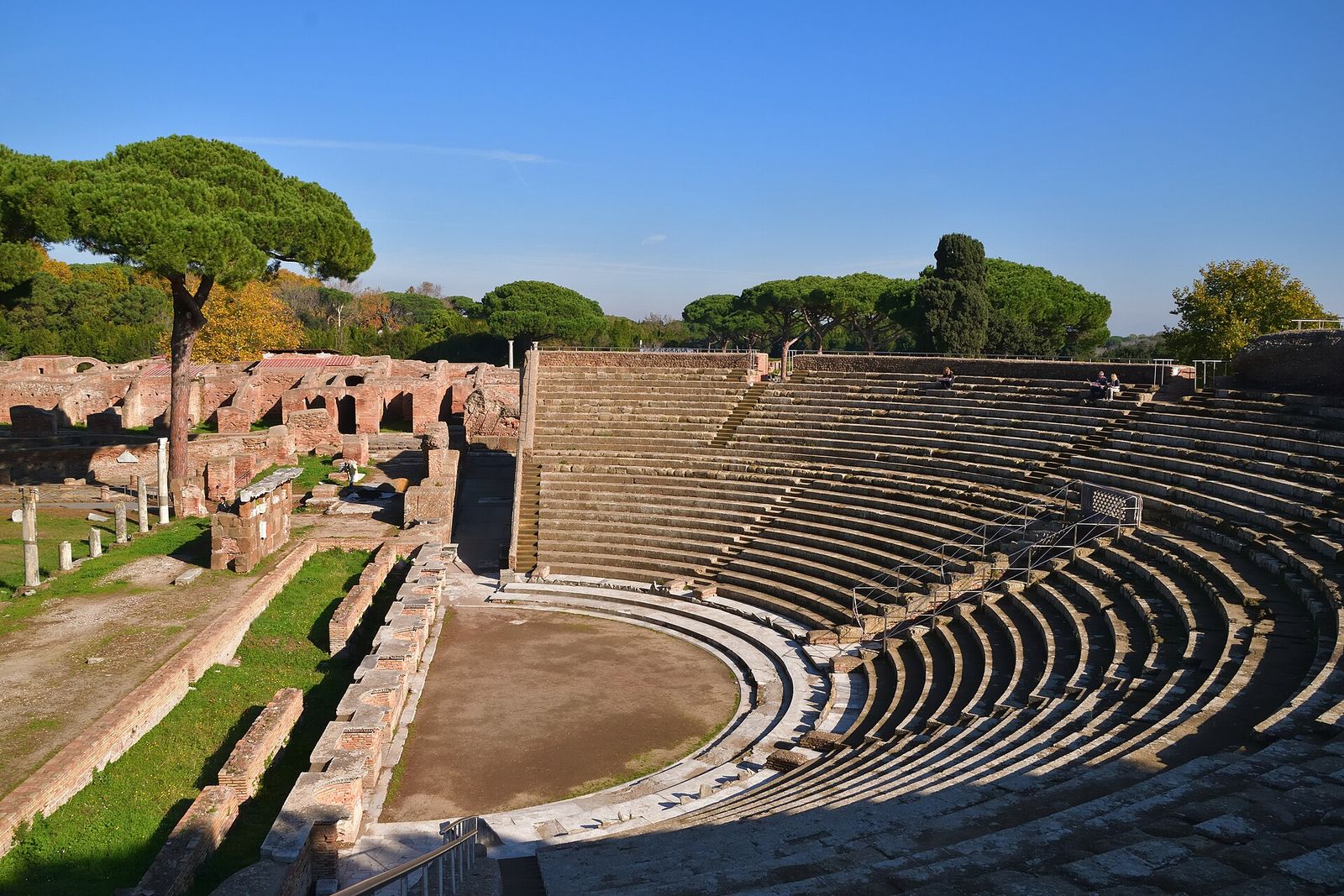
Ostia was the harbour city of ancient Rome at the mouth of the Tiber. As its harbours silted up and trade declined, it was gradually abandoned, and its streets, houses and warehouses survive in a quiet, pine-shaded setting.
Getting there: the Roma–Lido suburban line leaves from Porta San Paolo station, next to Piramide on metro line B, and reaches Ostia Antica in about 30 minutes. The line is part of Rome's urban transport network, so a standard city ticket usually covers it. From the station, a footbridge and a short walk lead to the entrance.
What to see: the main street, the Decumanus Maximus; the theatre; the Square of the Guilds, lined with mosaics that advertised shipping businesses; bath complexes; multi-storey apartment blocks; and an ancient bar with its serving counter.
How long: half a day. The site is usually closed on Mondays. The small medieval village nearby has a Renaissance castle, and the same train line continues to the beaches at Ostia Lido.
Tivoli: Villa d'Este and Hadrian's Villa
The hill town of Tivoli, about 30 km east of Rome, has two UNESCO World Heritage Sites. Villa d'Este is a 16th-century cardinal's villa whose terraced garden is famous for its fountains, including the Avenue of the Hundred Fountains and a water-powered organ. Hadrian's Villa (Villa Adriana), on the plain below the town, is the sprawling 2nd-century retreat of the emperor Hadrian, with pools, baths, theatres and the colonnaded Canopus.
Getting there: regional trains from Roma Tiburtina take roughly 45 to 75 minutes; the old town is a 20–25 minute walk from Tivoli station. Blue Cotral regional buses leave from Ponte Mammolo on metro line B and take about an hour, depending on traffic. A local bus links the town with Hadrian's Villa, a few kilometres away.
How long: a full day for both. Hadrian's Villa is vast and has little shade, so go early, then spend the afternoon in the cooler gardens of Villa d'Este. The two sites keep different opening hours, so check both before you go. Villa Gregoriana, a wooded park around a waterfall and gorge in the town, is a quieter extra.
Orvieto: a cathedral on a cliff
Orvieto, just across the border in Umbria, sits on top of a sheer cliff of volcanic tuff. Its Gothic cathedral is one of the finest in Italy, with a striped stone exterior and a façade glittering with mosaics.
Getting there: regional and intercity trains on the Rome–Florence line take about 1 to 1.5 hours from Termini or Tiburtina. A funicular climbs from the station to the edge of the old town in a few minutes.
What to see: - The cathedral: the façade, and inside, the Chapel of San Brizio with Luca Signorelli's frescoes of the Last Judgement. - St Patrick's Well: a deep 16th-century well with two spiral staircases that never meet, one for going down and one for coming up. - Underground Orvieto: guided tours of the caves, cellars and tunnels carved into the rock beneath the town.
How long: a full day, with lunch and a glass of the local white wine. Civita di Bagnoregio, the village on an eroding outcrop reached by a footbridge, is nearby but awkward by public transport, as buses from Orvieto are infrequent. Check timetables, or save it for a trip with a car.
Castelli Romani: lakes and wine towns
The Alban Hills, south-east of Rome, are dotted with small towns known as the Castelli Romani, long a weekend escape for Romans.
- Frascati: about 30 minutes by regional train from Termini, with views back over Rome, grand villas and its own white wine.
- Castel Gandolfo: on the rim of the volcanic crater lake of Lake Albano. The papal palace and gardens have opened to visitors as a museum, but the palace is once again used as a papal summer residence, so check the current arrangements.
- Ariccia: known for porchetta, slow-roasted pork, served in rustic taverns.
How long: half a day for one town, a full day for two. The towns are on different branch lines, so connecting them usually means a local bus.
Etruscan tombs: Cerveteri and Tarquinia
Before Rome rose, the Etruscans dominated this region. Their necropolises at Cerveteri and Tarquinia together form a UNESCO World Heritage Site.
- Cerveteri: the Banditaccia necropolis is a city of the dead, with grassy burial mounds and tombs carved to look like houses. Cotral buses from near Cornelia on metro line A take about an hour, and the necropolis is a walk of a couple of kilometres beyond the town centre.
- Tarquinia: famous for its painted tombs, with scenes of banquets, dancing and games, and a fine archaeological museum in the old town. Regional trains along the coast take roughly 1 to 1.5 hours; the station is below the town, connected by a local bus.
How long: a full day for one. Doing both without a car is a very long day.
Pompeii, Florence and other long days
- Pompeii: high-speed trains reach Naples in roughly an hour and a quarter, and a local line from Naples takes about 35–40 minutes more to the ruins. Pompeii has introduced named tickets and a daily visitor limit, with time slots in busy months, so book ahead on the official site and allow at least three to four hours there. Smaller Herculaneum, on the same local line, is quicker to see. With more time, the Amalfi Coast road trip makes a better base than Rome.
- Florence: high-speed trains take about 1.5 hours, so a day trip is possible, but Florence deserves a night or two. See where to stay in Florence, or our Tuscany hill towns road trip.
- Lake Bracciano: a little over an hour by regional train, with a hilltop castle and, in summer, swimming from lakeside beaches.
Practical tips for day trips from Rome
- Know your ticket type. Regional train tickets aren't tied to a specific train. If you buy a paper one, validate it in the machine before boarding; check the rules for digital tickets. High-speed seats are reserved, and booking ahead is wise.
- Check for strikes. Italian transport strikes are announced in advance, so look at the news and operators' sites the day before.
- Mind weekly closures and free days. Ostia Antica usually closes on Mondays. Some state sites offer free entry on the first Sunday of the month, which makes them much busier. Check the official sites before you go.
- Start early in summer. Archaeological sites are hot and exposed. Bring water, a hat and good shoes.
- Expect fewer buses on Sundays and holidays, and check the last return times.
- Choose a base near the right station. Termini serves most trains and Tiburtina many others. Our guide to where to stay in Rome compares the areas, and our three-day Rome itinerary shows how to fit a day trip into a longer stay.
Bloiq is reader-supported. Some links may earn us a commission; it never affects what we write. How we make money.
Cover photo: Rabax63, CC BY-SA 4.0, via Wikimedia Commons
.jpg)