Tool storage explained: rolling chests, cabinets and modular systems
How to choose tool storage: rolling cabinets and top chests, wall systems and stackable cases, plus what drawer slides, steel gauge and load ratings mean.
A tool collection grows faster than the space to keep it in, and a pile of loose sockets and cordless tools soon costs you time and money. The right storage depends on how many tools you own, where you use them and whether they need to travel. This guide explains the main types of tool storage, what the specifications on drawer slides, steel and casters mean, and how to avoid the common mistakes.
The main types of tool storage
| Type | Best for | Strengths | Watch out for |
|---|---|---|---|
| Rolling cabinet (bottom box) | Garages and workshops | Large capacity, moves to the job | Heavy when full; needs a level floor |
| Top chest | Adding drawers above a cabinet | Shallow drawers for hand tools | Must be secured to the cabinet below |
| Wall cabinets, pegboard and slatwall | Small garages, frequently used tools | Frees floor space; tools visible | Wall must carry the load |
| Modular stackable cases | Tradespeople, job sites, car boots | Portable; mix and match modules | Usually tied to one system's fittings |
| Tool bags and totes | Small kits, quick jobs | Light and cheap | Tools jumble together |
Many people end up with a mix: a rolling cabinet for hand tools, wall storage for long or awkward items, and a few portable cases for the kit that leaves the house.
Rolling cabinets and top chests
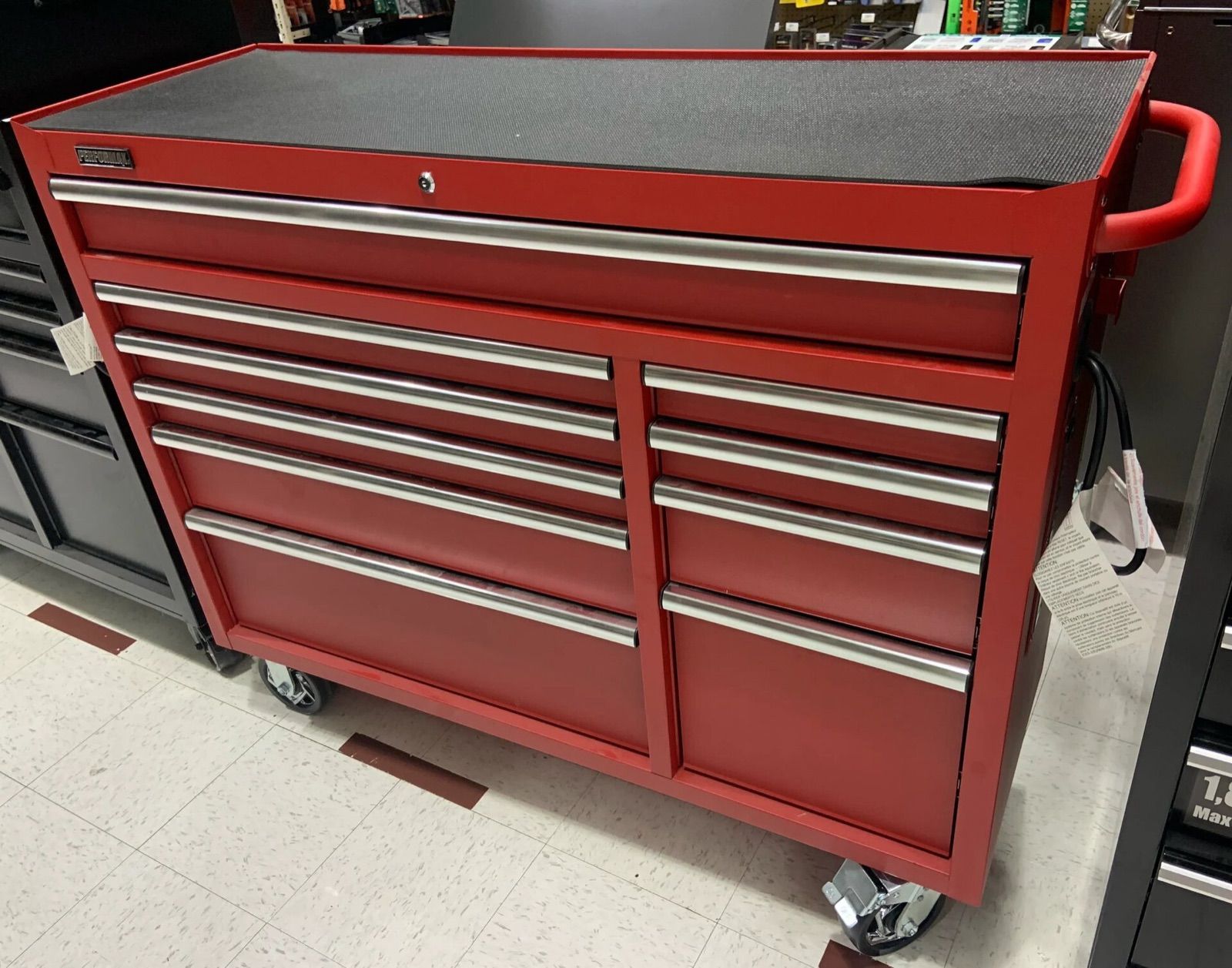
A rolling cabinet is a steel box of drawers on casters, often with a work surface on top. A top chest sits on it, adding shallow drawers and sometimes a lid compartment. Together they are the classic mechanic's set-up.
Widths vary widely, commonly from about 66 cm (26 in) for compact units to 1.4 m (56 in) or more for full workshop cabinets. Before choosing a size, measure the space, including room to open drawers fully and to walk past when they are open.
Think about the mix of drawers:
- Shallow drawers suit sockets, spanners (wrenches), screwdrivers and pliers laid flat, so you can see everything at a glance.
- Deep drawers hold cordless tools, grinders, battery chargers and bulky items.
- Full-width drawers take long tools such as breaker bars and pry bars.
If you already own a lot of hand tools, lay them out and measure before buying. It's the only reliable way to know how many shallow drawers you'll fill.
Drawer slides and load ratings
The drawer slide is where cheap and good storage differ most.
- Friction slides, where a drawer runs on plain metal or plastic rails, are found on budget boxes. They stiffen and sag under weight.
- Ball-bearing slides run smoothly under load and usually extend further. Most quality cabinets use them.
- Full-extension slides let the drawer open all the way, so you can reach the back.
- Soft-close mechanisms stop drawers slamming shut, which is kinder to the contents.
Manufacturers usually quote a load rating per drawer, often somewhere from about 45 kg (100 lb) to more than 90 kg (200 lb) on heavier units. Socket sets and spanners are denser than they look, so a generous rating is worth having for the drawers you'll load most.
Also check the total cabinet capacity and the caster rating. Four casters that together carry less than the loaded cabinet will fail, often at the worst moment.
Steel, casters and locks
Steel thickness is often given as a gauge, where a lower number means thicker steel. Lighter hobby boxes are commonly made from thinner sheet, while heavier cabinets use thicker steel for the frame and drawer fronts. Thicker steel resists dents and flexing under load, but adds weight and cost.
Look closely at the casters:
- Larger wheels, often 100–150 mm (4–6 in) on workshop cabinets, roll more easily over cracks and cords.
- Two locking swivel casters and two fixed ones is a common arrangement; some cabinets lock all four.
- Polyurethane or rubber treads are quieter and gentler on floors than hard plastic.
Most cabinets have a central lock that secures all drawers at once. It deters casual access and keeps drawers from sliding open when you move the cabinet, but it isn't high security. Keep the key somewhere you'll find it.
Preventing tip-overs
A loaded tool cabinet is extremely heavy, and opening several full drawers at once can shift the centre of gravity far enough to tip it forward. Standard advice:
- Load the heaviest items in the bottom drawers and the lightest at the top.
- Open one drawer at a time. Some cabinets have an interlock that allows only one drawer open at a time.
- Bolt the top chest to the cabinet using the brackets or holes provided.
- Anchor tall or narrow cabinets to the wall, especially where children might climb on them.
- Lock the casters before you open drawers, and keep cabinets on a level floor.
Move a full cabinet slowly, with the drawers locked, and never on a slope. On a very large unit, it's easier to empty the top chest first.
Wall storage: pegboard, slatwall and cabinets
Getting tools off the floor and bench is the cheapest way to gain space in a small garage.
- Pegboard is inexpensive and flexible, with hooks that reposition easily. Metal pegboard holds heavier items and keeps hooks from falling out.
- Slatwall panels have horizontal grooves for hooks, shelves and baskets, and handle more weight than basic pegboard.
- French cleats, strips cut at an angle and screwed to the wall, let you hang custom holders for power tools and move them around. They're a popular DIY option.
- Wall cabinets keep dust off tools and hide clutter.
Whatever you choose, fix it into studs or solid masonry with suitable fixings. The combined weight of tools on a wall adds up quickly, and plasterboard alone won't hold it.
Modular stackable systems
Several tool brands now sell modular storage systems: hard cases, organisers and drawer units that click together into a stack, often on a wheeled base. You can take one case to a job or roll the whole stack to the van.
They are convenient but come with trade-offs:
- Modules usually only connect to the same system, so you're committing to one range for future additions.
- Some cases have dust and water resistance ratings (IP codes) for site use; check the rating if you work outdoors.
- Small-parts organisers with removable bins suit screws, fixings and electrical connectors.
- Check the maximum stack height and weight the wheeled base can handle.
If your cordless tools are all from one platform, see our guide to drills and impact drivers for what to look for in the tools themselves.
Organising what goes inside
Good storage only helps if you can find things in it.
- Drawer liners stop tools sliding about and protect the drawer finish.
- Socket rails and trays keep sockets in size order; foam inserts with cut-outs show at once when something is missing.
- Label drawers by category (metric sockets, electrical, measuring tools).
- Keep batteries and chargers in a ventilated spot, not sealed inside a cramped drawer, and follow the manufacturer's charging guidance.
- Store flammable liquids such as fuel and solvents in approved containers away from ignition sources, not in a tool cabinet.
If you're setting up a full workspace, our guide to workbenches and vises covers the other half of the job.
The short version
- Measure the space, including room to open the drawers.
- Match the drawers to your tools: shallow for hand tools, deep for power tools.
- Choose ball-bearing slides and check the per-drawer and caster ratings.
- Remember lower gauge means thicker steel.
- Heavy items low, one drawer open at a time, and anchor tall units.
- Use wall storage fixed into studs or masonry to free floor space.
- Pick a modular system only if you're happy staying with one range.
Bloiq is reader-supported. Some links may earn us a commission; it never affects what we write. How we make money.