Paint sprayers explained: airless, HVLP and air-assisted compared
How airless, HVLP and air-assisted sprayers differ, what tip sizes mean, how to thin paint, and how to control overspray and stay safe while spraying.
A paint sprayer can cover a fence, a house exterior or a set of kitchen cabinets far faster than a brush or roller, and it can leave a smoother finish. But sprayers come in very different designs, and the wrong one can mean drips, a fog of overspray or hours of cleaning for a small job. This guide explains how the main types work, what the tip and nozzle numbers mean, and how to prepare, thin and spray safely.
The three main types at a glance
| Type | How it atomises paint | Best for | Trade-offs |
|---|---|---|---|
| Airless | Pumps paint at very high pressure through a tiny tip | Walls, ceilings, exteriors, fences, decks | Most overspray; big cleanup; injection hazard |
| HVLP | Large volume of low-pressure air breaks up the paint | Furniture, cabinets, doors, trim | Slower; thick paints usually need thinning |
| Air-assisted airless | Lower fluid pressure plus a little air at the tip | Fine finishes on large jobs | Expensive; needs a compressor; mostly professional |
Small handheld electric sprayers also exist, using either a turbine (HVLP style) or a small airless pump. They suit occasional small jobs but are slower and less refined than full-size units.
Airless sprayers
An airless sprayer uses a pump to push paint through a small tip at high pressure, commonly in the range of about 1,500 to 3,000 psi. The paint breaks into a fan-shaped spray as it leaves the tip.
Strengths: speed, and the ability to spray thick coatings such as wall paint, primers and many exterior paints, often without thinning. Larger units draw straight from the paint can or a bucket through a suction tube.
Drawbacks: heavy overspray, so thorough masking is essential, and a lot of paint left in the pump, hose and filters to clean out. For a single small room, a roller is often quicker once you count setup and cleaning.
When comparing airless models, look at:
- Maximum tip size the pump supports; bigger tips need more flow.
- Flow rate (litres or gallons per minute), which governs how fast you can work.
- Hose length and whether you can add more.
- Pressure control, so you can turn it down for finer work.
What airless tip numbers mean
Airless tips are usually marked with a three-digit code, such as 515 or 517. Under the convention most manufacturers use:
Tip codes: double the first digit for the approximate fan width in inches at about 12 in (30 cm) from the surface; the last two digits are the orifice size in thousandths of an inch. A 517 tip gives roughly a 10 in fan with a 0.017 in orifice.
- Smaller orifices suit thinner coatings such as stains and enamels.
- Larger orifices suit thicker paints such as wall emulsion (latex) and primers.
- Narrower fans give more control on trim and spindles; wider fans cover walls faster.
Tips wear, and a worn tip gives a smaller fan with heavy edges ("tails"). Check the paint manufacturer's recommended tip range on the tin or technical data sheet.
HVLP sprayers
HVLP stands for high volume, low pressure. A large volume of air at low pressure atomises the paint, so more of it lands on the surface and less drifts away as overspray. That makes HVLP the usual choice for furniture, cabinets, doors and detailed work where the finish matters.
There are two kinds:
- Turbine HVLP systems have their own blower. Turbines are often described by stages; more stages generally mean more pressure and better atomisation of thicker coatings.
- Compressor-fed HVLP guns run from an air compressor, which must supply enough air volume (CFM at a given pressure) for the gun.
Guns are fitted with a needle and nozzle set sized in millimetres. Smaller sets suit thin finishes such as lacquers and stains; larger sets suit primers and thicker paints. Check which sizes the gun accepts and which the manufacturer recommends for your coating.
HVLP is slower than airless and less suited to large exterior walls. Thick water-based wall paints usually need thinning to spray well.
Air-assisted airless
Air-assisted airless combines a lower-pressure paint pump with a small amount of compressed air at the tip. The result is a finer finish than airless with less overspray, and faster work than HVLP. These systems are mainly used by professional finishers, for example on cabinetry and joinery. For most DIYers, the choice is between airless and HVLP.
Thinning and preparing paint
The paint maker's technical data sheet is the authority on whether a coating can be thinned and by how much. General practice:
- Thin water-based paints with water and solvent-based paints with the thinner the maker specifies.
- Add thinner gradually, mixing well, rather than all at once. Over-thinned paint runs and hides poorly.
- A viscosity cup lets you time how long paint takes to drain, a repeatable way to match the sprayer's recommended consistency.
- Strain the paint through a paint strainer to catch lumps that clog tips and filters.
Test on a piece of card or scrap board before spraying the real thing.
Controlling overspray and technique
Most sprayer frustration comes from overspray and uneven coats.
- Mask thoroughly: floors, windows, fixtures and anything nearby. Outdoors, move cars and cover plants.
- Avoid spraying in wind. A light breeze can carry paint mist a long way.
- Hold the gun perpendicular to the surface at a consistent distance, typically around 25–30 cm (10–12 in) for airless.
- Move your arm, not just your wrist, so the distance stays constant.
- Overlap each pass by about half.
- Start moving before you pull the trigger and release before you stop, to avoid heavy spots at the ends.
- Apply two thin coats rather than one heavy coat.
If you're preparing an exterior first, our guide to pressure washer PSI and GPM covers cleaning, and our ladder guide covers working at height.
Safety when spraying
- Airless injection injuries. An airless sprayer's pressure can inject paint through skin, a serious medical emergency even if the wound looks small. Never put your hand or body in front of the tip, keep the tip guard fitted, engage the trigger lock when not spraying, and relieve the pressure before cleaning or changing a tip. Seek emergency treatment immediately for any injection injury.
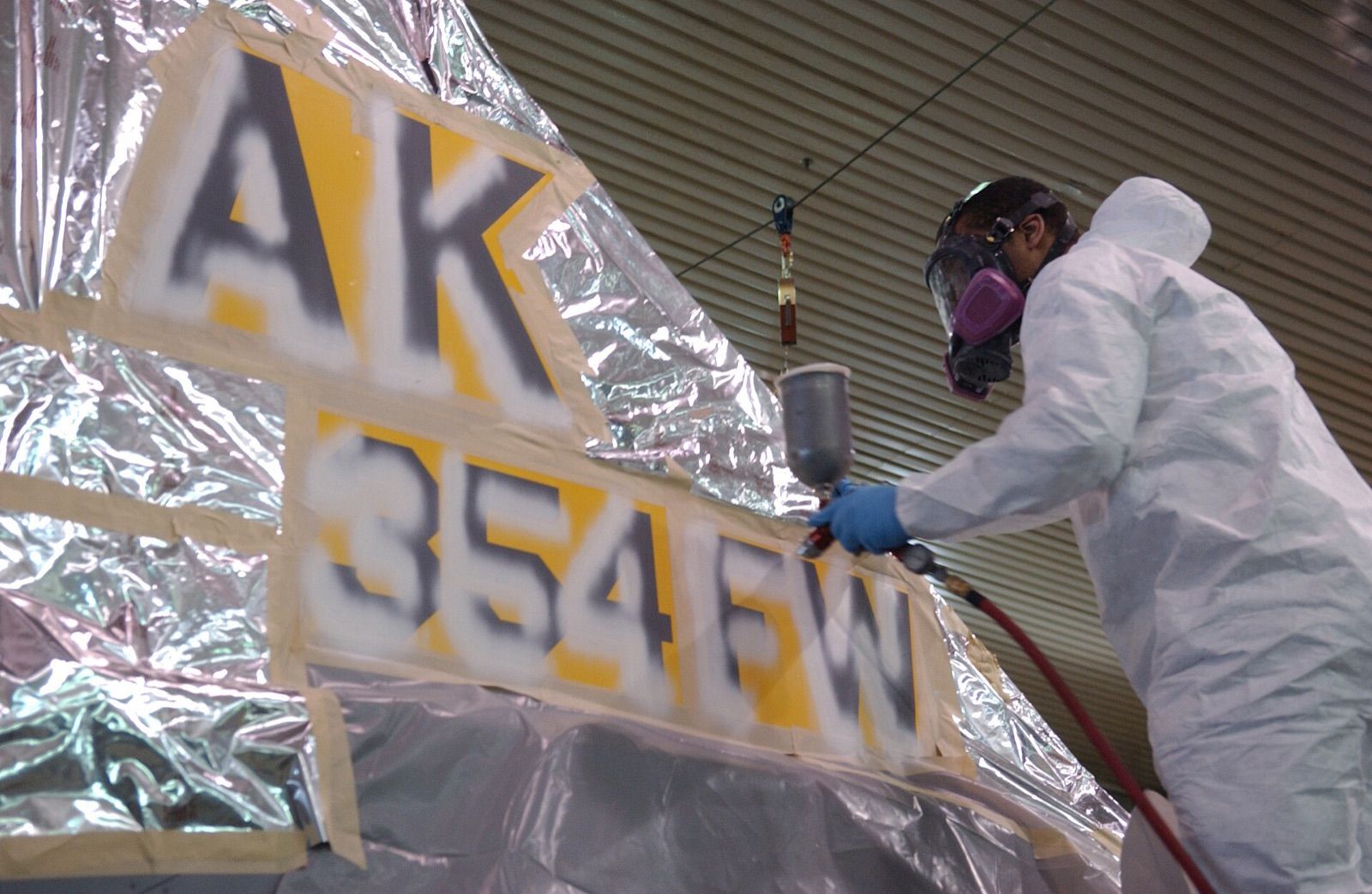
- Respiratory protection. Paint mist is easy to inhale. Wear a suitable respirator; solvent-based coatings call for organic vapour cartridges as well as particulate filters. Ventilate well.
- Fire. Solvent-based paint vapour is flammable. Keep away from pilot lights, heaters and sparks, and follow the manufacturer's grounding instructions.
- Eye protection and gloves are sensible for all spraying and cleanup.
The short version
- Airless for large areas and thick paints; HVLP for furniture and fine finishes.
- Read tip codes: first digit doubled is fan width, last two digits are orifice size.
- Check the paint's data sheet for thinning and tip recommendations.
- Strain paint and test before spraying.
- Mask everything and avoid wind.
- Never point an airless gun at skin; relieve pressure before cleaning.
- Wear a respirator and ventilate.
Bloiq is reader-supported. Some links may earn us a commission; it never affects what we write. How we make money.
Cover photo: Airman 1st Class Jonathan Snyder, U.S. Air Force, Public domain, via Wikimedia Commons