Paint brushes and rollers: bristles, nap lengths, trays and poles
Natural or synthetic bristles, which roller nap suits your wall, trays versus scuttles, and how extension poles help: a practical guide to painting tools.
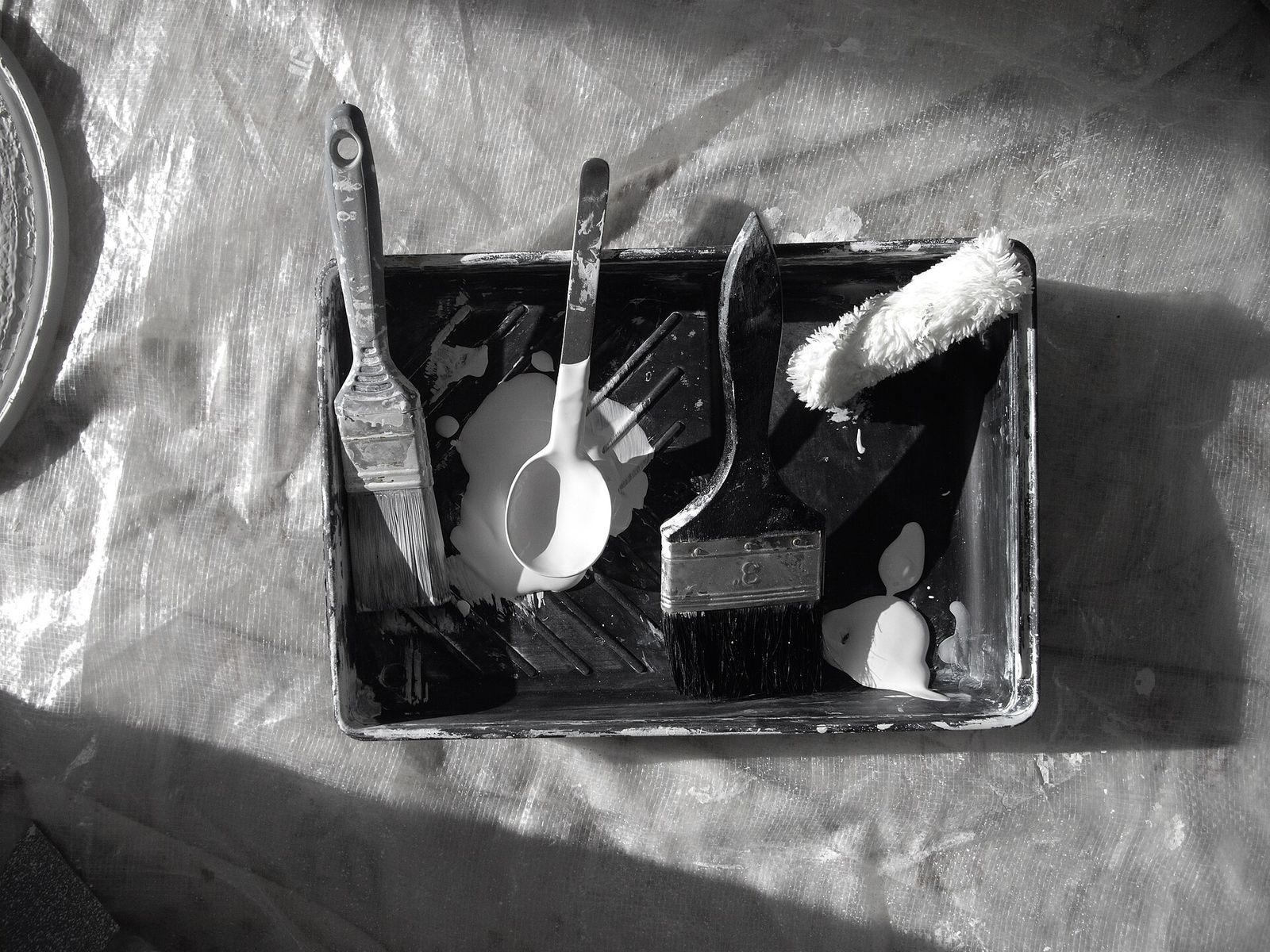
Good paint can look streaky, patchy or furry if it goes on with the wrong tool. The brush and roller you choose decide how much paint reaches the wall, how smooth the finish is and how quickly the job goes. This guide explains bristle types and brush shapes, what roller nap lengths are for, and which trays, scuttles and extension poles make painting walls and ceilings easier.
Natural or synthetic bristles
The first question is what kind of paint you're using.
| Natural bristle | Synthetic (nylon, polyester, blends) | |
|---|---|---|
| Best with | Solvent-based (oil) paints, varnishes, oils, wax | Water-based paints (emulsion, latex, acrylic) |
| In water-based paint | Absorbs water, goes limp | Keeps its shape |
| Finish | Very smooth with oil-based gloss | Smooth with modern water-based paints |
| Cleaning | Solvent | Water and a little soap |
- Natural bristle, usually hog hair (sometimes called China bristle), has split tips that hold a lot of paint and lay it on smoothly. It's the traditional choice for oil-based gloss and varnish, but it swells and loses its spring in water-based paint.
- Nylon is hard-wearing and holds its shape well; polyester stays stiffer in warm weather and thick paint. Nylon-polyester blends are the usual all-round choice for water-based paint, and good synthetics also work with solvent-based paints.
- Flagged (split) tips and tapered filaments hold more paint and release it more evenly. Cheap brushes often have cut, blunt ends that leave visible brush marks.
Signs of a well-made brush: bristles that spring back when bent, a full, tapered head rather than a thin one padded out with a wide spacer block, a firmly fixed metal ferrule, and few loose bristles when you fan it gently.
Brush shapes and sizes
- Flat brushes cover larger areas such as doors, panels and fences.
- Angled sash brushes have bristles cut on a slant, which makes "cutting in" along ceilings, skirting and window frames far easier.
- Round and oval brushes hold more paint and suit spindles, pipes and mouldings.
- Fitches and artist-style brushes reach small details and tight corners.
Typical sizes: 25 mm (1 in) for narrow trim and glazing bars, 38–50 mm (1.5–2 in) for cutting in and window frames, 63–75 mm (2.5–3 in) for doors and skirting, and 100 mm (4 in) or wider for large flat surfaces such as fences and masonry.
Roller frames and covers
A roller is a frame (the handle and cage) plus a removable cover, sometimes called a sleeve. Frames come in standard widths:
- Mini rollers, 100–150 mm (4–6 in): behind radiators, small areas, cabinet doors.
- Standard, 230 mm (9 in): the usual size for walls and ceilings.
- Wide, 300–450 mm (12–18 in): faster on big, flat walls, but heavier when loaded and needing a larger tray or bucket.
Look for a sturdy cage that turns freely, an end cap that holds the cover firmly, and a threaded handle if you want to use an extension pole.
Roller nap lengths
Nap (also called pile) is the length of the fibres on the roller cover. Longer nap holds more paint and pushes it into texture; shorter nap leaves a smoother, flatter finish.
| Nap | Typical use |
|---|---|
| 4–6 mm (3/16–1/4 in) | Very smooth surfaces: doors, cabinets, metal, gloss and satin finishes |
| 9–12 mm (3/8–1/2 in) | Most interior walls and ceilings in plaster or plasterboard |
| 15–20 mm (5/8–3/4 in) | Lightly textured walls, wood siding, rough plaster |
| 25 mm (1 in) and up | Brick, block, render, stucco and other rough masonry |
Rule of thumb: the rougher the surface, the longer the nap. For a smooth wall in matt or eggshell paint, a medium nap around 9–12 mm is the safe default.
Cover materials matter too:
- Woven synthetic covers shed less lint and leave a cleaner finish than knitted ones, which hold more paint but can leave fibres in the first coat.
- Microfibre covers hold a lot of paint and give a fine finish on walls.
- Foam rollers give a very smooth finish on small, flat areas such as doors, but can leave bubbles and don't hold much paint.
- Mohair or very short-pile covers suit gloss and varnish.
Before using a new cover, wrap it with masking tape and peel it off, or rinse it, to remove loose fibres.
Trays, scuttles and buckets
- Roller trays are shallow, with a ribbed ramp for working paint evenly into the cover. Disposable liners save cleaning between colours. Choose a tray wider than your roller and with a deep well so you aren't refilling constantly.
- Scuttles are upright, bucket-like containers with a built-in grid. They hold more paint, are harder to step in or kick over, and can hang on a ladder.
- Buckets with a grid suit big jobs: hang a metal or plastic roller grid inside a large bucket and load the roller straight from it.
- Brush kettles or paint pots let you decant a small amount from the tin, so the main tin stays clean and sealed.
Extension poles
A pole that screws into the roller handle lets you paint ceilings and tall walls from the floor and gives more even pressure on walls, with less bending and fewer ladder trips.
- Fixed poles are light and rigid; telescopic poles adjust, often from around 1 m to 2 m or more, which covers most rooms.
- Check the locking mechanism: a flip lock or twist lock should hold firmly without the pole sliding as you push.
- Check thread compatibility: many roller handles share a common thread, but not all, so confirm the pole fits your frame before buying.
- A stiffer pole gives better control; a long, whippy pole is tiring to use.
For stairwells and high walls you'll still need safe access; see our guide to ladder types and safety.
When a sprayer makes more sense
Brushes and rollers suit most rooms: they waste little paint and need little masking. For whole-house exteriors, long fences, lots of doors or new-build interiors, a sprayer can be much faster, at the cost of masking and setup. See our guide to airless and HVLP paint sprayers for when that trade-off is worth it.
Technique and cleaning
- Dip only the first third of a brush in the paint and tap off the excess; overloading pushes paint into the ferrule.
- Cut in first, then roll while the cut-in edges are still wet to avoid visible bands.
- Roll in overlapping sections, roughly a square metre at a time, and keep a wet edge.
- Between coats, wrap brushes and rollers tightly in cling film or a plastic bag to keep them from drying.
- Clean water-based paint off with water; solvent-based paint needs the solvent named on the tin. Don't pour paint or solvent down drains; check your local rules for disposal.
- Spin or shake out the water, reshape the bristles and store brushes flat or hanging so they keep their shape.
The short version
- Water-based paint: synthetic brushes (nylon-polyester blends) and a synthetic roller cover.
- Oil-based gloss or varnish: natural bristle or a good synthetic, and a short-nap or foam roller.
- Most walls and ceilings: a 230 mm roller with 9–12 mm nap, a sturdy frame and a telescopic pole.
- Rough masonry: a long nap of 20–25 mm or more and a stiff, wide brush.
- Cutting in: a 38–50 mm angled sash brush.
- Before buying: check pole and handle threads, tray width for your roller, and spare covers for second coats.
Bloiq is reader-supported. Some links may earn us a commission; it never affects what we write. How we make money.
Cover photo: whereareyousimon, CC BY 2.0, via Wikimedia Commons