Kayaks and stand-up paddle boards: inflatable or hard, size and safety
How inflatable and hard kayaks and paddle boards compare, how length and width affect speed and stability, and the lifejacket, leash and cold-water basics to know.
Kayaks and stand-up paddle boards (SUPs) are among the easiest ways onto the water, and inflatable versions have made them possible for people without roof racks or garage space. The choice between them, and between the many shapes of each, comes down to where you'll paddle, how you'll transport and store the craft, and how stable you need it to be. This guide covers construction, sizing and stability, and the safety gear and habits that matter more than any spec.
Kayak or paddle board?
- Kayaks keep you seated low, which is stable and efficient, especially for longer distances, wind and choppy water. They can carry gear and, in sit-inside designs, keep you drier and warmer.
- Paddle boards give a high view and a full-body workout, are easy to step on and off, and double as a swimming platform. They catch more wind, so they're best on calm water, and they're slower for touring.
Inflatable or hard?
| Inflatable | Hard | |
|---|---|---|
| Storage and transport | Packs into a bag; no roof rack | Needs racks or a trailer and storage space |
| Performance | Good; slower and more wind-affected | Better glide, speed and tracking |
| Durability | Tough, but can be punctured | Very tough (plastic) or light and stiff (composite) |
| Set-up time | Inflating and deflating each trip | Ready to go |
| Weight | Usually lighter | Plastic is heavy; composites are lighter |
Inflatable SUPs use drop-stitch construction: thousands of threads join the top and bottom layers so the board inflates to a flat, rigid shape. They are typically inflated to around 12 to 15 PSI or more, and a board run below its recommended pressure feels soft and bends. Multi-layer or laminated constructions are stiffer and more durable than single-layer ones. A good double-action hand pump or a 12 V electric pump makes inflating much easier.
Inflatable kayaks range from simple vinyl tubes for sheltered water to drop-stitch floors and high-pressure designs that track and paddle far better. Look for multiple air chambers, so a puncture in one doesn't sink the boat.
Hard kayaks and boards come in rotomoulded polyethylene (heavy, inexpensive and very durable), thermoformed plastics (lighter, stiffer), and composites such as fibreglass or carbon (light and fast, but expensive and easier to damage on rocks). Hard SUPs are usually epoxy and fibreglass over foam, or plastic.
Types of kayak
- Sit-on-top: you sit on a moulded deck with drain holes. Easy to get back on after a fall, stable and forgiving, but you'll get wet. Popular for warm water, beaches and fishing.
- Sit-inside recreational: short (often about 2.5 to 3.7 m, or 8 to 12 ft) and wide, with a large cockpit. Stable and easy to turn; slower in a straight line.
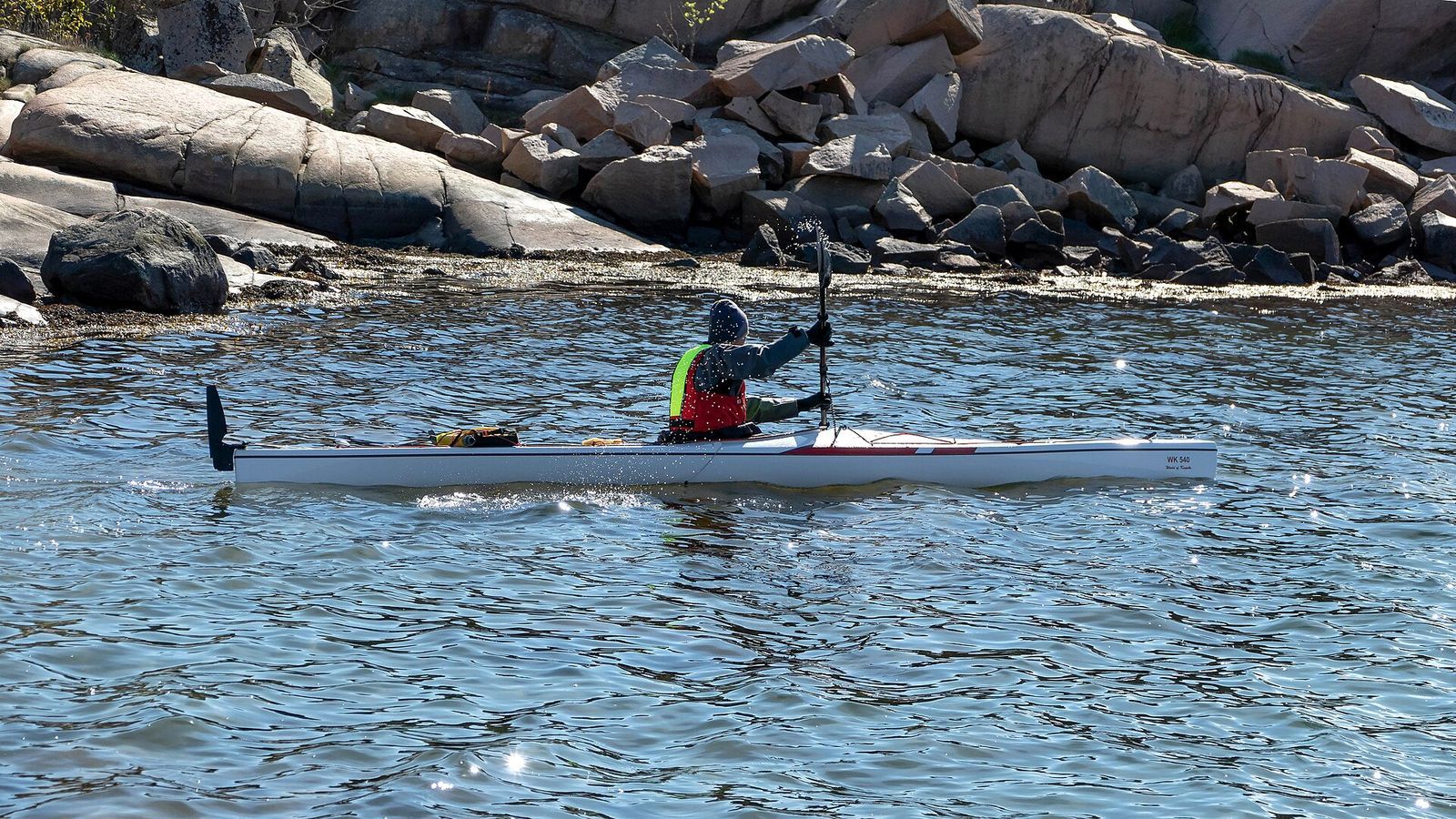
- Touring and sea kayaks: longer (often 4 m / 13 ft or more) and narrower, with sealed bulkheads, a skeg or rudder for tracking, and space for camping gear. Faster and more efficient, but less stable at rest and harder to re-enter after a capsize without practice.
- Fishing kayaks: wide, stable and often designed for standing, sometimes with pedal drives.
- Whitewater kayaks: short and highly manoeuvrable, for rivers with rapids and trained paddlers.
- Tandems: two seats; great for sharing, but both paddlers need to coordinate.
Size and stability
Length mostly affects speed and tracking: longer craft go straighter and faster for the same effort; shorter ones turn more easily. Width mostly affects stability: wider craft feel steadier when you sit or stand still, but are slower.
Kayakers talk about two kinds of stability. Primary stability is how steady a boat feels upright on flat water; wide, flat-bottomed boats have lots of it. Secondary stability is how well it resists capsizing once tilted, which matters in waves; touring kayaks often feel twitchy at first but are stable when leaned.
Paddle board sizes, as rough guides:
- All-round boards: about 3 to 3.5 m (10 to 11 ft 6 in) long and 76 to 86 cm (30 to 34 in) wide. The usual choice for beginners.
- Touring boards: longer (about 3.8 m / 12 ft 6 in or more) and narrower, for distance and speed.
- Yoga and fishing boards: extra wide for a steady platform.
- Youth boards: shorter and narrower for lighter riders.
Rule of thumb: check the recommended rider weight, not only the maximum capacity. A kayak or board loaded near its maximum sits low and handles poorly; stay well under it once you add gear, a child or a dog.
Paddle length matters too. SUP paddles are usually adjustable and set a little above head height for general paddling. Kayak paddles are chosen by the boat's width and the paddler's height; wider boats need longer paddles.
Safety gear
- Lifejacket or personal flotation device (PFD): wear one sized for you and approved for use in your country. In many countries, including Canada and the United States, kayaks and paddle boards used outside designated swimming areas are treated as vessels that must carry a lifejacket or PFD for each person, plus a sound signal such as a whistle. Wearing it, rather than just carrying it, is what saves lives. Check the current rules where you paddle.
- Leash (SUP): a coiled leash keeps the board within reach on flat water, and a board is a large flotation aid. On rivers and in current, use a leash attached to a quick-release waist belt, because an ankle leash can snag on obstacles and trap you underwater.
- Whistle, and lights if you might be out near dusk. Rules often require a light after dark.
- Kayak extras: a bilge pump, a paddle float for self-rescue in sit-inside boats, a spray deck in rough water, and a helmet for whitewater.
- Dry bag for your phone, keys and a warm layer.
Cold water and conditions
Cold water is the biggest hidden risk. A sudden fall causes a gasp reflex and rapid breathing within the first minute, and swimming ability can fade within minutes as muscles cool. Dress for the water temperature, not the air: wetsuits or drysuits in cold water, and quick-drying layers rather than cotton.
- Check the forecast, tides and currents before you go, and avoid offshore winds, which can quickly blow a kayak or board, especially an inflatable, away from shore.
- Stay close to shore when learning, and paddle with others when you can.
- Tell someone where you're going and when you'll be back.
- Practise getting back on your board or into your kayak in shallow, warm water before you need to.
- Consider a paddling or rescue course; many clubs and outfitters offer introductory sessions.
Transport and storage
- Hard craft need a roof rack with pads or kayak cradles, straps rather than bungee cords, and bow and stern lines on longer boats. Check the rack's and the car roof's load limits; our guide to roof racks and cargo boxes explains them.
- Inflatables should be rinsed and fully dried before being rolled for storage, to prevent mildew.
- Keep craft out of prolonged sun when not in use, since UV degrades plastics and PVC over time. An inflated board left in hot sun builds up pressure, so move it into shade.
For a paddling trip with an overnight stay, see our guide to camping tents.
The short version
- Calm water, fun and fitness: an all-round SUP, inflatable if storage or transport is tight.
- Distance, wind and carrying gear: a kayak; touring designs for longer trips, recreational ones for easy outings.
- Beginners: favour wider, more stable craft and stay well within the weight limits.
- Always: wear a PFD, use the right leash, dress for the water temperature, and check wind and forecast before launching.
Bloiq is reader-supported. Some links may earn us a commission; it never affects what we write. How we make money.