Garden irrigation: drip systems, soaker hoses, sprinklers and timers
How drip irrigation, soaker hoses and sprinklers compare, how to size a system to your tap's flow, and what smart timers and backflow preventers actually do.
Watering by hand works for a few pots, but beds, borders and lawns quickly turn it into a daily chore, and plants suffer when you miss a hot day. An irrigation setup does the job on a schedule, and a well-chosen one uses less water than a hose and nozzle because it puts water where roots can use it. This guide compares drip systems, soaker hoses and sprinklers, explains how to size a system to your water supply, and covers the timers and safety parts that tie it together.
The main options at a glance
| Drip irrigation | Soaker hose | Sprinklers | |
|---|---|---|---|
| Best for | Beds, borders, pots, shrubs | Straight rows and hedges | Lawns, large mixed plantings |
| Water efficiency | High | Good on short, level runs | Lower (evaporation, overspray) |
| Keeps leaves dry | Yes | Yes | No |
| Evenness | High with pressure-compensating emitters | Uneven on long runs or slopes | Depends on layout and wind |
| Set-up effort | Moderate | Low | Low (hose-end) to high (in-ground) |
Drip irrigation: the most precise option
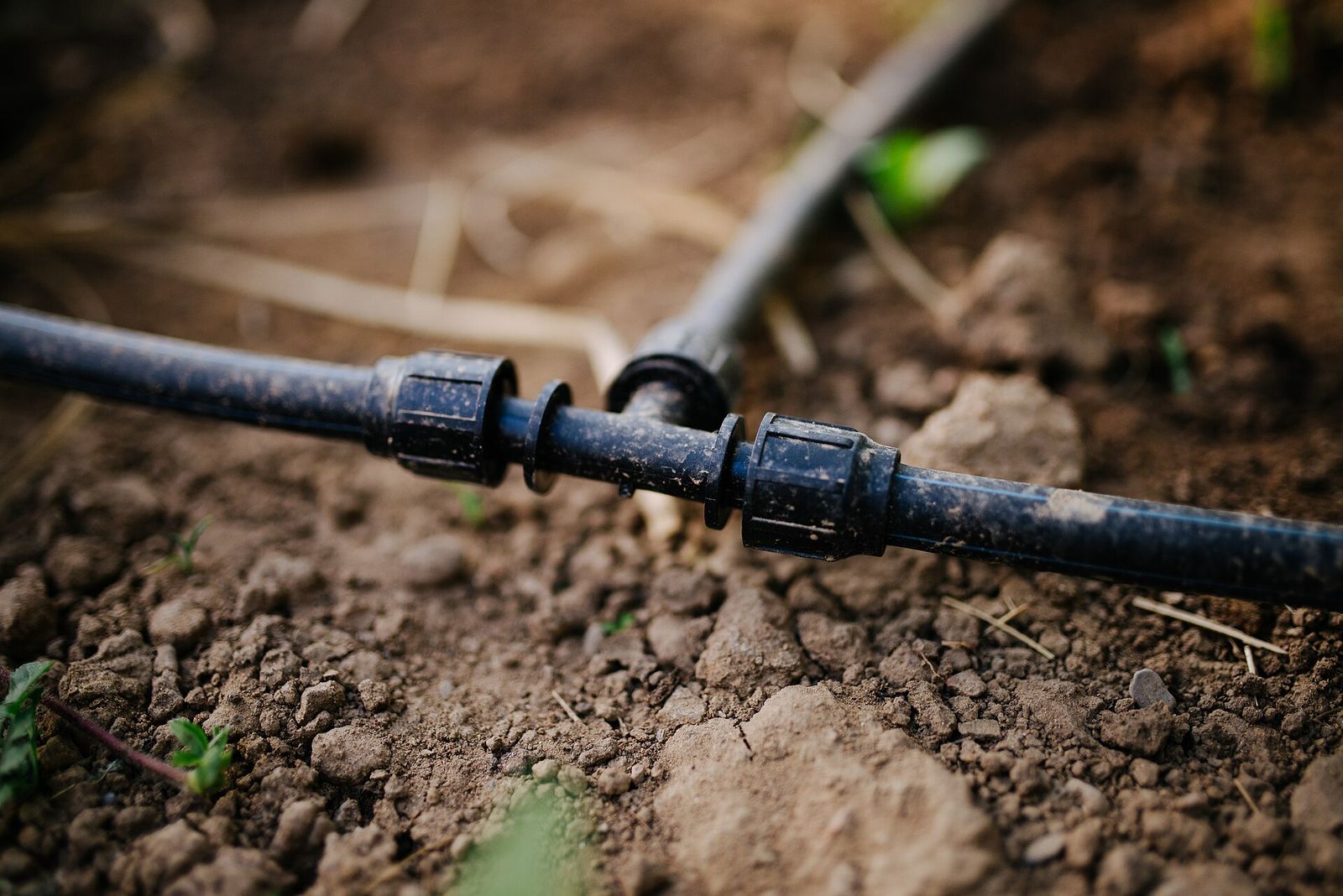
A drip system delivers water slowly at the base of each plant through small emitters. Because the water goes straight into the soil, little is lost to evaporation or runoff, and foliage stays dry, which helps reduce some leaf diseases.
A typical kit or home-built system has:
- Backflow preventer at the tap (see below).
- Filter to stop grit clogging the tiny emitter openings.
- Pressure regulator. Drip parts are designed for much lower pressure than household mains, commonly around 1 to 2 bar (15 to 30 PSI). Without a regulator, fittings can blow apart.
- Mainline tubing, often about 13–16 mm (1/2 in), laid along the beds.
- Emitters or micro-tubing. Emitters punched into the mainline, or thin 4–6 mm (1/4 in) tubes branching to individual plants. Emitters are rated by flow, typically a few litres per hour (often quoted in US gallons per hour, GPH).
- Inline drip line: tubing with emitters built in at regular spacing, handy for densely planted beds and vegetable rows.
- Micro-sprayers and bubblers for groundcover or trees that need a wider wetted area.
- End caps or flush valves so you can clear sediment each season.
Pressure-compensating (PC) emitters deliver the same flow along long runs and up and down slopes, so plants at the end of the line don't get less water. They cost a little more and are worth it on anything but short, level beds.
Soaker hoses: simple and inexpensive
A soaker hose is a porous hose, often made from recycled rubber, that weeps water along its whole length. Lay it along a row or snake it through a bed, cover it with mulch to reduce evaporation, and connect it to a tap or timer.
Soaker hoses are easy to install and cheap, but they are less even than drip line. Plants near the tap tend to get more water than those at the far end, especially on longer runs or slopes. They work best:
- In fairly short, level runs, following the maker's maximum length.
- At low pressure. Many need a flow restrictor or pressure regulator; if they spray rather than seep, the pressure is too high.
- Where every plant along the line needs similar amounts of water.
Don't confuse them with flat "sprinkler hoses", which have tiny holes that spray upwards.
Sprinklers: for lawns and large areas
- Oscillating sprinklers sweep a bar back and forth to cover a rectangle; suited to rectangular lawns.
- Impact (pulsating) sprinklers throw a jet that ticks round in a full or partial circle and reach farther; useful for large lawns, though they need reasonable water pressure to reach their rated distance.
- Rotary and turret sprinklers spin arms or streams over a circular area.
- Stationary spray heads wet a small fixed pattern with no moving parts.
- In-ground systems use pop-up spray heads or rotors connected to buried pipe and valves, usually designed and installed as zones.
Sprinklers lose more water to evaporation and wind drift than drip, so water early in the morning, when it's cooler and calmer and foliage dries during the day. A common rule of thumb for many lawns is about 2.5 cm (1 in) of water a week, including rainfall, applied in fewer, deeper sessions. To see how long that takes, put a few straight-sided containers on the lawn and time how long they take to collect 2.5 cm.
Sizing a system to your tap
Every tap can supply only so much water at a time, and a system that asks for more simply runs weak. Measure it before you design anything:
- Open the tap fully and time how long it takes to fill a bucket of known size, such as 10 litres.
- Convert to litres per minute. A 10-litre bucket filled in 30 seconds means 20 L/min.
Rule of thumb: add up the flow of every emitter or sprinkler that runs at the same time. For example, 60 emitters at 2 L/h use 120 L/h, or 2 L/min. Keep the total comfortably below what the tap supplies, and split larger gardens into zones that run one after another.
Group plants with similar needs into the same zone. Vegetables in summer, shrubs and lawns all want different amounts, and running them on one schedule overwaters some and underwaters others. Pots and raised beds dry out faster than open ground and often deserve their own zone.
Timers: mechanical, digital and smart
- Mechanical tap timers shut off after a set time. Simple and battery-free, but you still turn them on.
- Battery digital tap timers fit between the tap and the hose and run on a programmed schedule. Two- or four-outlet models can run separate zones in turn.
- Smart timers and controllers connect to an app over Bluetooth or Wi-Fi (often through a hub). Useful features include rain delay or skipping based on local weather forecasts, seasonal adjustment, flow monitoring that can flag leaks, and remote control while you're away.
- In-ground controllers run solenoid valves for multiple zones and are the norm for built-in sprinkler systems. Weather-based and soil-moisture-based controllers adjust watering automatically. In the United States, the EPA's WaterSense label is one way to identify controllers that meet a water-efficiency specification.
Many municipalities restrict watering to certain days or hours in summer, and some ban sprinklers during droughts while allowing drip. A programmable timer makes compliance easy, but check your local rules.
Backflow prevention and other safety parts
If pressure in the mains drops, water in a hose or irrigation line can be drawn back into the household supply, along with soil, fertiliser or anything else in the line. Many water utilities and plumbing codes require a backflow preventer on outdoor taps and irrigation systems, and some outdoor taps already include a vacuum breaker. Fit one at the tap before any timer or drip system, and always if you add fertiliser through the line.
Maintenance through the seasons
- Spring: flush the lines, clean the filter, and walk the system while it runs to spot blocked emitters and leaks.
- Summer: adjust run times as the weather and plants change; mulch helps any system go further.
- Autumn: in frost-prone areas, drain the lines, bring timers, filters and regulators indoors, and disconnect the hose from the tap. Water left in fittings can split them when it freezes.
For hoses and connectors themselves, see our guide to garden hoses and hose reels.
The short version
- Beds, borders and pots: drip irrigation with a filter, pressure regulator and pressure-compensating emitters.
- A few straight rows on a budget: soaker hoses in short, level runs at low pressure.
- Lawns: sprinklers matched to the shape of the area, run early in the morning.
- Any system: measure your tap's flow, split the garden into zones, add a timer, and fit a backflow preventer.
Bloiq is reader-supported. Some links may earn us a commission; it never affects what we write. How we make money.
Cover photo: Shixart1985, CC BY 2.0, via Wikimedia Commons