Garden hoses and hose reels: materials, diameters and fittings
Rubber, vinyl, hybrid or expandable? How hose diameter, length, fittings and drinking-water ratings affect flow and lifespan, plus how to pick a hose reel.
A garden hose looks like the simplest thing in the shed, yet a poor one kinks, leaks at the tap, cracks in its second winter and delivers a trickle at the far end of the garden. The differences come down to a handful of details: what the hose is made of, its inside diameter, its length, and the fittings at each end. This guide explains each of them, when an expandable hose makes sense, which hoses are suitable for drinking water, and how to choose a reel that won't fight you every time you put the hose away.
Hose materials compared
| Vinyl (PVC) | Rubber | Hybrid polymer | Polyurethane | Expandable | |
|---|---|---|---|---|---|
| Weight | Light | Heavy | Medium | Very light | Very light |
| Kink resistance | Poor to fair | Good | Good | Good | Kinks rarely when full |
| Flexibility in cold | Stiffens | Stays flexible | Good | Good | Good |
| Durability | Lowest | High | Medium to high | Medium to high | Lowest |
| Hot water | Usually no | Often yes | Check rating | Check rating | No |
- Vinyl hoses are inexpensive and light but stiffen in cold weather, kink more easily and can crack as they age in the sun. Several layers with a mesh or braided reinforcement between them perform much better than a single thin layer.
- Rubber hoses are heavier and cost more, but lie flat, resist kinking, cope with rough ground and often handle hot water. They are the usual choice for heavy daily use.
- Hybrid hoses blend rubber and PVC or other polymers to get much of rubber's flexibility at a lower weight.
- Polyurethane hoses, sometimes sold as lightweight or "garden" hoses with a coiled or flat design, are very light and flexible, and many are rated as drinking-water safe.
A hose's ply or reinforcement layer (a fabric mesh or spiral) is what stops it ballooning and bursting. A burst pressure rating, usually in PSI or bar, should sit comfortably above your mains pressure, which in homes is commonly somewhere around 3 to 5.5 bar (40 to 80 PSI).
Diameter and length: why flow drops off
Hoses are sold by inside diameter. The common sizes are:
- 12–13 mm (1/2 in): light and easy to handle, fine for watering pots and short runs.
- 15–16 mm (5/8 in): the all-round size in North America and a common upgrade elsewhere; carries noticeably more water.
- 19 mm (3/4 in): for long runs, high-flow sprinklers and heavy use. Heavier and bulkier on a reel.
Water loses pressure to friction as it travels, and the loss grows with length and shrinks sharply with diameter. A long, narrow hose can leave a sprinkler or pressure washer short of flow even though the tap is fully open. If you run a pressure washer from the hose, check the machine's minimum supply flow; see our guide to pressure washer PSI and GPM.
Rule of thumb: buy the shortest hose that reaches the far corner of your garden, and step up one diameter if the run is long or you use sprinklers.
Expandable hoses: light and compact, with trade-offs
Expandable hoses have a stretchy inner tube, usually latex or a thermoplastic elastomer, inside a loose fabric sleeve. Water pressure stretches the hose to roughly two or three times its resting length; when you shut off the water and open the nozzle, it shrinks back.
They suit small gardens, balconies and people who want something light to carry and store. The downsides:
- The quoted length is the expanded length, and it is only reached at full pressure.
- The inner tube is thin and eventually fails, often without warning; rough ground, thorns and sharp edges shorten its life.
- Leaving it pressurised in hot sun, or kinked under pressure, adds stress.
- They usually aren't suitable for hot water, and most aren't drinking-water rated.
Drain it after use, store it out of direct sun, and keep the pressure off when you're not watering.
Fittings and connectors
Leaks at the tap and the nozzle are the most common hose complaint, and they're usually fittings rather than the hose itself.
- Threads: in North America, garden hoses use a standard garden-hose thread (GHT), which is not the same as the pipe thread used in plumbing. In the UK and much of Europe, outdoor taps typically take a threaded tap connector, and hoses connect with snap-on (click) connectors.
- Snap-on systems: convenient for swapping nozzles, sprinklers and reels. Many are broadly compatible with each other, but not all; check before mixing parts from different makers.
- Materials: brass fittings last longest and tolerate being stepped on; plastic is lighter and cheaper but cracks when frozen or crushed; aluminium sits between them. If you'll drink from the hose, look for lead-free brass.
- Washers: most drips at a threaded coupling come from a missing, flattened or hardened rubber washer. Keep a few spares.
- Collars and strain relief: a spring or sleeve at the tap end reduces kinking right where the hose meets the fitting.
Drinking-water safe hoses
Standard garden hoses are not designed for drinking water. Testing by consumer and environmental groups has found lead and other chemicals, such as plasticisers, in water that had been sitting in some ordinary hoses, particularly after a warm day in the sun.
If you fill pets' bowls, top up a caravan or RV tank, or simply drink from the hose on a hot day:
- Choose a hose labelled drinking-water safe, ideally certified to a recognised standard. In North America that is often NSF/ANSI 61; in the UK, look for WRAS approval.
- Pair it with lead-free fittings.
- Run the water until it's cool before drinking, since water that has sat in a hose in the sun has had the most contact time with the material.
Watering vegetable beds is a lower-risk use, but a drinking-water safe hose removes the question entirely.
Choosing a hose reel or storage
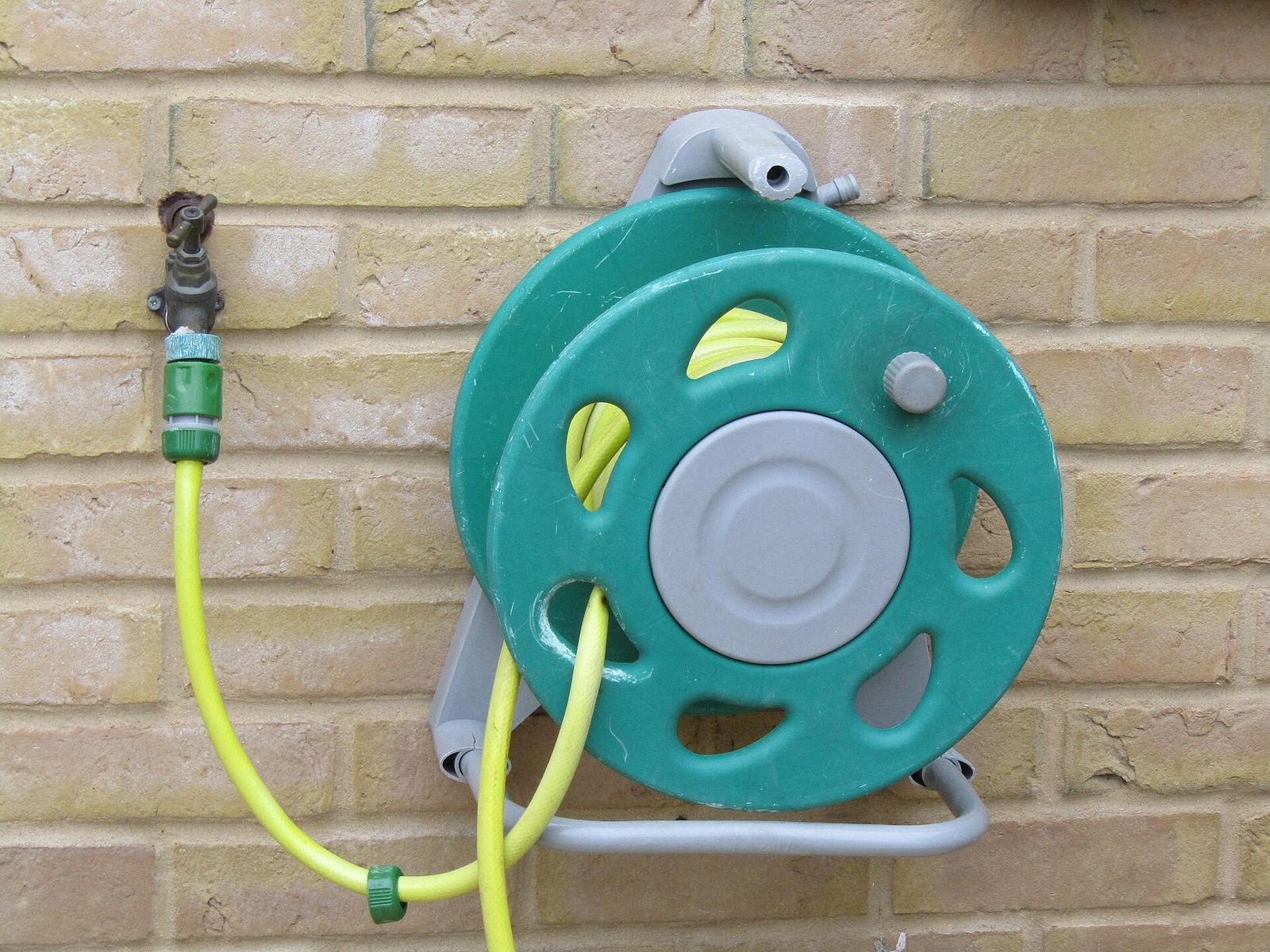
- Wall-mounted reels keep the hose off the ground near the tap. A short "leader" hose connects the tap to the reel's inlet.
- Hose carts roll on wheels, which helps when you use more than one tap or have a large garden.
- Enclosed reels and hose boxes hide the hose and protect it from sun.
- Auto-rewind (retractable) reels use a spring or, occasionally, a motor to wind the hose back. Look for a mechanism that guides the hose evenly and retracts at a controlled speed, since a fast-moving hose and nozzle can be dangerous.
- Hangers are the simplest option and work well for shorter hoses.
Check the reel's capacity for your hose diameter: a reel rated for a certain length of 12 mm hose holds less 15 or 19 mm hose. The swivel joint where water enters a reel is the part most likely to leak, so a metal inlet and replaceable seals are worth looking for.
Looking after a hose
- Drain it after use, and keep it out of the sun when it isn't in use.
- Don't pull it round sharp corners or drive over it.
- Before the first frost, disconnect the hose from the outdoor tap, drain it and store it indoors. A hose left attached can stop a frost-free tap from draining and may lead to a split pipe.
- Turn the water off at the tap, not just at the nozzle, when you finish; a hose left under pressure all day wears out faster.
For watering beds on a schedule rather than by hand, see our guide to drip irrigation, soaker hoses and sprinklers.
The short version
- Heavy use, rough ground or cold climates: reinforced rubber or a good hybrid hose.
- Small gardens and balconies: a lightweight polyurethane or expandable hose, drained after use.
- Long runs or sprinklers: the next diameter up, and no more length than you need.
- Drinking, pets or RVs: a certified drinking-water safe hose with lead-free fittings.
- Before buying: check your tap's thread or connector type, the reel's capacity for your diameter, and spare washers.
Bloiq is reader-supported. Some links may earn us a commission; it never affects what we write. How we make money.
Cover photo: Kolforn, CC BY-SA 4.0, via Wikimedia Commons