Steam irons, steam generators and garment steamers: how to choose
How steam irons, steam generator irons and garment steamers differ, what steam output and soleplate figures mean, and how to keep limescale under control.
There are three ways to get creases out of clothes at home: a classic steam iron, a steam generator iron with a separate water tank, and a garment steamer that you use on hanging clothes. Each suits a different household, and the specification sheets are full of figures (watts, grams per minute, bar) that are hard to compare. This guide explains what those numbers mean, which soleplates glide best and how to stop limescale from shortening the life of whatever you buy.
The three types at a glance
| Type | Best for | Consider |
|---|---|---|
| Steam iron | Everyday shirts and small loads; occasional ironing | Small tank; less steam on thick fabrics |
| Steam generator iron | Big weekly piles, bedding, linen and cotton | Bulky base; heavier to store; costs more |
| Garment steamer | Quick touch-ups, delicates, suits, curtains | No sharp creases; slower on heavy cotton |
Many households end up with two: an iron or steam generator for the weekly pile and a small handheld steamer for refreshing clothes on the hanger.
Steam irons: what the figures mean
A conventional steam iron drips water from its tank onto the hot soleplate, where it flashes into steam and leaves through the holes. Three figures matter:
- Power (watts). In 230 V countries, irons are commonly about 2,000 to 3,000 W; in North America, about 1,200 to 1,800 W. Higher wattage heats up faster and, more importantly, recovers its temperature quickly when you're steaming continuously.
- Continuous steam (g/min). How much steam the iron produces steadily. Figures of roughly 30 to 60 g/min are typical of mid-range irons; more steam helps on thick cotton and linen.
- Steam shot or boost (g). A short, powerful burst for stubborn creases, often quoted at 150 to 250 g. It's measured over a short period, so don't compare it with continuous steam.
The water tank usually holds 200 to 400 ml. A larger one means fewer refills but a heavier iron. Weight is partly a matter of taste: a heavier iron presses better on its own, while a lighter one is less tiring for long sessions.
Steam generator irons: more steam, more space
A steam generator has a separate base with a large tank, often 1 to 2 litres, that heats water in a boiler and sends steam through a hose to a lightweight iron. Because the steam is under pressure, it penetrates thick fabric much better.
- Pressure is quoted in bar, commonly somewhere around 5 to 8 bar. Higher pressure pushes steam deeper into fabric.
- Continuous steam is typically 100 g/min or more, two or three times that of an ordinary iron.
- Heat-up time is longer: usually a couple of minutes before the boiler is ready.
- Size: the base takes up space on the ironing board and in the cupboard, so check that your board has a rest wide enough for it.
A steam generator pays off if you iron a lot: shirts for a family, bedsheets, tablecloths. For a few shirts a week, it's more machine than you need.
Garment steamers: handheld and upright
Garment steamers boil water and blow low-pressure steam through a nozzle while the clothes hang. You smooth the fabric with the steam head rather than pressing it.
- Handheld steamers are compact and good for travel and quick touch-ups. Their tanks are small, often well under 300 ml, so expect to refill them frequently.
- Upright steamers stand on the floor with a larger tank, a hose and often a hanging pole. They suit curtains, long dresses and frequent use.
Steamers are gentle on delicate fabrics such as silk, chiffon and wool, help to refresh suit jackets and remove odours, and avoid shiny marks on dark fabrics. Their weakness is that they can't make crisp creases or press collars and cuffs flat, so they don't replace an iron for formal shirts. Some combine a steamer with a small pressing plate as a compromise.
Soleplates: materials and shape
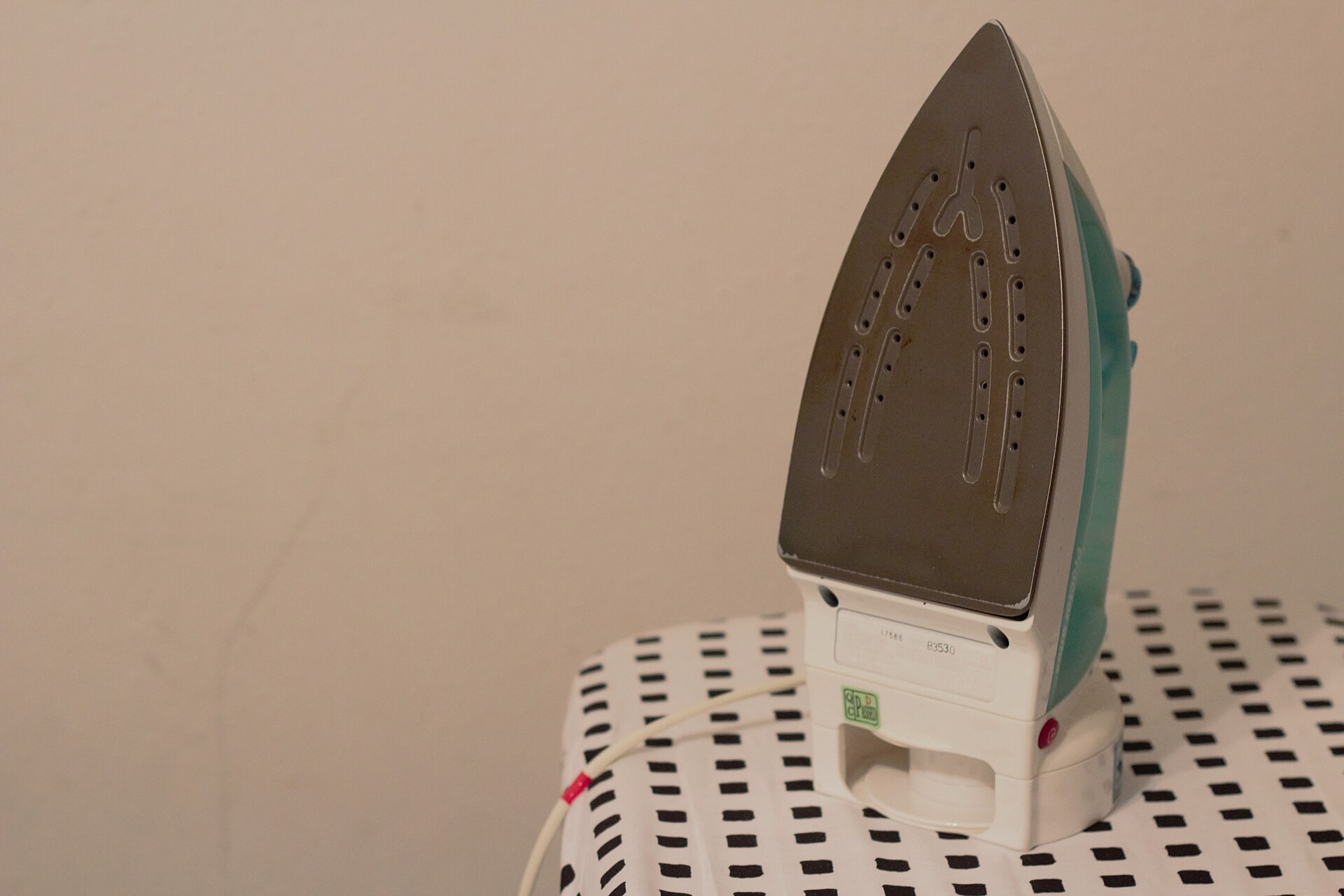
The soleplate decides how smoothly the iron glides and how well steam is spread.
- Stainless steel: durable, scratch-resistant and glides well; the most common choice on better irons.
- Ceramic or ceramic-coated: very smooth and spreads heat evenly, but coatings can chip if you iron over zips and rivets.
- Non-stick coatings: easy to clean and glide well when new, but they wear over time.
- Aluminium: heats quickly and is common on budget irons, but scratches more easily.
Look also at the steam holes. More holes spread steam more evenly, and holes reaching to the tip help with collars and pleats. A pointed, narrow tip makes it easier to iron around buttons and between pleats.
Temperature settings and fabric care labels
Most irons have a dial matched to the dots on clothing care labels:
- One dot: low heat, about 110 °C, for synthetics such as acrylic and nylon; often no steam.
- Two dots: medium heat, about 150 °C, for wool, silk and polyester.
- Three dots: high heat, about 200 °C, for cotton and linen.
A crossed-out iron means don't iron at all. Some irons have a single "smart" setting that claims to suit all ironable fabrics; it's convenient, but check the care label for delicate items. When in doubt, test on an inside seam.
Limescale: the main reason irons fail
In hard-water areas, minerals come out of solution as limescale inside the iron. Over time it blocks steam vents, reduces output and can send brown or white flakes onto your clothes. Manufacturers deal with this in several ways:
- Anti-calc cartridges or filters in the tank, which need replacing periodically.
- Self-clean functions that flush water through the steam chamber.
- Calc-clean or scale-collector systems, mainly on steam generators, where a removable valve or cartridge collects scale for you to rinse out.
What water to use depends on the appliance. Many irons are designed for ordinary tap water, and some manufacturers recommend mixing tap water with distilled or demineralised water in hard-water areas. Others warn against using only distilled water. Never use water with additives, perfumed ironing water, rainwater or water from a condenser dryer unless the manual allows it. Follow the instructions for your model.
If limescale is a problem throughout the house, our guide to water softeners and whole-house filters explains the options.
Safety and convenience features
- Automatic shut-off: many irons switch off after a short time left flat or on their side and after a few minutes standing upright.
- Anti-drip: stops water from leaking out at low temperatures, when it can't flash into steam.
- Vertical steam: lets you steam hanging clothes and curtains with an iron.
- Cord length and swivel: a long cord on a 360° pivot reduces tugging; cordless irons exist but cool down quickly on the board.
- Carry lock: on steam generators, a lock that holds the iron to the base for carrying.
Always empty the tank after use, let the iron cool upright and keep it away from children while it's hot. Dry clothes properly in the first place to save ironing: our guide to clothes dryers explains which types are gentlest on fabric.
The short version
- Small loads, occasional ironing: a good steam iron with 2,000 W or more (in 230 V countries) and a stainless or ceramic soleplate.
- Large weekly piles: a steam generator with a big tank and an easy scale-collector system.
- Touch-ups, delicates and travel: a handheld or upright garment steamer.
- Compare continuous steam, not just the boost figure.
- Check the limescale system and what water the manual recommends, especially in hard-water areas.
- Look for auto shut-off, anti-drip and a narrow tip for buttons and collars.
Bloiq is reader-supported. Some links may earn us a commission; it never affects what we write. How we make money.
Cover photo: Michael Slaten, CC BY-SA 4.0, via Wikimedia Commons