Heated clothes airers and drying racks: capacity, wattage and damp
How to choose a heated airer or drying rack by capacity, wattage, covers and layout, and how to dry laundry indoors without condensation and mould.
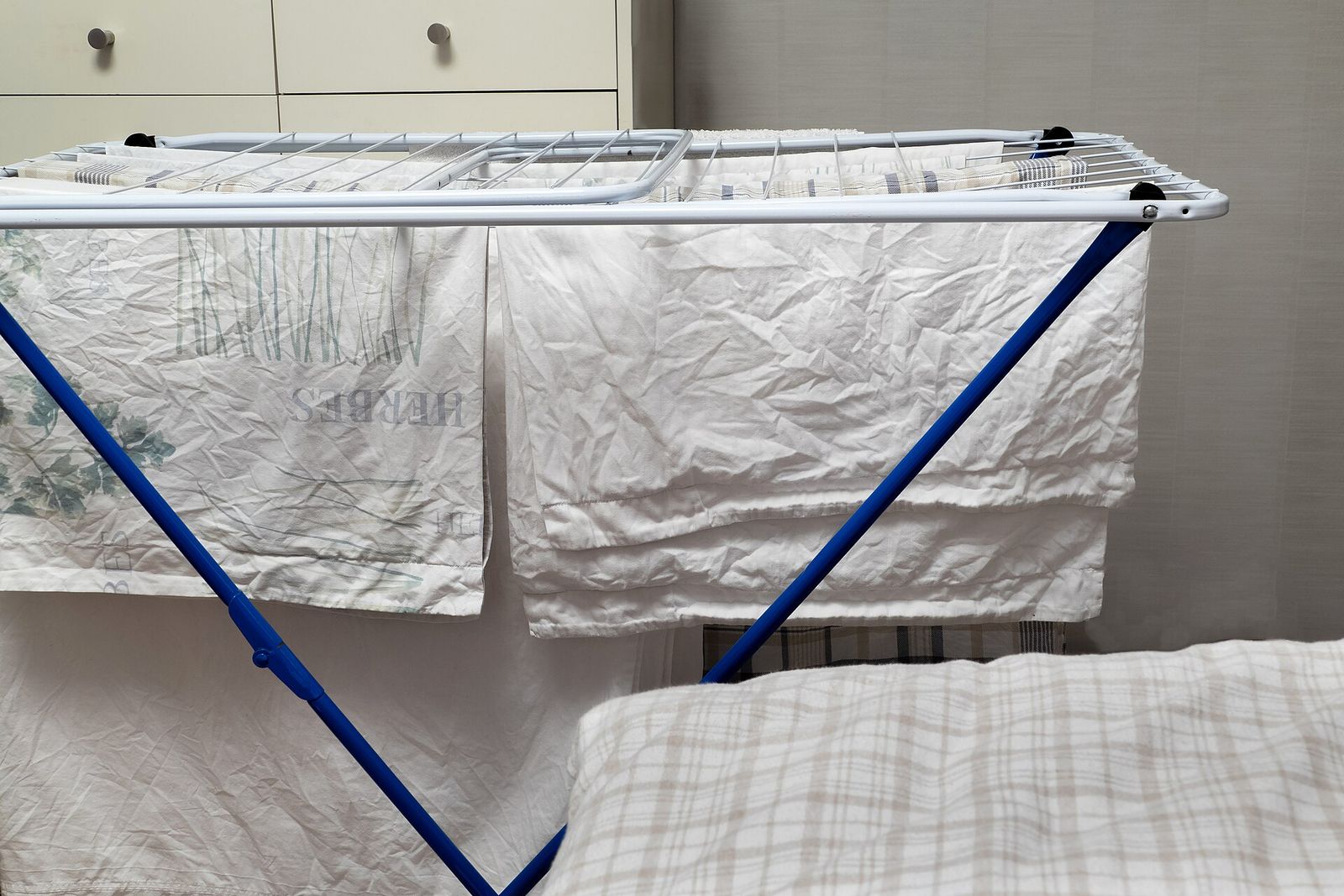
For half the year, many households dry their washing indoors, and a good airer makes the difference between laundry that dries overnight and damp towels that start to smell. Heated airers speed things up for a fraction of the energy of most tumble dryers, but every indoor load still puts water into the air. This guide compares the main types of rack, explains capacity, wattage and covers, and shows how to keep condensation under control.
The main types of airer
| Type | How it works | Good for | Consider |
|---|---|---|---|
| Folding A-frame (clothes horse) | Hinged frame with rails on both sides | Small loads, occasional use | Limited space for long items |
| Winged ("gullwing") rack | Central section with folding wings | Everyday loads; long items over the wings | Takes floor space when open |
| Tiered tower | Two or three shelves stacked vertically | Small rooms; lots of rail in a small footprint | Lower tiers dry more slowly |
| Wall-mounted or over-door | Fold-down or concertina arms | Hallways, utility rooms, bathrooms | Smaller capacity; needs fixing to the wall |
| Ceiling pulley airer | Wooden or metal rails raised on a rope | Kitchens and utility rooms with high ceilings | Needs fitting into joists; you lift wet washing overhead |
| Heated airer | Rails warmed by an electric element | Faster drying in cold months | Uses electricity; must stay away from water |
Unheated racks are cheap to run (they use no power at all) and fine in a warm, ventilated room. Heated airers shine in colder homes and in winter, when an unheated rack can take a day or more.
Capacity: rail length matters more than kilograms
Airers are usually described by total drying length in metres of rail, and sometimes by a maximum load in kilograms. The rail length is the more useful figure: it tells you how much washing can hang without overlapping.
- Many folding racks offer roughly 10 to 20 metres of drying space; large winged and tiered models go higher.
- A typical full machine load, spread out properly, needs more rail than people expect. Items that touch or hang double dry much more slowly.
- A stated maximum load is about the frame's strength, not how much will dry well.
Think about what you dry, too. Bed sheets and long trousers need either long, high rails or wings that open wide; small items such as socks are easier on a rack with clips or a hanging carousel.
Heated airers: wattage and running costs
Heated airers pass a low-temperature element through hollow rails, warming them so that clothes in contact with them dry faster. They're designed to feel warm rather than hot.
- Typical ratings are roughly 100 to 300 W, far lower than a conventional tumble dryer.
- To work out running costs, multiply the wattage (in kilowatts) by the hours of use and by your electricity rate. A 250 W airer running for four hours uses 1 kWh.
- Tiered heated airers usually draw more than single-level winged ones, simply because there's more heated rail.
- Some models have a timer or an on/off switch for each level; basic models simply plug in and stay on until switched off.
Rule of thumb: kWh used = watts ÷ 1,000 × hours. Check your current electricity rate to turn that into a running cost.
Heated rails dry the parts of clothes that touch them fastest, so turning items partway through, or using a cover, gives more even results. Delicate fabrics such as wool, silk and some synthetics may not suit heated rails: follow the care label.
Covers: faster, but where does the water go?
Many heated airers come with, or offer, a zip-up cover or a fitted sheet that sits over the top. The cover traps warm air round the clothes and can shorten drying time considerably.
What a cover doesn't do is remove the water. The moisture still escapes into the room, just more slowly. If the room is cold and closed, you'll see it as condensation on windows.
Only use covers designed for your model, and don't drape towels or blankets over a heated airer to make your own: it can trap heat beyond what the manufacturer intended.
Drying indoors without condensation and mould
A full load of washing can release a couple of litres or more of water as it dries. In a closed room, that raises humidity quickly, and repeated drying in the same spot can lead to condensation, black mould on cold walls and a musty smell.
To keep it under control:
- Spin at the highest speed your fabrics allow; less water in the clothes means less in the air.
- Dry in one room with the door closed, rather than across the house, and ventilate it: open a window slightly or run an extractor fan.
- Use a dehumidifier alongside the airer. Many have a laundry mode, and together they often dry clothes faster than an airer alone. Our dehumidifier buying guide explains sizes and types.
- Leave space between items and between the airer and the walls so air can circulate.
- Avoid draping wet clothes on radiators. It blocks the heat from reaching the room and puts moisture straight into the air.
If you dry most of your laundry indoors all year round, it's worth comparing a heated airer plus dehumidifier with a heat-pump dryer; our guide to clothes dryers covers the options.
Materials, build and storage
- Aluminium is light and doesn't rust; most heated airers use it for the rails.
- Powder-coated or stainless steel is sturdy; check welds and joints, since chipped coatings on steel can rust and mark clothes.
- Wood is traditional for pulley airers and some clothes horses. It looks good, but needs to dry out between loads.
- Rails: smooth, rounded rails leave fewer marks; closely spaced rails hold more but slow drying.
- Stability: locking hinges and non-slip feet stop a loaded rack from collapsing or sliding.
- Folded size: measure the cupboard or the gap where it will live, and check the weight if you'll carry it up and down stairs.
Using a heated airer safely
Heated airers are low-power appliances, but they're still electrical appliances used with wet laundry.
- Use them only in the places the manufacturer allows. Most are for dry indoor rooms, not bathrooms or near sinks, unless they're specifically rated for that.
- Plug them directly into a wall socket where the instructions say so, and keep the cable away from walkways and drips.
- Don't overload the frame or let washing touch other heaters.
- Switch off and unplug the airer when not in use, and follow the instructions on covers and on whether it may be left running unattended or overnight.
- Check for a recognised safety marking for your region.
The short version
- Choose the type by space: winged or tiered for everyday loads, wall-mounted or pulley airers for small rooms.
- Compare metres of drying rail, not just maximum load.
- A heated airer of roughly 100 to 300 W speeds up winter drying for modest running costs.
- A cover speeds drying but doesn't remove moisture.
- Pair indoor drying with ventilation or a dehumidifier to prevent condensation and mould.
- Check stability, folded size and safety marking, and follow the rules on where it can be used.
Bloiq is reader-supported. Some links may earn us a commission; it never affects what we write. How we make money.
Cover photo: W.carter, CC BY-SA 4.0, via Wikimedia Commons