Pop-up toasters: two or four slots, long slots, settings and crumb trays
How to choose a pop-up toaster: two-slot, four-slot or long-slot, slot width, browning control, bagel, defrost and reheat settings, and easy crumb cleaning.
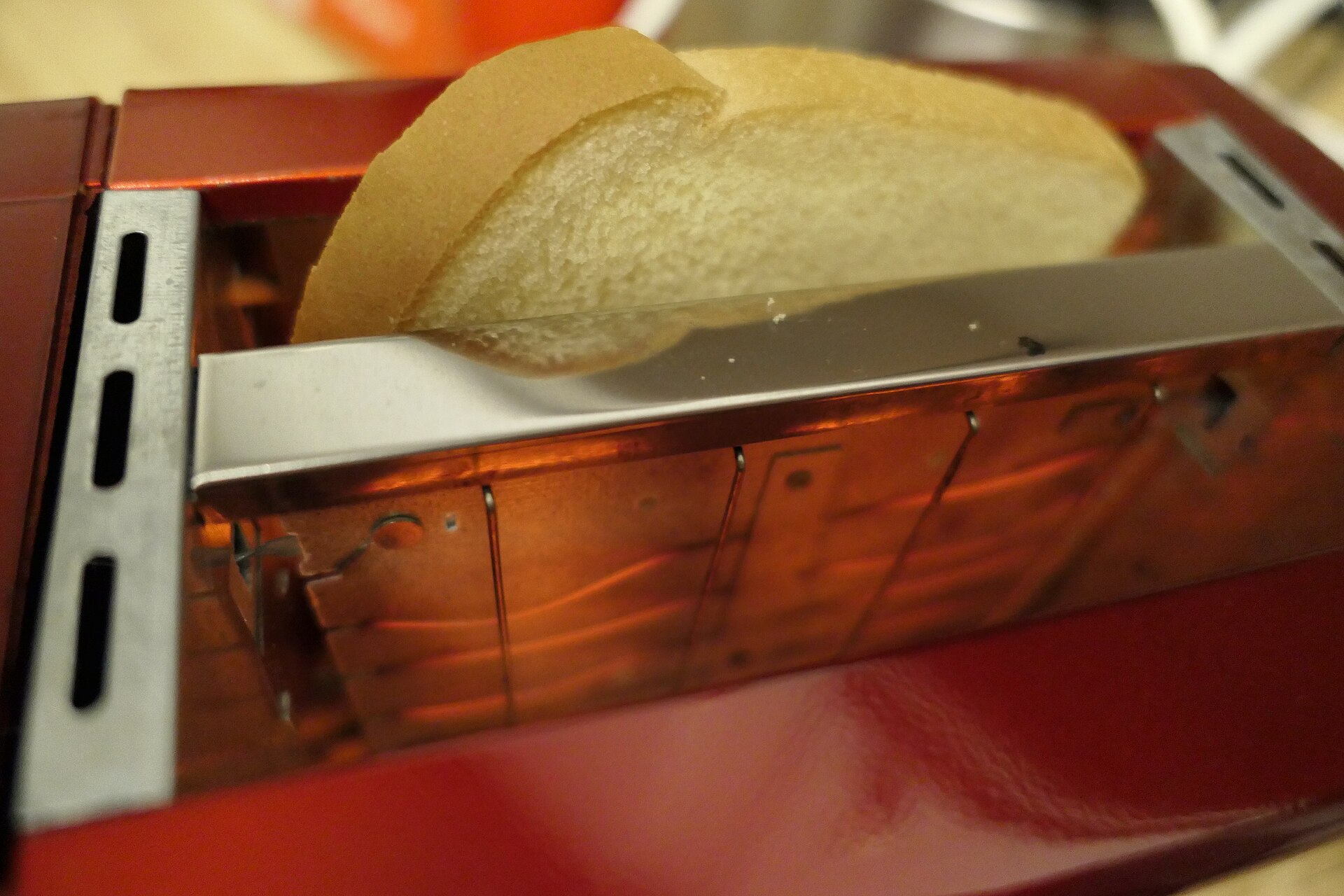
A pop-up toaster does one job, yet plenty of them do it badly: pale edges and a burnt middle, bagels that won't fit, or a second batch that comes out much darker than the first. The difference between a good toaster and a frustrating one is mostly in slot size, how the browning is controlled and a few small details you only notice after weeks of use. This guide explains the formats, the settings and what to check before you buy.
Two-slot, four-slot or long-slot
The first choice is the layout, and it should follow the bread you actually eat and how many people want toast at the same time.
| Layout | Holds | Suits | Consider |
|---|---|---|---|
| Two-slot | 2 standard slices | 1–3 people, small kitchens | Breakfast for a family means several rounds |
| Four-slot (two pairs) | 4 slices | Families, busy mornings | Twice the counter width; check for separate controls per pair |
| Two long slots | 4 standard slices, or 2 long slices | Sourdough and bakery loaves | Short slices can sit unevenly at the ends |
| Single long slot | 2 standard slices or 1 long slice | Narrow counters | Holds less than it looks |
Four-slot toasters are usually two two-slot toasters in one body. The most useful ones have independent controls for each pair, so you can toast just two slices without heating all four slots, and set different shades on each side.
Long-slot toasters are made for oval bakery loaves, whose slices are too long for standard slots and end up with an untoasted strip at the top. If you mostly buy sandwich loaves, standard slots work fine.
Slot width and depth
Slot size decides what fits.
- Width: standard slots suit sliced sandwich bread. Wide slots, often described as around 3.5 to 4 centimetres (about 1.5 inches), take bagel halves, thick-cut bread, crumpets and teacakes.
- Depth: a deeper slot toasts taller slices all the way to the top. Measure a slice of your usual loaf against the slot depth given in the specifications.
- Self-centring guides: spring-loaded racks that grip the bread in the middle of the slot. They help thin slices brown evenly on both sides.
If a slice stands proud of the slot, the top strip stays pale. If it's too thick to fit, forcing it in can jam the mechanism or bring bread too close to the elements.
How browning control works
Almost every toaster has a browning dial or buttons, usually numbered from about 1 to 6 or 7. The number doesn't measure temperature: it sets how long the elements stay on. A few points follow from that:
- Settings aren't consistent between models. A 4 on one toaster may be a 2 on another. Expect a few days of trial and error.
- The second batch can come out darker. A toaster that is already hot browns faster. Many electronic models compensate by shortening the cycle when they're warm; basic mechanical ones often don't.
- Bread type matters as much as the setting. Fresh, moist bread takes longer than stale bread; sugary breads such as brioche brown quickly.
Older and simpler toasters use a mechanical or bimetallic timer. Most current models use an electronic timer, which tends to give more repeatable results. Some premium models add a sensor or a countdown display.
Rule of thumb: start in the middle of the dial with your usual bread, then adjust by one step at a time. Write down the setting that works for each kind of bread you buy.
Power and evenness
Typical ratings are roughly 800 to 1,200 W for two-slot toasters and 1,500 W or more for four-slot models; in North America, the 120 V supply limits four-slot toasters to around 1,500 to 1,800 W. Higher power toasts faster but does not by itself mean better toast.
Evenness depends mostly on how the heating elements are spread across the slot and how close the bread sits to them. Most toasters use wire elements wound on mica sheets; elements with closer spacing, and elements that reach the bottom and ends of the slot, give fewer pale patches. Some toasters use quartz or similar elements that heat up faster.
If you often get one side darker than the other, the bread is probably leaning towards one element. Self-centring guides help, and so does toasting slices of the same thickness.
Bagel, defrost, reheat and cancel
These are the settings you're most likely to use, and they're found on most mid-range models.
- Bagel: toasts the cut face and only warms the crust side. The outer elements run at reduced power or switch off. Put the cut side facing the inside or the centre of the slot as the manual shows, because it varies by model.
- Defrost: adds extra time for bread straight from the freezer, so you can use your normal browning setting.
- Reheat: a short, gentle cycle to warm toast that has gone cold, without browning it further.
- Cancel or stop: ends the cycle and pops the toast up immediately. Use it rather than forcing the lever up.
- Lift or high-lift lever: raises small items higher so you can take out crumpets or short slices without reaching into the slot.
Extras such as a warming rack for rolls and pastries, a "peek" button that lifts toast mid-cycle, or a sandwich cage can be useful, but they're optional. If you want to toast open sandwiches, melt cheese or reheat pastries often, a toaster oven may suit you better; see our guide to toaster ovens and countertop ovens.
Crumb trays and cleaning
Crumbs collect at the bottom of every toaster. Left there, they can burn, smell and in rare cases catch fire, so easy cleaning matters more than it seems.
- Look for a removable crumb tray that slides out from the front or side, and check it doesn't need the toaster turned round to reach.
- On four-slot models, check whether there is one tray or two.
- Empty the tray every week or so, and more often if you toast seeded or crusty bread.
- Always unplug the toaster and let it cool before emptying it or wiping it.
Never reach into the slots with a knife or fork to free stuck bread: it's an electric-shock risk and can damage the elements. Unplug the toaster, let it cool and turn it upside down over the sink to shake loose crumbs.
Housing, safety and size
- Cool-wall or insulated housings keep the outside cooler than plain metal bodies, which matters if children are around.
- Stainless steel looks smart but shows fingerprints and gets hot. Brushed and coloured finishes hide marks better.
- Automatic shut-off if bread jams, and a lever that won't stay down when the toaster is unplugged, are standard on most current models.
- Cord storage under the base keeps the counter tidy.
- Footprint: measure the counter space, including room to get to the crumb tray, and check clearance under wall cupboards. Toasters vent hot air upwards.
People who avoid gluten often keep a separate toaster, because crumbs carry over between slices. Reusable toaster bags are another option if the manufacturer allows them, so check the manual first.
The short version
- Choose two or four slots by household size; get independent controls on a four-slot model.
- Pick long slots if you mostly buy bakery loaves, and wide slots for bagels and thick bread.
- An electronic timer with warm-toaster compensation gives more consistent batches.
- Bagel, defrost, reheat and cancel cover nearly everything; other extras are optional.
- Insist on a removable crumb tray that's easy to reach, and empty it regularly.
- Check the footprint, the housing temperature and the cord storage for your kitchen.
Bloiq is reader-supported. Some links may earn us a commission; it never affects what we write. How we make money.
Cover photo: Kansattica, CC BY 4.0, via Wikimedia Commons