Juicers explained: centrifugal vs masticating (cold press) machines
How centrifugal and masticating juicers differ in speed, juice yield, foam, leafy greens and cleaning, and which type suits the way you actually make juice.
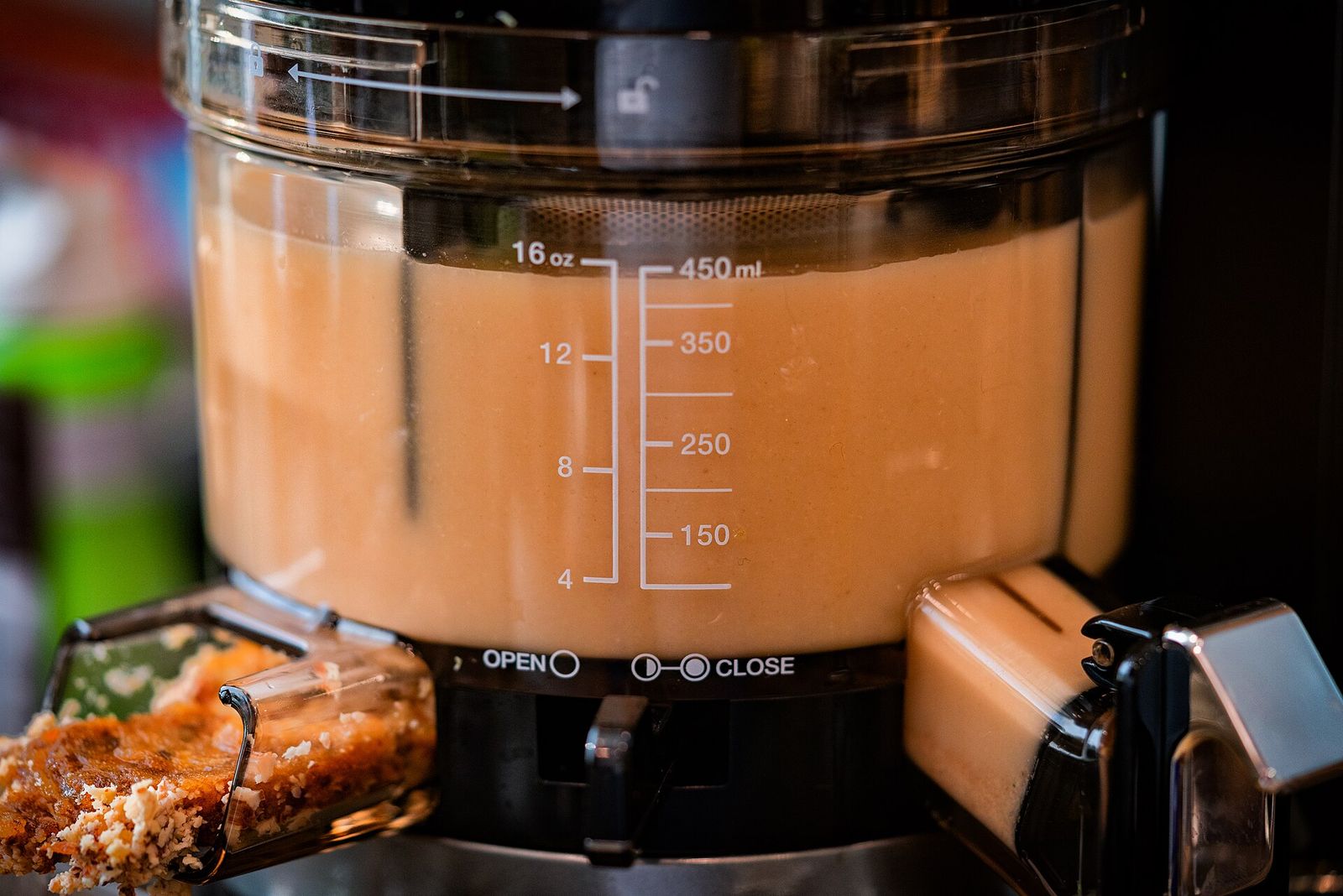
Juicers split into two main families that work in completely different ways. A centrifugal juicer shreds produce at high speed and flings the juice out; a masticating, or "cold press", juicer crushes it slowly with a screw. Each has real strengths, and the one that suits you depends on what you juice, how much time you have in the morning and how much cleaning you'll put up with. This guide explains the differences and what to check.
How the two types work
Centrifugal juicers have a flat cutting disc at the bottom of a fine mesh basket. The disc spins at several thousand revolutions per minute, grates the produce and throws the pulp against the mesh; juice passes through and the pulp is ejected into a bin. They're fast and usually take whole or halved fruit through a wide feed chute.
Masticating juicers, also sold as slow or cold-press juicers, use a rotating auger (a thick screw) turning at roughly 40 to 100 rpm. The auger crushes produce against a screen and squeezes out the juice. They come in two layouts:
- Vertical: the auger stands upright and gravity feeds the produce. Compact, quicker to use and the most common type today.
- Horizontal: the auger lies flat. Particularly good with leafy greens and wheatgrass, and many can also make nut butters, sorbets or pasta with extra attachments. They take more counter space and need more chopping.
A third, less common type, the twin-gear (triturating) juicer, presses produce between two interlocking gears. It's slow, thorough and suited to people who juice large amounts of greens.
Side-by-side comparison
| Centrifugal | Masticating (cold press) | |
|---|---|---|
| Speed | Very fast: seconds per glass | Slower: several minutes per glass |
| Prep | Little; wide chutes take whole apples | More chopping, though wide-chute models are reducing this |
| Hard produce (carrots, apples, beetroot) | Very good | Very good |
| Leafy greens and herbs | Poor to fair | Good to very good |
| Soft fruit (berries, mango) | Fair; can turn to purée | Fair to good; can clog the screen |
| Juice yield | Lower; pulp is often damp | Usually higher; pulp is drier |
| Foam and separation | More foam, separates sooner | Less foam, smoother juice |
| Noise | Loud, like a blender | Quiet hum |
| Price range | Lower | Higher on average |
Juice yield: what drier pulp tells you
Yield is how much juice you get from a given weight of produce. Masticating juicers generally extract more, especially from leafy greens, where a centrifugal machine may leave much of the juice behind. With hard produce such as carrots and apples, the gap is smaller.
You can check yield at home: squeeze a handful of pulp. If juice runs out easily, the machine is leaving a lot behind. Many people run wet centrifugal pulp through a second time.
Over months of regular juicing, higher yield means less produce bought for the same amount of juice. If you juice a few times a month, it matters much less.
Rule of thumb: if leafy greens make up a big part of what you juice, choose a masticating juicer. If you mostly juice apples, carrots and citrus and value speed, a centrifugal machine does the job well.
Leafy greens, wheatgrass and soft fruit
Kale, spinach, celery, herbs and wheatgrass are where the two types differ most. A fast-spinning disc tends to fling light leaves around and shred them without extracting much. An auger grips and squeezes them. Celery juice, popular in recent years, is much more efficient in a masticating juicer.
Some tips that help with either type:
- Roll leaves into tight bundles and feed them between pieces of hard produce, such as apple or carrot.
- Cut fibrous stalks like celery into short lengths, so the fibres don't wrap round the auger.
- Soft fruit such as bananas and avocados doesn't juice well in any machine; blend it in afterwards instead.
Foam, freshness and the "cold press" claim
Centrifugal juicers draw in more air, so their juice is foamier and separates into layers more quickly. Masticating juice is smoother and keeps its colour and texture longer.
"Cold press" mainly describes the process: slow crushing rather than high-speed cutting. Claims that it preserves noticeably more nutrients are often made in marketing, but the differences in practice are modest. The safest advice is the same for both types: drink juice soon after making it, and if you store it, keep it covered and chilled and use it within the time the manufacturer suggests. Homemade juice is unpasteurised, so wash produce well first.
Cleaning: the part people underestimate
The main reason juicers end up in a cupboard is cleaning. Before you buy, look at:
- Number of parts: most juicers have four to seven parts to wash. Fewer, simpler parts make daily use realistic.
- The screen or mesh basket: this is the slow bit. Fine mesh needs scrubbing with the supplied brush. Some masticating models use a rotating brush that wipes the screen during juicing, which helps.
- Dishwasher-safe parts: check which parts the manufacturer says are dishwasher safe; screens often need hand washing.
- Rinse straight away. Dried pulp sets hard in the mesh. Many machines let you run water through them as a quick rinse between batches.
- Pulp ejection: an outside pulp bin is easier than pulp that collects inside the chamber.
Carrots and beetroot can stain plastic parts. Wiping them with a little lemon juice or a paste of bicarbonate of soda usually lightens the marks.
Juicer or blender?
A juicer separates the juice from the fibre; a blender keeps everything, making a thicker smoothie. If you want the fibre and a drink that keeps you full, or you'd rather own one appliance, a blender may be the better choice. Our guide to blender types explains the options. Many people who like both clear juice and smoothies use a juicer for greens and roots and a blender for fruit.
For citrus alone, neither is ideal: a simple citrus press or reamer gives better orange and grapefruit juice with far less washing up.
Other details worth checking
- Feed chute width: wide chutes (often 7 to 8 cm or more) save chopping. Narrower chutes are partly a safety feature. Never push produce down with your fingers; use the pusher.
- Reverse function: on masticating juicers, it backs the auger out to clear a jam.
- Pulp control: some models have adjustable screens or caps for more or less pulp in the juice.
- Wattage: don't compare power across types. Masticating juicers often use 150 to 250 W; centrifugal machines commonly use 700 W or more. Neither figure tells you about yield.
- Safety interlocks: the machine should only run with the lid locked in place.
- Height and footprint: vertical models are tall, so check under wall cupboards.
The short version
- Choose centrifugal for speed, hard fruit and vegetables, and a lower outlay.
- Choose masticating for leafy greens, higher yield, quieter running and smoother juice.
- Pick vertical for a compact everyday masticating juicer, horizontal for wheatgrass and extra attachments.
- Look hard at cleaning: few parts, an easy screen and an outside pulp bin.
- Check chute width, a reverse function and pulp control.
- Drink juice fresh, and consider a blender if you want the fibre too.
Bloiq is reader-supported. Some links may earn us a commission; it never affects what we write. How we make money.
Cover photo: Tony Webster, CC BY-SA 2.0, via Wikimedia Commons