Radar and laser detectors explained: bands, false alerts and the law
How radar and laser speed measurement works, what a detector can and can't warn you about, why false alerts happen, and why legality varies so much by place.
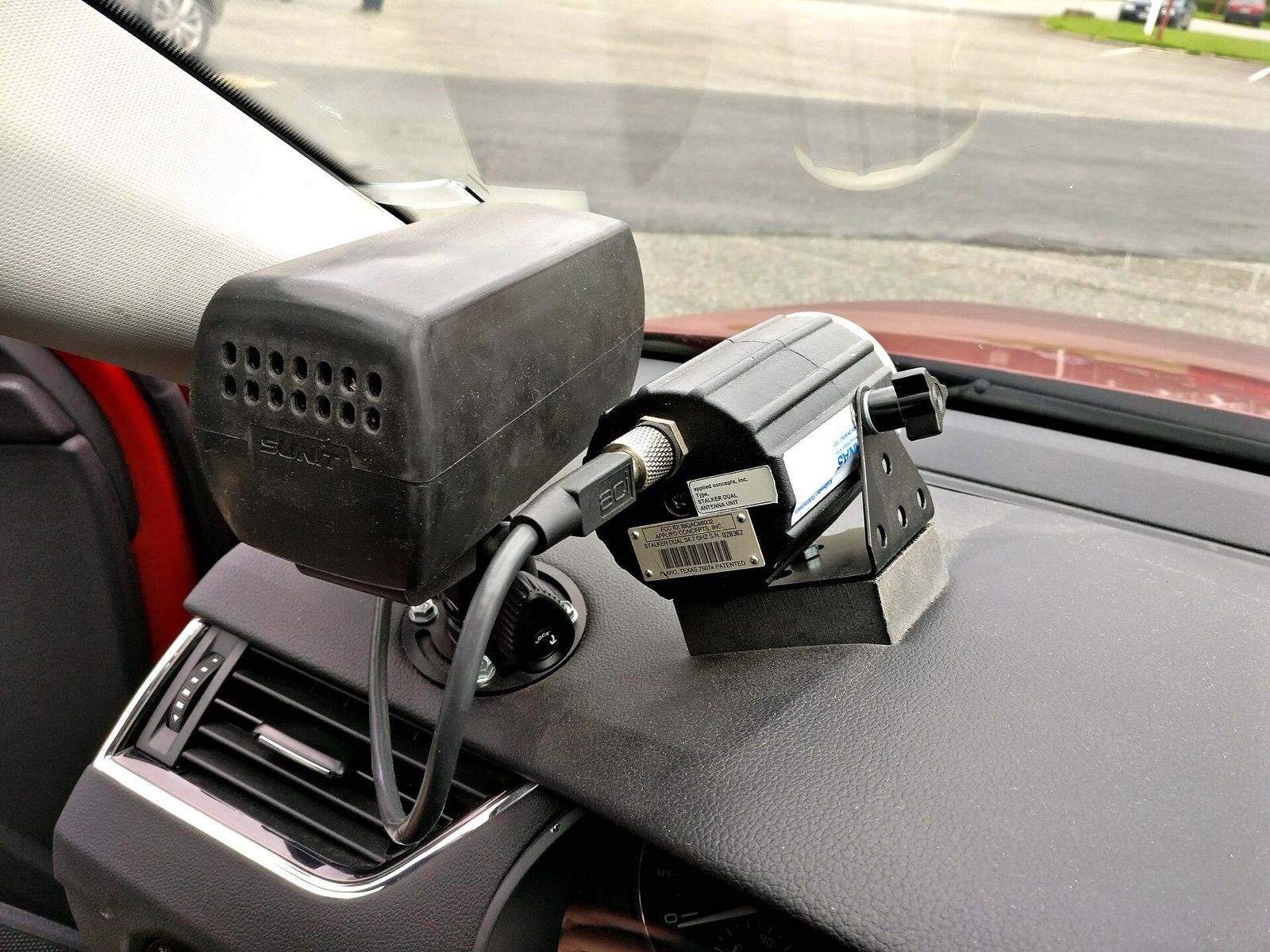
Radar detectors have been around for decades, and their spec sheets are full of band names, filter modes and range claims that are hard to interpret. Before anything else, two points matter: a detector is no substitute for driving at a safe, legal speed, and in many places owning or using one is itself against the law. This guide explains how speed enforcement technology works, what detectors can realistically do, why they give false alerts and what to check about the rules where you drive.
How police radar measures speed
Traffic radar sends out a microwave signal and measures the change in frequency of the signal reflected back from a moving vehicle, known as the Doppler shift. The faster the vehicle, the larger the shift. Radar beams spread out as they travel, so they can reflect off many vehicles and surfaces, and they can often be picked up well beyond the distance at which they measure a car's speed.
Police radar in North America operates in three main bands:
- X band (around 10.5 GHz): the oldest band, now rarely used for enforcement in many areas but still used by some automatic door openers and other devices.
- K band (around 24 GHz): widely used, and shared with many non-police sources.
- Ka band (roughly 33–36 GHz): widely used by modern police radar in North America.
Other regions use some of the same bands and, in places, different frequencies, so a detector designed for one market may not suit another.
Radar can be used in two broad ways. Constant-on radar transmits continuously, which gives a detector the best chance of warning you early. Instant-on radar stays silent until the operator triggers it at a specific vehicle; if that vehicle is yours, the measurement can be complete before any alert is useful. A detector helps most when instant-on radar is aimed at vehicles ahead of you.
How laser (lidar) works
Laser speed guns, often called lidar, fire short pulses of invisible infrared light and time their reflections to calculate distance, then speed. The beam is very narrow, so it's usually aimed at a specific vehicle, and a measurement takes a fraction of a second.
This has a practical consequence: by the time a detector registers laser light, the car it's fitted to has usually already been measured. Laser detection is therefore of limited use as a warning. Laser jammers, which try to interfere with the measurement, are illegal in many jurisdictions, and this guide doesn't cover them.
What a detector can't see
Many enforcement methods don't use radar or laser that a detector can sense, or they use it in a way that gives no warning:
- Fixed and average-speed cameras may use sensors in the road surface, number-plate recognition across two points, or low-powered radar at close range.
- Aircraft, pacing and visual estimates involve no signal at all.
- Camera location alerts, a feature of many detectors and navigation apps, rely on a database of known sites rather than detection. The rules on these alerts also differ by country; in some places they're restricted or must be presented only as general "danger zone" warnings.
Why false alerts happen
Because K band in particular is shared with everyday devices, false alerts are the biggest frustration with detectors. Common sources include:
- automatic doors at shops, petrol stations and car parks;
- blind-spot monitoring and other driver-assistance radar on nearby cars;
- roadside speed display signs and traffic-flow sensors;
- other radar detectors that leak signals.
Detectors try to reduce these in several ways:
| Feature | What it does |
|---|---|
| City/highway modes | Reduce sensitivity, or ignore weak signals, in built-up areas |
| Band selection | Lets you switch off bands not used for enforcement where you drive |
| Driver-assistance filters | Try to recognise signals from other cars' safety systems |
| GPS lockouts | Learn locations of repeated false alerts and mute them next time |
| Speed-based muting | Stay quiet below a set speed |
| Firmware updates | Add new filters and band settings as sources change |
No filter is perfect: every reduction in false alerts carries some risk of missing a real one. Expect to spend time adjusting settings to suit your area.
The legal picture, in general terms
The law on radar detectors varies widely, and it can change. In broad terms:
- Some jurisdictions allow private drivers to own and use a detector.
- Others ban them in vehicles altogether, usually including visitors' cars passing through; this is the case in several Canadian provinces and some US jurisdictions.
- Many countries prohibit them outright, and some also restrict camera-location alerts.
- Commercial vehicles are often subject to stricter rules than private cars.
Some police forces use equipment designed to detect radar detectors themselves. Penalties can include fines and confiscation of the device.
Rules vary by country, province and state, and sometimes by vehicle type; check local law before you buy, and again before you drive into another jurisdiction with a detector in the car.
Mounting and using one safely
Even where detectors are legal, the way you fit one matters:
- Many places restrict objects on the windscreen that block the driver's view. Mount the detector low and out of your line of sight, and check local rules on windscreen-mounted devices.
- Keep it out of any airbag deployment zone.
- Route the power cable so it can't tangle with the steering wheel, pedals or gear lever.
- Set it up before you drive; adjusting menus on the move is a distraction.
- An alert is a prompt to check your speed and the road ahead, not a reason to brake sharply.
If you already have a dash cam and a phone mount on the windscreen, adding a detector can quickly clutter your view. Consider how everything fits together.
Features worth checking
- Band coverage that matches the enforcement frequencies where you drive.
- Effective filtering of driver-assistance radar and automatic doors.
- GPS features: lockouts and speed-based muting.
- Clear display and adjustable volume, so alerts are informative without being startling.
- Updates via an app or computer, for firmware and location databases.
- Mounting options that keep it low and secure.
The short version
- Check the law first; detectors are banned in many places.
- Radar detectors give the best warning of constant-on radar; laser alerts usually come too late to help.
- Many cameras and methods can't be detected at all.
- Expect false alerts and use filters, band settings and GPS lockouts to manage them.
- Mount it safely, low and away from airbags.
- The most reliable protection against a ticket is driving at the limit.
Bloiq is reader-supported. Some links may earn us a commission; it never affects what we write. How we make money.
Cover photo: Santeri Viinamäki, CC BY-SA 4.0, via Wikimedia Commons