Car jacks and jack stands: types, ratings and safe lifting points
Floor, bottle and scissor jacks compared, what tonnage ratings and lift ranges mean, where to place a jack and stands, and how to raise a car safely at home.
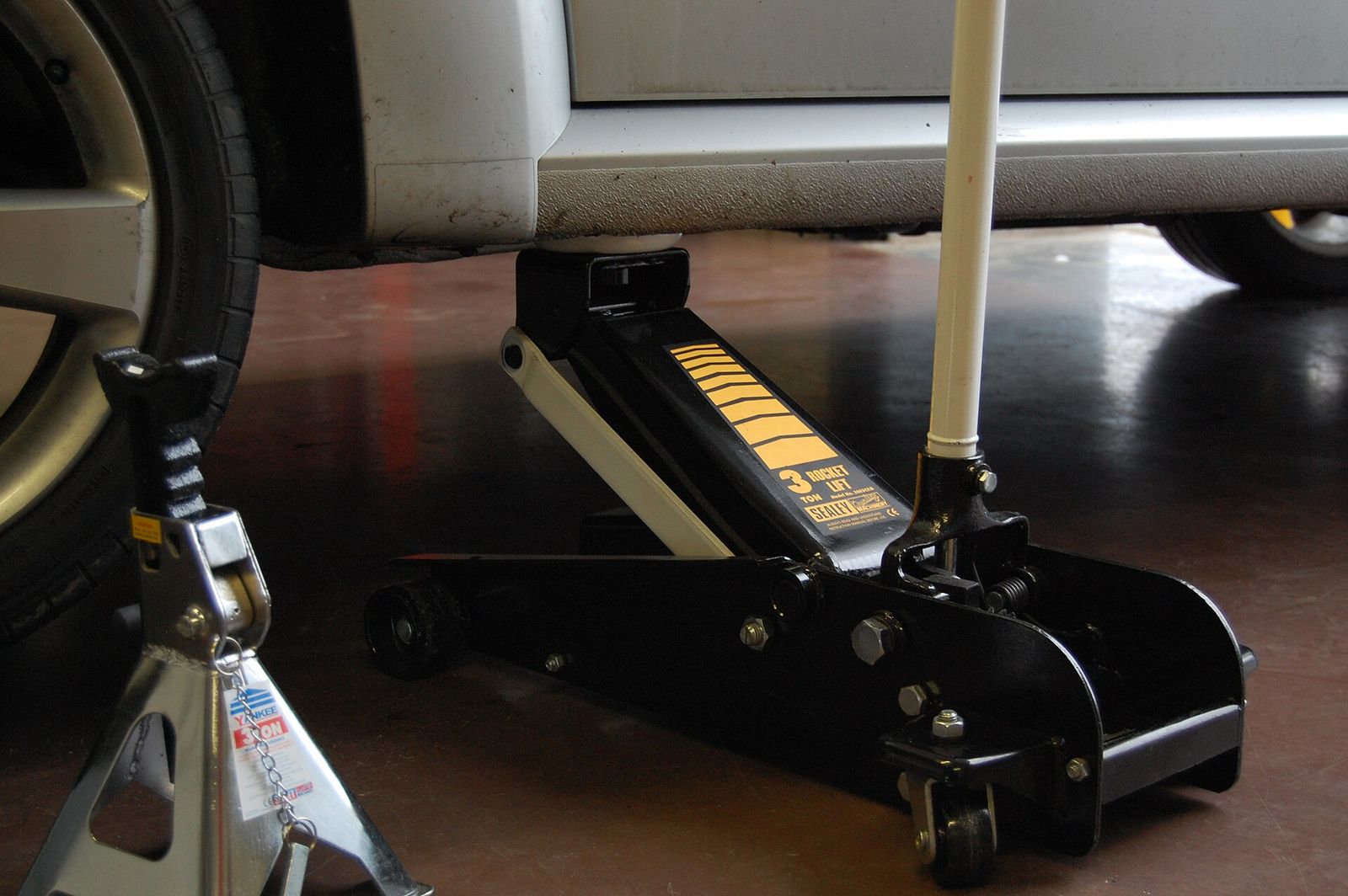
Swapping wheels, changing brake pads and draining oil all start with getting the car off the ground, and that is the part of home car maintenance where mistakes are most dangerous. The principle is simple: a jack lifts the car and stands hold it up. This guide explains the main types of jack, what capacity and lift-range figures mean, how to choose stands, and where and how to lift a car safely.
A jack lifts, a stand holds
A hydraulic jack holds the car up on oil pressure, sealed in by valves and seals. It can creep down slowly or drop suddenly if a seal fails, and it's designed to raise a load, not to support one while someone works underneath. Jack stands, called axle stands in the UK, are mechanical supports that lock at a fixed height.
The one rule: never put any part of your body under a vehicle held up only by a jack. Lift it, lower it onto stands rated for the load, and check that it's stable before you go underneath.
The scissor jack that comes in many cars' spare-wheel kits is meant for changing a wheel at the roadside, and nothing more.
Types of jack
| Type | Typical use | Strengths | Limitations |
|---|---|---|---|
| Scissor | Roadside wheel changes | Light, compact, supplied with many cars | Slow, narrow base, not for workshop use |
| Floor (trolley) | Home and workshop | Stable, quick, rolls into position | Heavy and long; needs a hard, smooth floor |
| Low-profile floor | Lowered and sports cars | Slides under low bodywork | Longer still; some lift less high |
| Bottle | Trucks, SUVs, vans | Compact, high capacity for its size | Tall minimum height, small saddle, less stable |
| High-lift (farm) | Off-road recovery | Very tall lift | Unstable; the handle can kick back; specialist use |
Floor jacks are the usual choice at home. A long chassis on wheels carries a lifting arm driven by a hydraulic pump. As the arm rises in an arc, the jack rolls slightly towards the car, so it doesn't drag the saddle sideways. Steel versions are heavier and generally cheaper; aluminium and hybrid ones are easier to carry.
Bottle jacks put a vertical ram in a compact body. They lift a lot for their size and suit tall vehicles, but their minimum height is often too tall to fit under a car, they must be used upright, and the small saddle and base make them less stable than a floor jack.
What the capacity ratings mean
Jacks and stands are rated in tons or tonnes. A US ton is 2,000 lb, about 907 kg, so it's lighter than a metric tonne of 1,000 kg. Check which one the label means.
When you lift one end of a car, the jack carries that end's share of the weight, often more than half on a car with the engine at the front. Leave a generous margin:
- Jack: a common rule of thumb is a rating of at least three-quarters of the vehicle's gross weight.
- Stands: usually rated per pair. A pair labelled 3 tons is meant to share 3 tons between them, not carry 3 tons each. Choose a pair whose combined rating is at least the vehicle's gross weight.
- Gross weight is the maximum loaded weight, shown in the handbook and often on a label in the driver's door frame. Electric cars and loaded pickups are heavier than they look.
In North America, look for compliance with ASME PASE, the standard for portable automotive service equipment, which covers both jacks and stands. In Europe, jacks are covered by EN 1494. Some jack stand designs have been recalled in the past, so register your purchase and check for recalls.
Lift range: minimum and maximum height
Two figures matter as much as capacity:
- Minimum height: the lowered saddle must fit under the lifting point. Standard floor jacks often start at about 13–15 cm (5–6 in); low-profile models go down to roughly 7–9 cm (3–3.5 in). Bottle jacks commonly start somewhere around 15–25 cm (6–10 in).
- Maximum height: the jack must raise the car high enough to fit stands and take a wheel off. Car floor jacks commonly reach roughly 45–50 cm (18–20 in); jacks for trucks and lifted SUVs go higher.
Measure the height of your car's lifting points and, for a long floor jack, the lowest point of the front bumper or spoiler it must slide under. Very low cars may need to drive onto low ramps first.
Choosing jack stands
- Ratchet stands have a toothed post held by a spring-loaded pawl. They're quick to adjust; look for a positive lock and a secondary safety pin.
- Pin stands use a steel pin through holes in the post. They're simple and positive, with coarser height steps.
- Screw stands adjust on a thread, which allows fine height setting.
- Base and saddle: a wide base resists tipping. V- or U-shaped saddles suit axles and frame rails; rubber or slotted saddles suit the pinch-weld seams on many cars.
Always use stands in pairs, set to the same height. Before each use, look for bent legs, cracked welds, worn teeth and a pawl that doesn't snap firmly into place, and retire any damaged stand. Drive-on ramps are a good alternative for oil changes, used with wheel chocks on level ground.
Where to lift: finding the right points
Your owner's handbook shows the lifting points; workshop manuals often add the support points used by garage lifts.
- Sill points: most modern cars have reinforced points on the pinch-weld seam under the sills, just behind the front wheels and in front of the rear wheels, often marked by notches, arrows or a small triangle. A flat steel saddle can bend this seam, so use a slotted rubber pad, often sold as a pinch-weld adapter.
- Central points: many handbooks show a front crossmember or subframe point and a rear point (a towing-eye bracket, subframe or, on some rear-wheel-drive cars, the differential) for lifting a whole end with a floor jack. Use them only if the handbook shows them.
- Trucks with a separate frame: the frame rails and solid axle tubes are strong lifting and support points.
- Never lift on the oil sump, gearbox casing, floor pan, exhaust, plastic sill covers or undertrays, steering parts, or suspension arms the manual doesn't list.
- Electric and hybrid cars: the battery pack covers much of the floor. Lift only at the marked points, with any adapters the manufacturer specifies, and never on the battery casing.
A common approach is to lift at a central point, then set stands under the sill points or frame on each side.
Lifting a car safely, step by step
- Park on firm, level concrete. Gravel, grass, slopes and asphalt softened by heat are not safe bases.
- Apply the parking brake, select Park or a low gear, and switch off.
- Chock the wheels at the end that stays on the ground.
- If you're removing a wheel, loosen the wheel nuts slightly while the tyre still grips the ground.
- Centre the saddle under the lifting point and lift slowly, checking that it seats squarely.
- Raise the car a little higher than needed, place the stands, set them to the same height and lower slowly onto them.
- Check stability: give the car a firm push. If it moves or rocks, lift it and reposition the stands.
- As a backup, leave the jack raised just short of the car, and slide a removed wheel under the sill.
- To finish, lift the car off the stands, remove them, lower slowly and torque the wheel nuts to the specified value. Our guide to torque wrenches explains how.
Care and storage
- Store a floor jack with the ram fully lowered, which protects the polished piston from rust and dirt.
- Check the oil level as the manual describes, and top up only with the oil it specifies, usually hydraulic jack oil. Brake fluid can damage the seals.
- A jack that feels spongy or won't reach full height may have air trapped in it; the manual explains how to bleed it.
- Repair or replace any jack that sinks under load, leaks or has a bent arm.
The short version
- A jack lifts; stands hold. Never go under a car supported only by a jack.
- A floor jack suits most home use; check its minimum and maximum heights against your car.
- Choose a jack rated for at least three-quarters of the gross weight, and stands rated per pair for the full gross weight.
- Lift only at the handbook's points, with a pad on pinch welds.
- Work on level concrete, chock the wheels, lower onto stands and push-test before going underneath.
Bloiq is reader-supported. Some links may earn us a commission; it never affects what we write. How we make money.
Cover photo: Mark Hunter, CC BY 2.0, via Wikimedia Commons