Home / Travel / Spain · Where to stay
Where to stay in Seville: neighbourhoods compared, with summer heat tips
Santa Cruz, the Centro, El Arenal, Triana, the Alameda, the María Luisa Park area and Nervión compared, plus how to choose a room that copes with Seville's summer heat.
This guide contains affiliate links, marked as such. If you book through them, Bloiq may earn a commission at no extra cost to you.
Seville's historic centre is one of the largest in Europe, yet the cathedral, the Real Alcázar and most of the famous sights are a short stroll apart. Where you stay changes the feel of your trip more than the logistics: whitewashed lanes or a riverside barrio, late-night tapas squares or quiet residential streets. And from June to September, the building you sleep in matters almost as much as the neighbourhood. Here's how the main areas compare.
The quick answer
- First visit, sights on the doorstep: Santa Cruz or the streets around the cathedral.
- Shopping, tapas and a central hub: the Centro, around Plaza Nueva, Alfalfa and the Encarnación.
- Between the cathedral and the river: El Arenal.
- Local character, ceramics and flamenco: Triana.
- Bars, a younger crowd and an alternative feel: the Alameda de Hércules and the Macarena.
- Green space and space to breathe: around the María Luisa Park and San Bernardo.
- Train travellers and quieter, modern hotels: Nervión, near Santa Justa station.
Santa Cruz: the classic old quarter
Santa Cruz is the Seville of postcards: a maze of narrow lanes, whitewashed houses with iron balconies, tiled patios and small squares shaded by orange trees. It wraps around the walls of the Real Alcázar and sits right beside the cathedral and the Archivo de Indias, which together form a UNESCO World Heritage Site. The Murillo Gardens run along its eastern edge.
Good for: first-time visitors, short stays and anyone who wants to step straight out into the old city. Consider: the lanes are busy with tour groups by day, cars and taxis can't reach many doors, and rooms in old houses can be small.
The Centro: Plaza Nueva, Alfalfa and the Encarnación
North of the cathedral, the commercial heart of the city spreads around the shopping streets of Sierpes and Tetuán, the town hall on Plaza Nueva, and the bar terraces of Plaza del Salvador and Alfalfa. Further north, the Metropol Parasol, a huge wooden canopy locals call "Las Setas" (the mushrooms), shelters a market and a rooftop walkway.
Good for: travellers who want shops, restaurants and nightlife on foot, with the tram at Plaza Nueva. Consider: it can be noisy at night, especially around Alfalfa and El Salvador, and Holy Week processions pass through these streets.
El Arenal: between the cathedral and the river
El Arenal was once the city's port district. Today it holds the Real Maestranza bullring, the Maestranza theatre and, on the riverbank, the Torre del Oro, a medieval watchtower that now houses a small naval museum. The riverside promenade is lovely in the evening, and the cathedral is only a few minutes away.
Good for: couples and anyone who wants a central base that feels more open than Santa Cruz. Consider: some streets are full of bars aimed at visitors, and it's busy during events at the bullring.
Triana: across the river
Over the Isabel II Bridge (usually just called the Triana Bridge) lies the barrio with the strongest identity in Seville, with a long tradition of ceramics and flamenco. The Triana Market sits beside the bridge, above the excavated remains of the Castillo de San Jorge, and the riverside Calle Betis looks back across the water at the old city. South of Triana, residential Los Remedios hosts the April Fair grounds.
Good for: repeat visitors, food lovers and travellers who prefer a neighbourhood where people actually live. Consider: the cathedral is a 15- to 25-minute walk. Calle Betis is lively at night, and Los Remedios is packed during the April Fair.
The Alameda de Hércules and the Macarena
The Alameda de Hércules, a long, tree-lined square laid out in the 16th century, is ringed by bars and cafés and has a relaxed, bohemian, LGBTQ+-friendly feel. North of it, the Macarena district has the Basílica de la Macarena, home of one of the most venerated images in Holy Week, and a surviving stretch of the medieval city walls. Calle Feria has a traditional food market and a long-running Thursday flea market.
Good for: younger travellers, longer stays and anyone who enjoys evenings out among locals. Consider: it's a 15- to 25-minute walk to the cathedral, and the Alameda's terraces are loud on weekend nights.
Around the María Luisa Park and San Bernardo
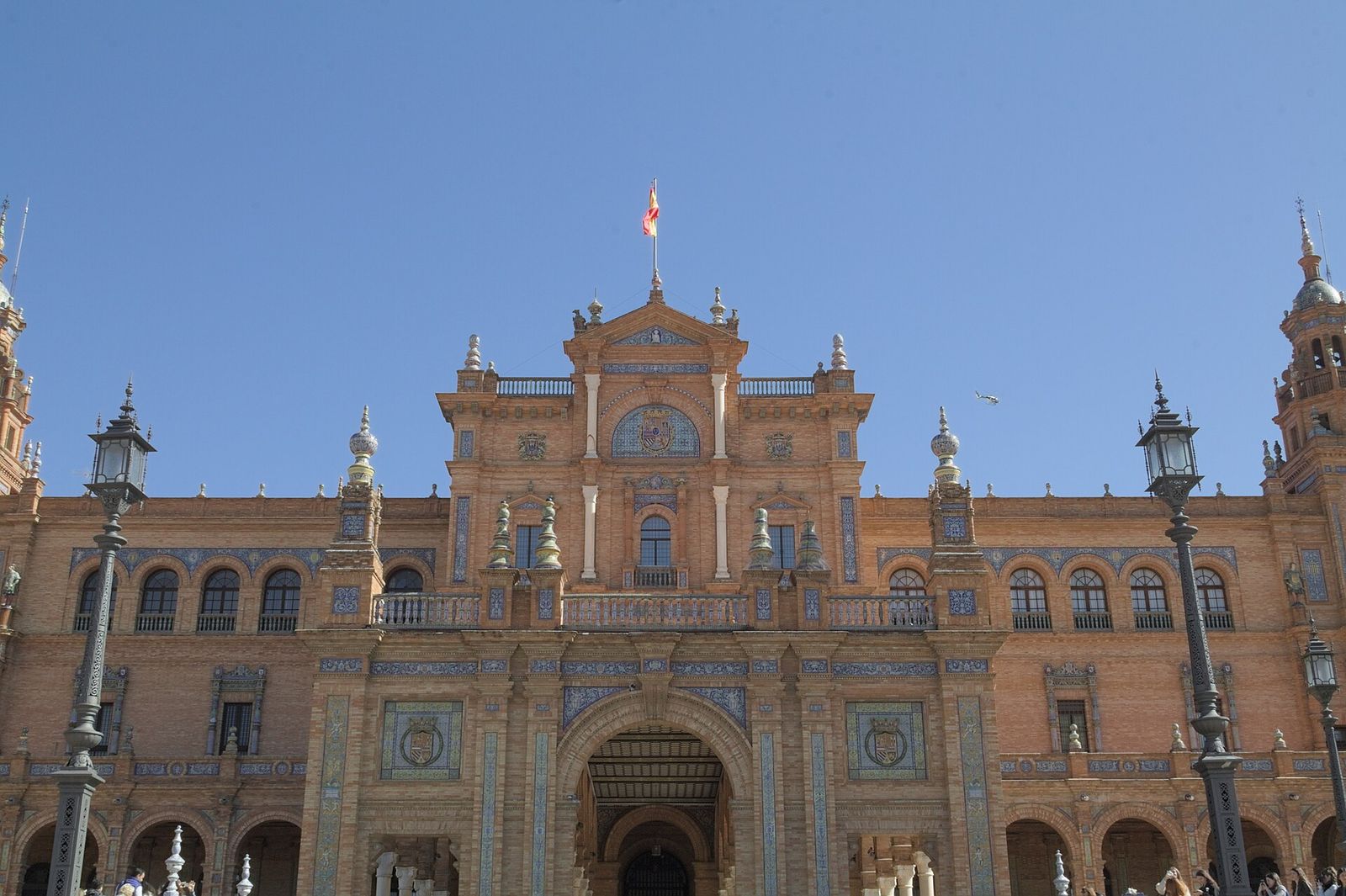
South of the centre, the María Luisa Park and the Plaza de España, both shaped by the 1929 Ibero-American Exposition, give this area more greenery than anywhere else in central Seville. San Bernardo, to the east, has metro and suburban rail stations, and the Prado de San Sebastián bus station and tram stop are close by.
Good for: families, runners and travellers who want a calmer base with easy transport. Consider: evenings are quieter, and it's a 10- to 20-minute walk to the cathedral, longer from the far side of the park.
Nervión: modern and practical
East of the old city, Nervión is a modern commercial district with shopping centres, office blocks and the Sevilla FC stadium. Santa Justa station, the main railway station, is on its northern edge, and both the metro and the tram serve the area.
Good for: business travellers, early trains and anyone who prefers newer buildings. Consider: it lacks historic atmosphere, the old centre is a tram ride or a 25- to 35-minute walk away, and match days bring crowds.
How the areas compare
| Area | Noise at night | Walk to the cathedral | Best for |
|---|---|---|---|
| Santa Cruz | Medium | 0–10 min | First visits |
| Centro | High in places | 5–15 min | Shopping, tapas |
| El Arenal | Medium | 5–10 min | Central, by the river |
| Triana | Medium, high on Betis | 15–25 min | Local character |
| Alameda / Macarena | High at weekends | 15–25 min | Evenings out |
| María Luisa / San Bernardo | Low | 10–20 min | Families, transport |
| Nervión | Low | 25–35 min | Trains, modern hotels |
Choosing a room for the summer heat
Seville has one of the hottest summers in Europe. In July and August, afternoon highs often reach the high 30s °C (around 100 °F), heatwaves push past 40 °C, and nights can stay warm. Spring and autumn are far more comfortable for sightseeing.
- Air conditioning is non-negotiable from June to September. Check that the listing says the bedroom itself is air-conditioned, not just the common areas.
- Avoid top-floor rooms under the roof in summer unless the building is well insulated; they can stay hot long after sunset.
- Interior rooms facing a patio are often cooler and quieter, if darker.
- A pool or shaded roof terrace makes a real difference on the hottest afternoons, even a small rooftop plunge pool.
- Plan the day around the heat: visit the Alcázar and the cathedral early, rest indoors through the afternoon and head out again in the evening, as locals do.
- Carry water and wear a hat, and check the heat warnings issued by Spain's weather service.
- In August some family-run restaurants and shops close for their own holidays.
Getting around
- From the airport: an airport bus runs to the centre, stopping near Santa Justa station, the Prado de San Sebastián and Plaza de Armas, in roughly 35–40 minutes. Taxis are plentiful; check the current airport fare.
- Tram and metro: a short tram line runs from Plaza Nueva past the cathedral and San Bernardo to Nervión, and the single metro line crosses the city via Puerta de Jerez, San Bernardo and Nervión.
- Cycling: the city has many cycle lanes and a public bike-share scheme.
- Trains: high-speed trains from Santa Justa reach Córdoba in under an hour and Madrid in about two and a half hours; see our guide to where to stay in Madrid if you're combining the two.
- Driving: avoid it in the old town, where access is restricted and parking is scarce. A car is useful for Andalusian villages or the Algarve coast, roughly two hours' drive away.
Practical tips before you book
- Holy Week and the April Fair, the city's two great spring festivals, fill the centre. Rooms book out months ahead, minimum stays are common, and processions can block the streets around the cathedral for hours. Check the dates for your year.
- Check the exact street. In Santa Cruz and the Centro, cars may not reach the door, and older buildings may have no lift.
- Holiday apartments are regulated, and the city has restricted new tourist flats in parts of the centre. Make sure any apartment you book is properly licensed.
- Tourist tax: a city tourist tax has been under discussion; check whether one applies when you travel.
Choose Santa Cruz or El Arenal for a first visit, Triana or the Alameda for local life, and the María Luisa Park area or Nervión for calm. Then pick a room that stays cool, and Seville is a pleasure in any season.
Bloiq is reader-supported. Some links may earn us a commission; it never affects what we write. How we make money.
Cover photo: o_andras, CC BY-SA 4.0, via Wikimedia Commons