Home / Travel / France · Campus tours
Sorbonne campus tour: visiting the Latin Quarter's historic university
A guide to visiting the Sorbonne in Paris: the historic building and chapel, the Jussieu science campus, the Latin Quarter, open days, transport and where to stay.
"The Sorbonne" means several things at once, and that confuses many families planning a visit. It is a famous building in the Latin Quarter of Paris, the historic seat of the University of Paris. It is also part of the name of several modern universities, the largest of which is Sorbonne Université. This guide untangles the names, then shows what you can actually see, how to get an open-day visit right, and where to base yourselves.
First, which Sorbonne?
The medieval University of Paris grew up on the Left Bank, and the Sorbonne began as a college founded around 1257 by Robert de Sorbon, a chaplain to King Louis IX. After 1968, the university was split into separate institutions. Today:
- The Sorbonne building on Rue des Écoles is shared by several universities and houses the Chancellerie des universités de Paris, which looks after the building.
- Sorbonne Université was created in 2018 by merging Paris-Sorbonne (humanities) and Pierre and Marie Curie (sciences and medicine). It has faculties of letters, science and engineering, and medicine.
- Other universities carry the name too, among them Université Paris 1 Panthéon-Sorbonne and Sorbonne Nouvelle, each with its own programmes and sites.
When you look at a programme, check which university offers it and where the classes are held. A literature student and a physics student may spend their days in very different buildings.
The historic Sorbonne building
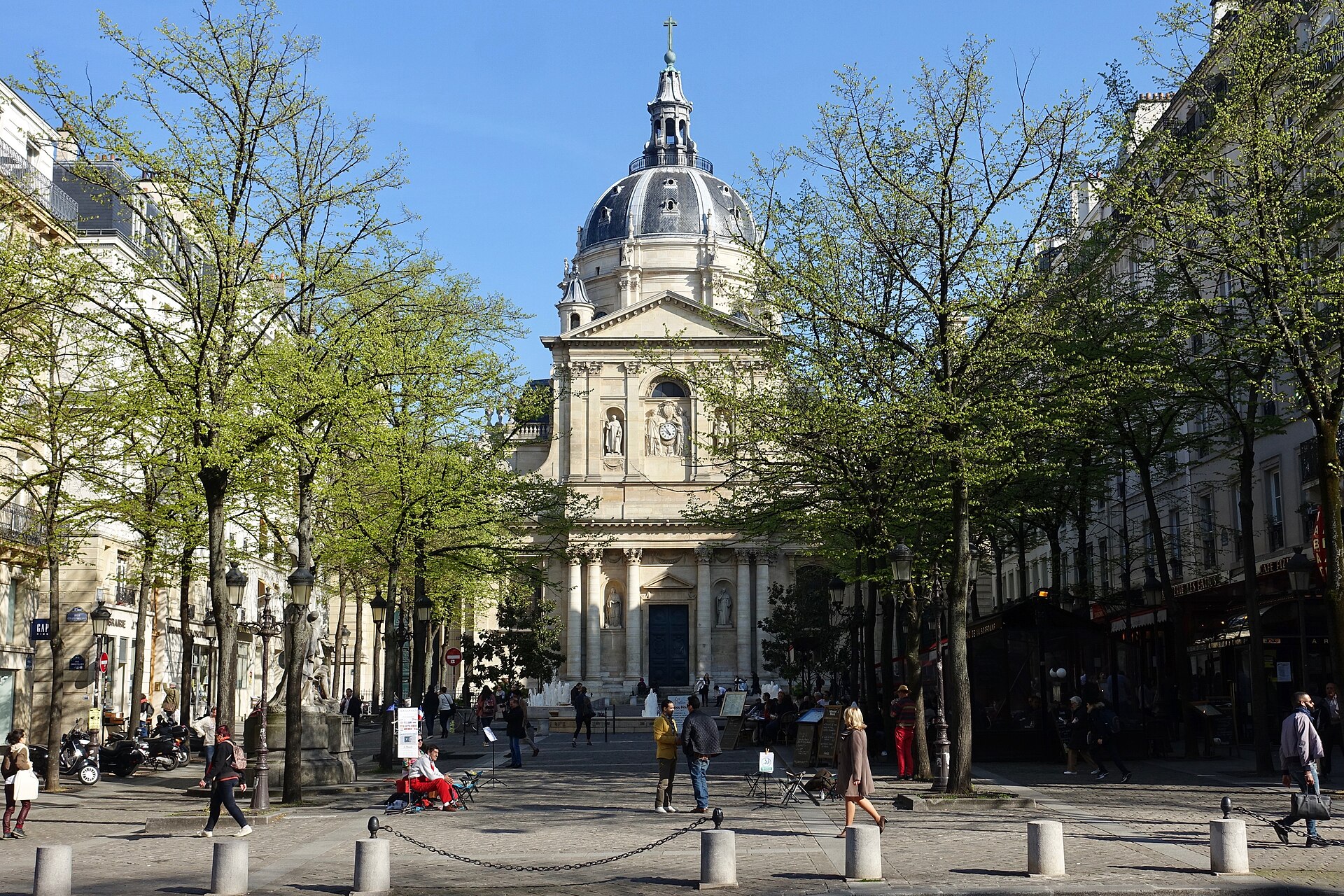
The building you see today dates mostly from a rebuilding completed around 1900, with a grand amphitheatre, a library, galleries and painted halls. Its main entrance faces Rue des Écoles; the most photographed view is from the Place de la Sorbonne, a small square with fountains and café terraces that ends at the domed chapel.
Access is controlled. The interior can usually be seen only on organised guided visits, which need to be booked well ahead, and during special events such as the European Heritage Days in September. Check the official Sorbonne visitor information for current options.
The chapel and Richelieu's tomb
The Chapelle de la Sorbonne, with its dome and classical facade, was built in the 1630s and 1640s for Cardinal Richelieu, who was the college's patron. His tomb is inside. The chapel opens mainly for exhibitions and events, so look out for what's on during your dates.
Jussieu: the science and engineering campus
About fifteen minutes' walk east, the Pierre and Marie Curie campus at Jussieu is where most of Sorbonne Université's science is taught. It's a vast modernist grid of buildings raised on pillars, with courtyards between them and the Zamansky tower rising above. It's not pretty in the traditional sense, but it's a real campus, and it sits next to the Seine, the Institut du monde arabe and the Jardin des Plantes, with its greenhouses and natural history galleries. Medicine is taught mainly around the big teaching hospitals, such as the Pitié-Salpêtrière.
A walk around the Latin Quarter
The university's neighbourhood is the real campus. In a couple of hours on foot you can see:
- The Panthéon, up the hill from the Sorbonne, and the elite lycées around it.
- The Luxembourg Gardens, where students read and relax between classes.
- The Musée de Cluny, the national museum of the Middle Ages, next to the Sorbonne.
- Rue Mouffetard, a sloping market street with inexpensive restaurants.
- The quays of the Seine with their bookstalls, and Notre-Dame across the river.
How students live
There are no US-style dorm campuses. Students rent rooms and studios across Paris and the inner suburbs, share flats, or live in public student residences. The Cité internationale universitaire de Paris, in the 14th arrondissement, is a large park lined with residence houses, many of them associated with particular countries. Paris housing is hard to find, so admitted students should apply early for university and public options.
Undergraduate degrees (the licence) are taught in French; some master's programmes are in English. Expect lectures in large amphitheatres and more independent study than many international students are used to.
Visiting and open days
French universities don't usually run daily campus tours. Instead, they hold open days (journées portes ouvertes) with talks by departments and student associations, and many run online information sessions. International applicants should also look at the official national channels for studying in France. Check Sorbonne Université's official pages for current dates and formats.
Reaching campus
- From Charles de Gaulle Airport: the RER B runs directly to Saint-Michel–Notre-Dame and Luxembourg, both a short walk from the Sorbonne.
- Metro: line 10 stops at Cluny–La Sorbonne; lines 7 and 10 serve Jussieu.
- On foot: the Sorbonne, Jussieu and the Panthéon are all within about fifteen minutes of each other.
Choosing a base for the visit
The Latin Quarter (5th) puts you within walking distance of both the Sorbonne and Jussieu. Saint-Germain-des-Prés (6th) is elegant and close by, and the Marais, across the river, is lively and central. Our guide to where to stay in Paris compares these areas in more detail.
Tips before you go
- Book any guided visit of the Sorbonne building as early as possible.
- Build in time for the city: our Paris 3-day itinerary fits easily around a morning of university visits.
- In July and August the university is quiet and many offices close; visit during term to see student life.
Bloiq is reader-supported. Some links may earn us a commission; it never affects what we write. How we make money.
Cover photo: Guilhem Vellut from Paris, France, CC BY 2.0, via Wikimedia Commons