Home / Travel / United States · Campus tours
Penn campus tour: Locust Walk, the Quad and University City
A visitor's guide to the University of Pennsylvania in Philadelphia: College Hall, Locust Walk, Fisher Fine Arts Library, the Quad, the Penn Museum and getting there.
The University of Pennsylvania traces its founding to Benjamin Franklin, and his influence is everywhere on campus, from statues to street names. Penn fills much of University City in West Philadelphia, just across the Schuylkill River from downtown, and it combines a green, walkable core with the energy of a big city. For families planning a visit, the good news is that the campus is easy to reach by train and easy to explore on foot. Here's how to approach it.
Start with the geography
Think of Penn as a long rectangle running west from the Schuylkill River. Its spine is Locust Walk, a pedestrian path that crosses the campus from east to west, with the main academic buildings, libraries and many student organisations on either side. Most of the undergraduate college houses are toward the western and southern edges. Drexel University is immediately to the north, and the busy streets of University City, with their food trucks, cafés and shops, wrap around the whole area.
A good visit follows Locust Walk from east to west, with a few detours.
College Hall and the Franklin statues
Near the eastern end of the central campus stands College Hall, built in the 1870s of green serpentine stone, the oldest building on this campus and still home to the university's main offices. In front of it, a seated bronze of Benjamin Franklin looks out over the lawn. A second, more casual Franklin, sitting on a bench reading a newspaper, is a favourite photo stop along Locust Walk.
The Fisher Fine Arts Library
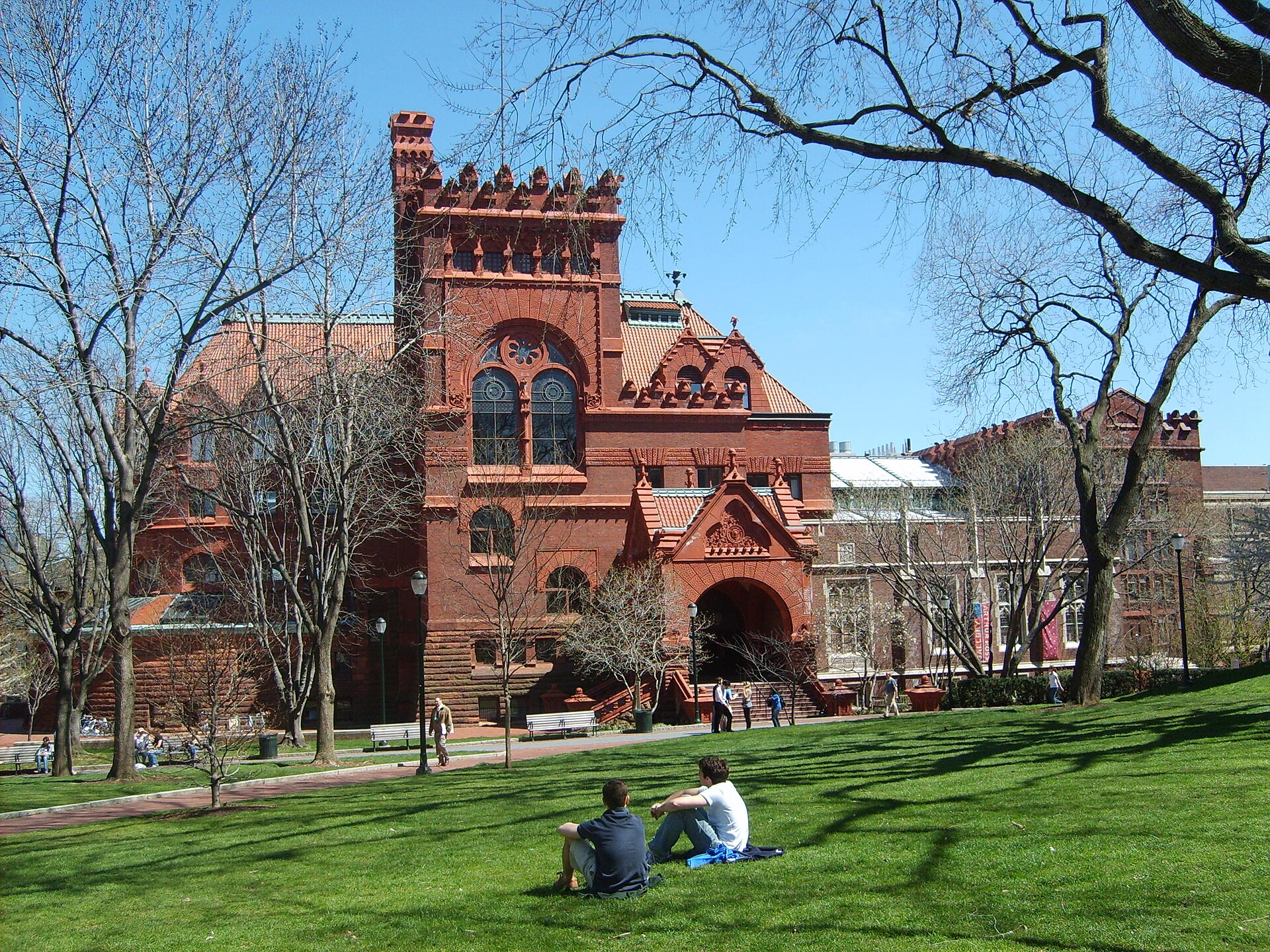
Right beside College Hall is the Fisher Fine Arts Library, designed by the Philadelphia architect Frank Furness and completed in 1891. Its red sandstone, brick and terracotta, heavy chimneys and tall reading room lit from above make it one of the most striking buildings in the city. It was built as the university's main library and now serves the fine arts, architecture and design.
Along Locust Walk
Locust Walk is where Penn's student life is most visible: people heading to class, groups handing out flyers, and fraternity and society houses along its middle section. Near Van Pelt Library, the main library, is the Split Button, a large sculpture of a broken button by Claes Oldenburg, where students like to sit and meet. Houston Hall, one of the first student unions built in the United States, is close by.
The Quad and the college houses
First-year students at Penn live in college houses, residential communities with their own faculty, staff and programmes. Many begin in the Quad, a long chain of courtyards in the Collegiate Gothic style, with turrets, archways and carved details. It sits just south of Locust Walk, and tours usually pass through or beside it.
The Penn Museum and Franklin Field
At the south-eastern edge of campus, the Penn Museum is one of the great university museums of archaeology and anthropology. It holds major collections from ancient Egypt, Mesopotamia, the Mediterranean, Asia, Africa and the Americas. Its most famous resident is a granite sphinx of the pharaoh Ramesses II, one of the largest sphinxes outside Egypt. The museum is open to the public; check current hours before you go.
Nearby, Franklin Field hosts Penn football and each spring the Penn Relays, a huge track and field meet that brings thousands of high school, college and professional athletes to campus. Penn Park, along the river, adds playing fields and views of the Center City skyline.
Reaching campus
- By train: 30th Street Station, one of the busiest stations on the Northeast Corridor, is a short walk from the eastern edge of campus. Trains from New York usually take about 75 to 90 minutes.
- From the airport: Philadelphia International is connected by a regional rail line that stops at University City and 30th Street, typically in under half an hour.
- Around the city: the Market–Frankford subway line and the trolley lines under Market Street link campus with Center City in a few minutes. Walking from Rittenhouse Square takes about 25 minutes across the river.
Visiting: tours and information sessions
Penn's admissions office generally runs information sessions and student-led campus tours on many days during the academic year, and registration in advance is usually required. Self-guided walking tours are also offered for those whose schedules don't fit. Formats and times change, so check the university's official admissions and visitor pages before you travel.
Choosing a base for the visit
- University City: several hotels are on or next to campus, ideal for an early start.
- Center City: Rittenhouse Square and the streets around it offer more choice, plus restaurants, parks and museums, with an easy ride or walk to campus.
- Near 30th Street Station: convenient if you're arriving by train and continuing to other campuses.
Pairing Penn with other visits
Philadelphia's historic district, including Independence Hall and the Liberty Bell, is about 15 minutes away by subway. If you're building a longer college trip along the Northeast Corridor, Princeton is around an hour away by train, Columbia under two hours, and Johns Hopkins in Baltimore is a similar distance to the south.
Tips for the day
- Allow two to three hours for the tour and Locust Walk, and more if you add the Penn Museum.
- Weekdays during term show the campus at its busiest.
- Spring brings the Penn Relays and blossom on the walks; late spring and early autumn are the most comfortable seasons weather-wise.
- Wear comfortable shoes: the campus is flat but long from end to end.
Bloiq is reader-supported. Some links may earn us a commission; it never affects what we write. How we make money.
Cover photo: MatthewMarcucci at English Wikipedia, Public domain, via Wikimedia Commons