Home / Travel / Italy · Day trips
Day trips from Florence: Siena, Pisa and Lucca, Chianti and Bologna
The best day trips from Florence compared by travel time: medieval Siena, Pisa and walled Lucca, the Chianti wine villages and Bologna's porticoes and food.
Florence sits at the centre of a web of railways and roads, which makes it one of the best bases in Italy for day trips. Within about an hour you can be in a Gothic hill city, at the Leaning Tower, inside a ring of Renaissance walls, among vineyards or in the food capital of the north. Most of these trips work well by train or bus; one is far better with a car or a tour. This guide compares the classic options, explains how to get to each one and how long to allow.
The quick comparison
- Siena: about 1 to 1.5 hours by bus or train. Best for a medieval city, a great cathedral and the Piazza del Campo. A full day.
- Pisa and Lucca: about an hour by train to Pisa, then around 30 minutes on to Lucca. Best for the Leaning Tower and a walk on the walls. A full day for both.
- Chianti: 30 minutes to an hour by car. Best for wine, villages and countryside. A full day, ideally with a driver or tour.
- Bologna: under 40 minutes by high-speed train. Best for food, porticoes and a lively university city. A full day.
Siena: Gothic streets and the Piazza del Campo
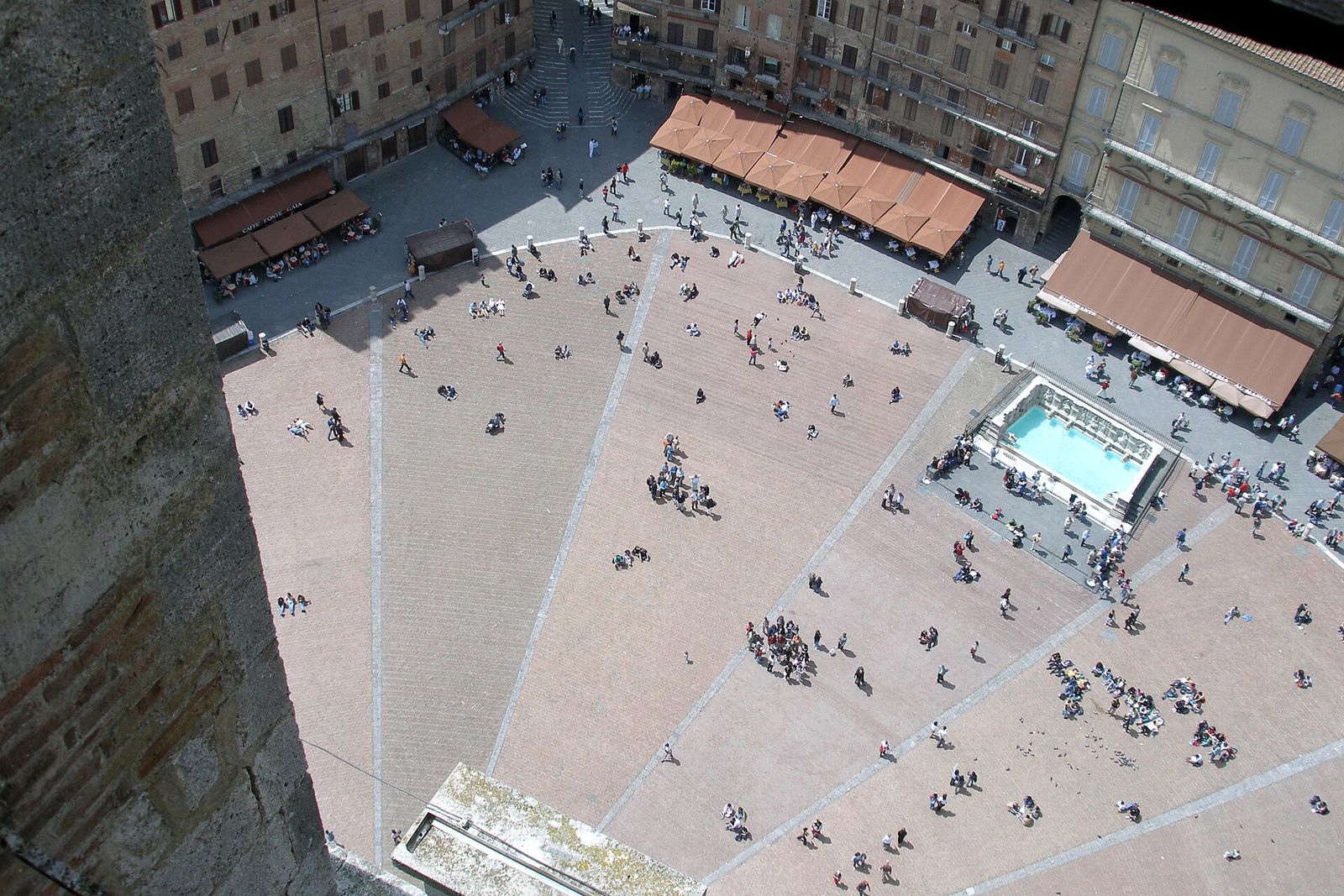
Siena was Florence's great rival in the Middle Ages, and its historic centre, a UNESCO World Heritage Site, still feels like a Gothic city. Its heart is the Piazza del Campo, a sloping, shell-shaped square where the Palio horse race is run twice each summer, on 2 July and 16 August.
Getting there: direct buses from near Santa Maria Novella take roughly 1 to 1.5 hours and arrive close to the centre. Trains take about as long, but Siena's station is below the town, so you'll need a local bus or the escalators up the hill.
What to see: - The Piazza del Campo: with the Palazzo Pubblico, home to the Civic Museum and its famous frescoes of good and bad government, and the tall Torre del Mangia, which can be climbed. - The cathedral: a striped marble building with an inlaid marble floor, the Piccolomini Library and its frescoes, and the unfinished extension known as the Facciatone, with views from the top. - The contrade: Siena is divided into 17 districts, each with its own symbol, flag and fountain, which you'll spot as you wander.
How long: a full day. If the Palio days fall during your trip, expect huge crowds and plan carefully.
Pisa and Lucca: the Leaning Tower and a walled city
These two make an easy pair on the same railway line.
Pisa: the Piazza dei Miracoli (Square of Miracles) brings together the cathedral, the baptistery, the monumental cemetery (Camposanto) and the famous bell tower that began to lean during construction in the 12th century. Climbing the tower is by timed ticket, numbers are limited and children under a certain age aren't allowed, so book ahead on the official site and check the current rules. Beyond the square, the riverside and the university town are worth an hour.
Lucca: a calm, elegant city entirely surrounded by Renaissance walls, about 4 km around, topped with a tree-lined path that's ideal for walking or cycling. Inside, look for the oval Piazza dell'Anfiteatro, built on the outline of a Roman amphitheatre, the Guinigi Tower with trees growing on its roof, the cathedral of San Martino and the church of San Michele in Foro. Lucca is also the birthplace of Giacomo Puccini.
Getting there: regional trains from Santa Maria Novella reach Pisa Centrale in about an hour; the Piazza dei Miracoli is a 20–25 minute walk or a short bus ride from there, and Pisa San Rossore station is closer. Trains between Pisa and Lucca take around 30 minutes, and direct trains from Florence to Lucca take roughly 1.5 hours.
How long: a full day for both. Do Pisa in the morning before the crowds peak, then spend the afternoon on Lucca's walls.
Chianti: vineyards and hill villages
The Chianti hills between Florence and Siena are classic Tuscan countryside: vineyards, olive groves, cypress-lined drives and stone villages. The Chianti Classico wine area, marked by its black rooster symbol, covers villages such as Greve in Chianti, Panzano, Castellina in Chianti and Radda in Chianti.
Getting there: the scenic SR222, the Chiantigiana road, runs from Florence through the heart of the region. Regional buses reach some villages, such as Greve, but wineries are spread out and services are limited, so a car, a hired driver or a guided wine tour is far easier.
What to see: - Greve in Chianti: a market town with a funnel-shaped arcaded square. - Panzano, Castellina and Radda: small hill villages with views and places for a long lunch. - Wineries: many offer tastings and cellar visits, usually by booking.
How long: a full day. Italy's drink-driving limits are strict, and lower for newly licensed drivers; if you plan to taste, don't drive. Florence's historic centre is a restricted traffic zone (ZTL) with cameras, so check the rules before picking up or returning a rental car.
Bologna: porticoes, towers and food
Bologna, in Emilia-Romagna, is one of the easiest day trips from Florence. It's home to one of the oldest universities in the world, many kilometres of covered porticoes, inscribed on the UNESCO World Heritage List in 2021, and a food culture that gave the world tagliatelle al ragù, tortellini and mortadella.
Getting there: high-speed trains from Santa Maria Novella reach Bologna Centrale in under 40 minutes, mostly through tunnels under the Apennines. Book seats ahead at busy times.
What to see: - Piazza Maggiore: with the vast Basilica of San Petronio and the Neptune Fountain. - The Two Towers: the Asinelli and Garisenda towers, symbols of the city. Access to the Asinelli tower has been suspended in recent years while the Garisenda is made safe, so check whether it's open. - The Quadrilatero: the old market streets near the main square, lined with food shops and delis. - The Archiginnasio: a former seat of the university, with its anatomical theatre. - San Luca: the sanctuary on a hill outside the city, reached by a portico almost 4 km long.
How long: a full day, built around lunch.
Other easy trips
- Fiesole: a small hill town with an Etruscan and Roman archaeological area and views over Florence, about 20–30 minutes by city bus. Half a day.
- San Gimignano: the town of medieval towers, reached by bus via Poggibonsi, and a stop on our Tuscany hill towns road trip.
- Rome: high-speed trains take about 1.5 hours, but Rome deserves more than a day. See our day trips from Rome for ideas once you're there.
Practical tips for day trips from Florence
- Know your ticket type. Regional tickets aren't tied to a specific train; if you have a paper ticket, validate it before boarding, and check the rules for digital tickets. High-speed seats are reserved.
- Check for strikes. Italian transport strikes are announced in advance, so check the operators' sites and the news the day before.
- Start early. Pisa, Siena and San Gimignano are busiest in the middle of the day, especially in summer.
- Book timed entries ahead, such as the Leaning Tower, and check the opening days of museums, many of which close one day a week.
- Choose a base near Santa Maria Novella if you plan several trips by train or bus. Our guide to where to stay in Florence compares the areas, and with a car, the Tuscany hill towns road trip links Siena, the Chianti and the towns of the Val d'Orcia.
Bloiq is reader-supported. Some links may earn us a commission; it never affects what we write. How we make money.
Cover photo: Vyacheslav Argenberg, CC BY 4.0, via Wikimedia Commons