Home / Travel / Canada · Hotels
Château Frontenac, Québec City: history, setting and what's nearby
A guide to Québec City's landmark hotel: its railway-era history, its clifftop setting in Old Québec, how to get there and the best sights within a short walk.
This guide contains affiliate links, marked as such. If you book through them, Bloiq may earn a commission at no extra cost to you.
Few hotels define a city's skyline the way the Château Frontenac does. Its copper roofs and turrets crown the cliff above the St. Lawrence River, and almost every view of Old Québec includes it. This guide covers what the hotel is, where it sits, how to reach it and what to see within walking distance, so you can decide whether it's the right base for your trip.
A railway hotel that became a landmark
The Canadian Pacific Railway opened the hotel in 1893, one of a series of grand, château-style hotels it built to draw travellers onto its trains. The American architect Bruce Price designed the original building, and the hotel grew in stages; its tall central tower, the part most people picture, was added in 1924.
The Château's place in history goes beyond tourism. In 1943 and again in 1944, Winston Churchill and Franklin D. Roosevelt met in Québec City for the Quebec Conferences, and the hotel hosted delegates and meetings. Today it operates as Fairmont Le Château Frontenac, is a National Historic Site of Canada, and is often described as the most photographed hotel in the world.
Where it is and how to get there
The hotel stands in Upper Town, inside the walls of Old Québec, a district listed as a UNESCO World Heritage Site. It faces Place d'Armes on one side and the river on the other.
- By air: Québec City's Jean Lesage International Airport is roughly 20–30 minutes away by taxi, depending on traffic.
- By train: VIA Rail trains from Montréal arrive at the Gare du Palais in Lower Town, a short taxi ride or an uphill walk from the hotel.
- By car: the old town's streets are narrow and parking is limited, so check the hotel's parking arrangements before you arrive.
Once you're there, you won't need a car for the old town. Almost everything below is on foot.
Dufferin Terrace
Step outside and you're on Dufferin Terrace (Terrasse Dufferin), a wide wooden boardwalk running along the cliff edge. It's the town's evening promenade and the best place for sunset, with views across the river to Lévis. In winter, a traditional toboggan slide usually operates at its far end.
Petit Champlain and Place Royale
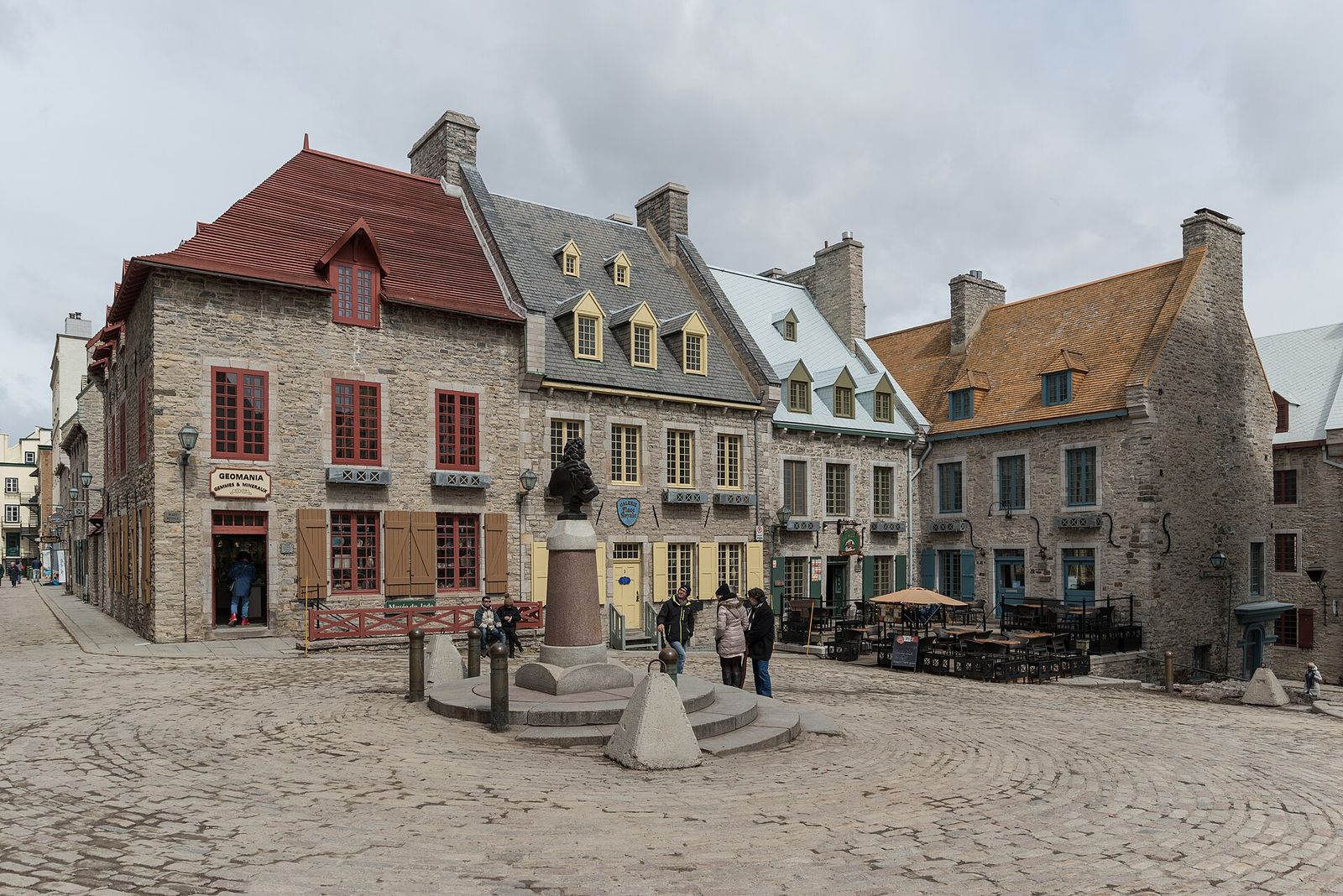
From the terrace, take the funicular or the steep Breakneck Stairs (Escalier Casse-Cou) down to Lower Town. The Petit Champlain quarter is a cluster of narrow lanes lined with shops, cafés and restaurants in old stone buildings. A few steps away, Place Royale marks the spot where Samuel de Champlain founded Québec in 1608; the small church of Notre-Dame-des-Victoires faces the square.
Allow an unhurried morning or afternoon for both, and go early in summer if you want photographs without crowds.
The walls, the Citadelle and the Plains of Abraham
Back in Upper Town, you can follow sections of the city walls, the only remaining fortified city walls north of Mexico, to the star-shaped Citadelle, an active military site with guided visits. Beyond it lie the Plains of Abraham, a vast park where the 1759 battle between British and French forces took place. Today locals picnic, jog and cross-country ski there, depending on the season.
Beyond the old town
- Montmorency Falls: about a 15–20 minute drive east, these falls are around 30 metres higher than Niagara. A cable car, stairs and a suspension bridge give different viewpoints.
- The Lévis ferry: the short crossing to Lévis and back is an easy, inexpensive way to see the whole of Old Québec from the water. After dark, the lit-up Château makes it the best view of the hotel itself.
- Île d'Orléans: a rural island of farms, orchards and villages, about 20–30 minutes' drive away, makes a good half-day by car.
Who it suits and when to go
The Château suits couples, history lovers and anyone who wants to stay inside the walls with the old town on the doorstep. Families will find the location practical, although the hills and stairs are real.
Summer and early autumn are the easiest seasons, with long days and outdoor terraces open. Winter is cold but, for many, the most memorable: snow on the roofs and the Québec Winter Carnival, which usually runs from late January into February. Hotels in the old town fill quickly for the carnival and summer festivals, so book early for those dates.
Nearby alternatives
If the Château is full or over budget, Old Québec has many smaller hotels and inns in historic buildings, both in Upper Town and around Petit Champlain in Lower Town. Staying just outside the walls, along Grande Allée or in Saint-Roch, is usually quieter and still walkable. If you're combining the trip with Montréal, the guide to where to stay in Montréal compares that city's neighbourhoods.
Practical tips before you book
- Room views vary widely. River-view rooms usually cost more; check what a room category actually overlooks.
- Pack for hills. Streets between Upper and Lower Town are steep; good shoes with grip matter, especially on icy winter days.
- Check the current rates for parking, taxes and any resort or service fees when you book.
- French is the main language of the city, though English is widely spoken in hotels and tourist areas.
Bloiq is reader-supported. Some links may earn us a commission; it never affects what we write. How we make money.