Home / Travel / United Kingdom · Day trips
Day trips from Edinburgh: Stirling, St Andrews, the Borders and Loch Lomond
How to reach Stirling, St Andrews, the Scottish Borders, Loch Lomond and the coast from Edinburgh, what to see in each and how long to allow.
Edinburgh makes an excellent base for seeing more of Scotland. Within an hour or so by train you can reach a royal castle, a medieval university town by the sea, ruined abbeys in the Borders or a very different city in Glasgow, and the first lochs and hills of the Highlands are not much farther. The main question is whether you want to go by train, by car or on an organised tour. Here's how the options compare.
The quick comparison
Travel times are rough guides from Edinburgh Waverley, by train unless noted.
| Trip | Typical travel time | Best for |
|---|---|---|
| Stirling | 45–55 minutes | A great castle, Wallace and Bannockburn |
| Linlithgow and Falkirk | 20–30 minutes | A royal palace, the Kelpies, the Falkirk Wheel |
| North Berwick | About 35 minutes | Beaches, seabirds, a clifftop castle |
| Rosslyn Chapel | 45–60 minutes by bus | Medieval stone carving, a half day |
| Glasgow | About 50 minutes | Museums and architecture |
| The Scottish Borders | About 1 hour to Tweedbank | Ruined abbeys, Walter Scott's home |
| St Andrews | About 1 hour to Leuchars, plus a short bus | Golf, ruins, a university town, beaches |
| Loch Lomond and the Trossachs | About 2 hours via Glasgow, or 1.5 hours by car | Lochs, boat trips, hill walks |
| Glencoe and the Highlands | 3 hours or more each way | Better as an overnight trip |
Stirling: castle and battlefields
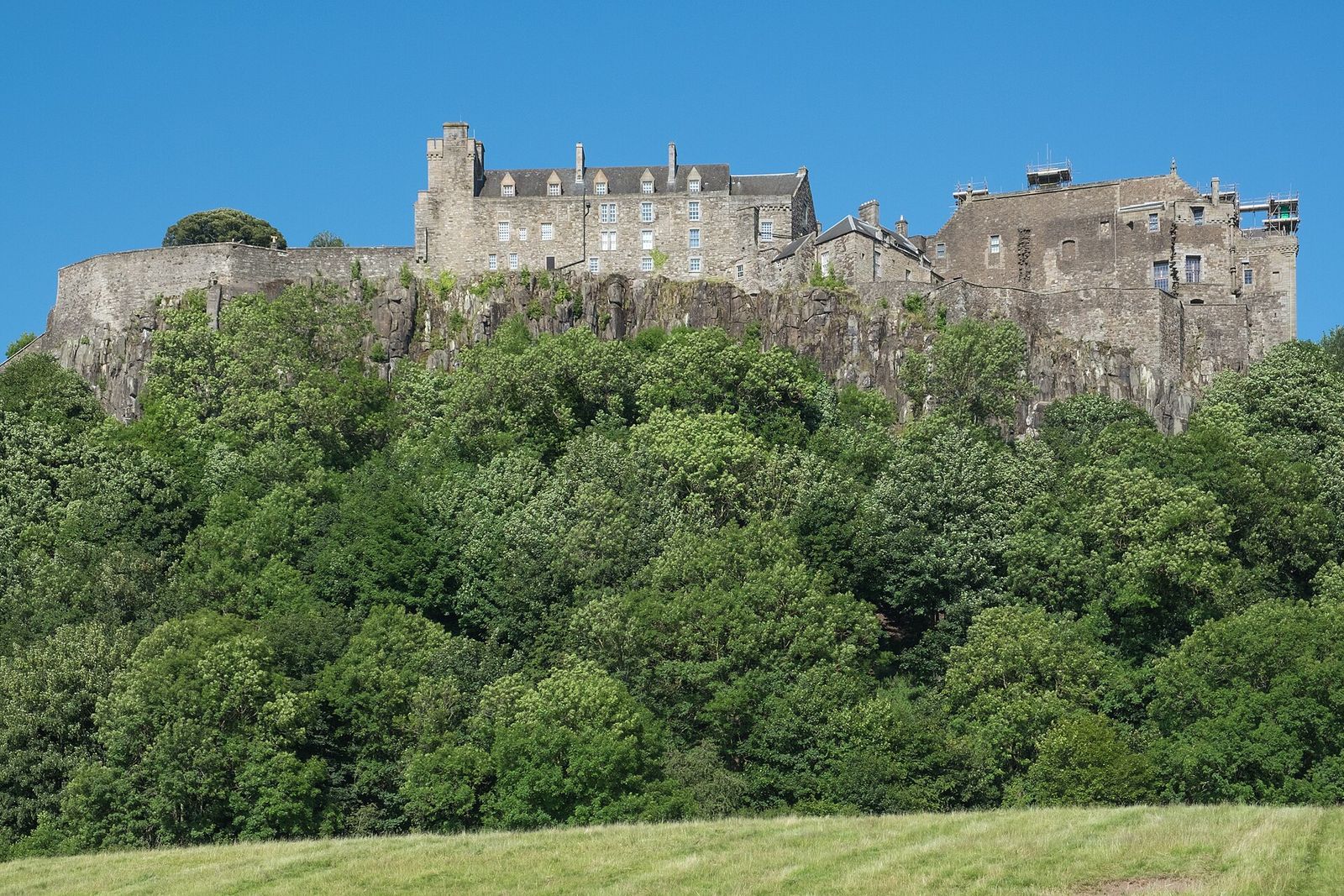
Stirling Castle stands on a volcanic crag above the old town, and for centuries whoever held it controlled the route into the Highlands. Highlights include the Great Hall, restored with its striking limewashed walls, and the Royal Palace of James V, recreated with richly coloured interiors and copies of the carved oak portrait medallions known as the Stirling Heads. Below the castle, the Church of the Holy Rude is where the infant James VI was crowned in 1567.
Also see: the National Wallace Monument, a Victorian tower on the Abbey Craig commemorating William Wallace and his victory at the Battle of Stirling Bridge in 1297. Climbing its narrow spiral staircase is hard work, but the view is wide. The site of the Battle of Bannockburn, fought in 1314, has a visitor centre on the southern edge of town. Local buses link the three.
How long to allow: a full day for all three, or half a day for the castle alone.
Linlithgow, Falkirk and the Forth bridges
Linlithgow Palace, a grand roofless royal palace beside a loch, was the birthplace of Mary, Queen of Scots, in 1542. It's about 20 minutes by train, a short walk from the station.
Farther west near Falkirk, the Kelpies are two huge steel horse heads, about 30 m (100 ft) tall, beside a canal, and the Falkirk Wheel is a rotating boat lift that links two canals, with boat trips through it. Both are a bus or taxi ride from Falkirk's stations, so a car makes this combination easier.
Closer to the city, South Queensferry has views of three bridges from three centuries across the Firth of Forth. The red steel Forth Bridge, a railway bridge opened in 1890, is a UNESCO World Heritage Site. Dalmeny station is about 15 minutes from Waverley.
North Berwick and the East Lothian coast
North Berwick is a small seaside town with sandy beaches on both sides of its harbour. The Scottish Seabird Centre explains the wildlife of the Firth of Forth, and boat trips in season circle the Bass Rock, home to a vast colony of northern gannets for much of the year. As with any wildlife trip, sightings aren't guaranteed and sailings depend on the weather. Climb North Berwick Law, a steep little hill behind the town, for views along the coast, or travel a few kilometres east to Tantallon Castle, a dramatic ruin on the cliff edge.
How long to allow: half a day to a full day.
Rosslyn Chapel
About 11 km (7 miles) south of the city, Rosslyn Chapel was founded in the 15th century and is covered in some of the most intricate medieval stone carving in Scotland, with foliage, figures and legends at every turn. It drew new crowds after featuring in The Da Vinci Code. It's still a place of worship, and visits are usually by timed ticket, so book ahead and check opening days. Allow half a day, including the bus journey.
The Scottish Borders: abbeys and Walter Scott
The Borders Railway runs from Waverley to Tweedbank in about an hour. From the station it's a short walk to Abbotsford, the house and gardens Sir Walter Scott built beside the River Tweed. Melrose Abbey, a red sandstone ruin where the heart of Robert the Bruce is said to be buried, is a few kilometres away by bus or on foot. Walkers can climb the triple-peaked Eildon Hills from Melrose.
The other great Border abbeys at Dryburgh, Jedburgh and Kelso are spread out and harder to combine by bus, so a car is the easiest way to see more than one. Scott's View, above a loop of the Tweed, is a classic stop on the way.
How long to allow: a full day.
St Andrews: golf, ruins and the sea
St Andrews has no railway station: take the train to Leuchars, about an hour, then a frequent bus of 10–15 minutes into town. The town is home to Scotland's oldest university, founded in 1413, and our St Andrews campus tour covers its colleges and quadrangles.
What to see: the ruins of the cathedral, once the largest church in Scotland, and St Rule's Tower beside it, which you can climb; the clifftop castle, with a medieval siege mine and countermine you can walk into; the Old Course, the most famous golf links in the world, with its Swilcan Bridge; and the long West Sands beach. With a car or a bus connection, the fishing villages of the East Neuk, such as Crail and Anstruther, make a good extension.
How long to allow: a full day.
Glasgow: a city day
Scotland's largest city is under an hour away and has a completely different character: Victorian grandeur, a strong design tradition and excellent museums. Kelvingrove Art Gallery and Museum and the Riverside Museum of transport are free to enter. Glasgow Cathedral, a rare medieval survivor, stands beside the hilltop Necropolis, and buildings by the architect Charles Rennie Mackintosh are scattered around the centre and the West End.
How long to allow: a full day.
Loch Lomond, the Trossachs and the Highlands
Loch Lomond is the largest stretch of inland water in Great Britain by surface area and the heart of a national park. By train, change in Glasgow for Balloch, at the southern end of the loch, where boat cruises leave in season. With a car you can add the conservation village of Luss on the western shore, or the climb up Conic Hill near Balmaha for one of the best views over the loch's islands. In the Trossachs, cruises on Loch Katrine, the setting of Scott's poem The Lady of the Lake, make a peaceful half day.
Glencoe, Loch Ness and the far north are popular as long coach day trips from Edinburgh, but they mean many hours on the road. They're much better on an overnight trip: our Scottish Highlands road trip explains how to plan one.
Practical tips for day trips
- Book trains sensibly. Most trips leave from Waverley, and many trains also stop at Haymarket. Buy tickets before boarding, check whether the conditions vary by time of day, and see whether a railcard you hold cuts the fare.
- Consider a tour for the lochs and Highlands. Organised coach tours combine places that are awkward by public transport, such as Loch Lomond with Stirling or the Trossachs.
- Hiring a car? Driving is on the left. Edinburgh has a low emission zone in the city centre, so check that your car complies, or collect it on the edge of the city.
- Compare passes. Stirling Castle, Linlithgow Palace, Melrose Abbey, Tantallon and the St Andrews ruins are all run by Historic Environment Scotland. If you're seeing several, compare its multi-site pass with single tickets.
- Watch the daylight and the weather. Winter days are short and some sites shorten their hours or close, so check the official sites before you go. Pack a waterproof layer whatever the forecast says.
- Base yourself near the station. Our guide to where to stay in Edinburgh compares the areas around Waverley and Haymarket with the rest of the city.
Choose Stirling for history, St Andrews or North Berwick for the sea, the Borders for quiet countryside, and save the Highlands for a trip with a night or two away.
Bloiq is reader-supported. Some links may earn us a commission; it never affects what we write. How we make money.
Cover photo: DeFacto, CC BY-SA 4.0, via Wikimedia Commons