E-bikes explained: classes and rules, hub vs mid-drive motors, range
How e-bike classes and legal limits work in general terms, how hub and mid-drive motors differ, and what battery watt-hours mean for the range you'll actually get.
An electric bike flattens hills, shortens commutes and makes carrying shopping or children far easier. But e-bikes differ in ways that matter: whether the law treats them as bicycles, where the motor sits and how much energy the battery holds. This guide explains the legal classes in general terms, the difference between hub and mid-drive motors, and how to estimate the range you'll get in real riding.
When an e-bike counts as a bicycle
In most countries, an e-bike is treated like an ordinary bicycle (no licence, registration or insurance) only if it stays within limits on motor power and assisted speed. Faster or more powerful machines are classed as mopeds or motorcycles, with all the rules that brings. The limits vary by region:
- European Union and United Kingdom: the standard e-bike, often called a pedelec, only assists while you pedal, has a motor rated at no more than 250 W continuous, and stops assisting at 25 km/h (15.5 mph). A throttle is usually limited to a walk-assist function at very low speed. Faster "speed pedelecs" that assist up to 45 km/h are treated as mopeds, which typically means type approval, a number plate, insurance, a licence and a helmet. In the UK, riders must be at least 14.
- United States: most states use a three-class system. Class 1 assists only while pedalling, up to 20 mph. Class 2 adds a throttle, also up to 20 mph. Class 3 assists while pedalling up to 28 mph, and often comes with age limits, helmet rules and restrictions on some paths. Motor power is generally limited to 750 W.
- Canada: the federal definition allows a motor of up to 500 W and assisted speed up to 32 km/h, while provinces set the rules on age, helmets and where you can ride.
Where you may ride varies too: cycle lanes are usually open to standard e-bikes, but some paths, parks and trails restrict them. Tuning or derestricting an e-bike can make it illegal on public roads and may void the warranty and your insurance. Rules change, so check the current rules with your local or national transport authority.
Hub motors: simple and affordable
A hub motor is built into the centre of the front or rear wheel. Most are geared hubs, which are relatively light and let the wheel roll freely when the motor is off. Heavier direct-drive hubs are silent and durable but less common on lightweight bikes.
- Strengths: simpler and usually cheaper, work independently of the gears, don't put extra strain on the chain, and pair naturally with a throttle where that's allowed. A rear hub gives good traction.
- Weaknesses: the weight sits in the wheel, which affects handling, and removing the wheel to fix a puncture is fiddlier because of the motor cable. A front hub can spin on wet or loose climbs and changes the steering feel. Because the motor can't use the bike's gears, long, steep hills are harder work for it.
Mid-drive motors: efficient on hills
A mid-drive motor sits at the cranks and drives the chain, so its power goes through the bike's gears.
- Strengths: shifting down lets the motor work efficiently on steep climbs, the weight sits low and central for natural handling, and wheels come out as easily as on a normal bike. Most mid-drives use a torque sensor, which makes the assistance feel smooth and natural. They're standard on electric mountain bikes and many quality commuter bikes.
- Weaknesses: they cost more, the chain, cassette and chainrings wear faster and need replacing more often, and motors and parts are often specific to one maker, so servicing usually goes through a dealer.
Torque, measured in newton-metres (Nm), tells you more about hill-climbing than wattage, especially in Europe, where every legal e-bike motor carries the same 250 W rating. City and commuter motors often produce roughly 40–70 Nm; motors for electric mountain bikes typically 85 Nm or more.
The sensor also shapes the ride. A cadence sensor switches the assistance on when the pedals turn, which is cheaper but can feel abrupt. A torque sensor measures how hard you push and adds power in proportion.
| Hub motor | Mid-drive motor | |
|---|---|---|
| Typical cost | Lower | Higher |
| Steep, long hills | Fair | Best |
| Ride feel | Can feel like being pushed | Natural, especially with torque sensor |
| Drivetrain wear | Normal | Faster |
| Puncture repair | Fiddlier | Like a normal bike |
| Best for | Flat to rolling commutes, budget bikes | Hills, heavy loads, off-road |
Batteries: watt-hours, placement and care
Battery capacity is measured in watt-hours (Wh): volts multiplied by amp-hours. A 36 V, 14 Ah battery holds about 504 Wh. Always compare watt-hours rather than amp-hours, because voltages differ. Our guide to power banks explains the units in more detail.
- Typical sizes: lightweight e-bikes often have around 250–400 Wh; mainstream commuter and trekking bikes around 500–750 Wh; cargo and touring bikes may carry two batteries for 1,000 Wh or more.
- Placement: batteries integrated into the down tube look neat; external down-tube batteries are often easier to remove; rack-mounted batteries put weight high and at the back, which affects handling. If you can't charge where you park, make sure the battery comes out easily.
- Lifespan: lithium-ion batteries typically manage several hundred to around a thousand full charge cycles before their capacity, and so your range, drops noticeably.
- Care: for long breaks, store the battery part-charged rather than full or empty, somewhere cool and dry. Avoid charging it when it's very cold or hot.
Battery safety deserves real attention. Use only the charger supplied or approved by the maker, and buy bikes and replacement batteries from reputable sources, with recognised safety certification for the battery and electrical system (in North America, look for UL 2849 on the bike). Charge on a hard surface in a room with a working smoke alarm, never in a hallway or by the only exit, and unplug once it's full. Never use a battery that has been dropped hard, damaged, swollen or soaked, and take old batteries to a proper recycling point.
E-bike batteries are far above the limits airlines accept, so they can't be flown. If you carry the bike by car, remove the battery and check the rack's weight limit; see our guide to roof racks and bike racks.
How far will it go?
Makers' range figures are best cases, usually at the lowest assist level on flat ground. A simple estimate is more useful:
Range (km) ≈ battery capacity (Wh) ÷ energy used per km (Wh/km). Expect roughly 5–8 Wh/km on low assist on the flat, and 10–20 Wh/km on high assist, hills or with heavy loads.
On that basis, a 500 Wh battery might give you around 25 km of hard, hilly riding, or 80 km or more of gentle riding on low assist. The main factors are:
- Assist level: the biggest single factor, and the one you control.
- Hills, wind and weight: rider, luggage and child seats all add load.
- Speed: air resistance rises steeply with speed, so riding near the assist limit costs more.
- Tyres and traffic: under-inflated or knobbly tyres waste energy, and so does stop-start riding.
- Cold: lithium batteries deliver noticeably less range in winter.
Other things to check before you buy
- Weight: most e-bikes weigh roughly 20–30 kg, and cargo bikes more. Think about stairs, racks and trains.
- Brakes: hydraulic disc brakes are worth having on a heavier, faster bike.
- Fit and frame: a step-through frame is easier to mount with luggage. A test ride tells you more than any spec sheet.
- Commuting kit: integrated lights, mudguards, a rack and a sturdy kickstand.
- Security: e-bikes attract thieves. Lock the frame to a fixed object, take the battery and display with you, and consider insurance.
- Service: check that a local dealer can service the motor and update its software.
- Helmet: wearing one is sensible on any bike, and some e-bike types and places require it.
The short version
- Know your legal category first: a 250 W, 25 km/h pedelec in Europe and the UK, or a Class 1, 2 or 3 bike in most of the US, counts as a bicycle; faster machines are mopeds.
- Choose a hub motor for simple, affordable riding on flat or rolling routes, and a mid-drive for hills, heavy loads and off-road.
- Compare batteries in watt-hours. For many commuters, 400–600 Wh is plenty; estimate range by dividing by 5–20 Wh/km.
- Insist on certified batteries and chargers, and charge somewhere safe.
- Test-ride, and check the weight, brakes and local service support.
Bloiq is reader-supported. Some links may earn us a commission; it never affects what we write. How we make money.
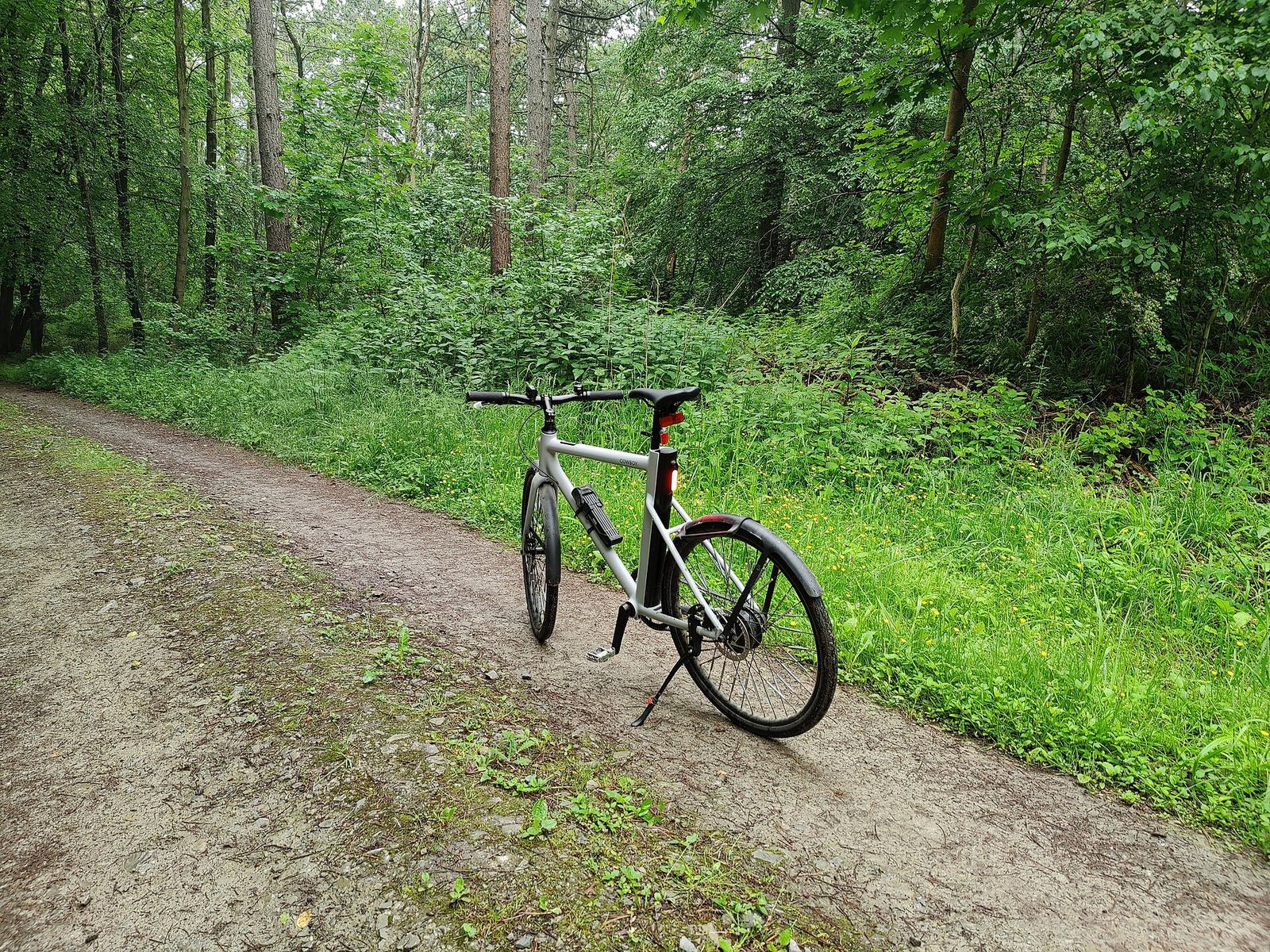
Cover photo: Elmschrat, CC BY-SA 4.0, via Wikimedia Commons