Stand mixers explained: wattage, bowl size, tilt-head or bowl-lift
What wattage really tells you, how big a bowl you need, tilt-head versus bowl-lift designs and which attachments are worth having on a stand mixer.
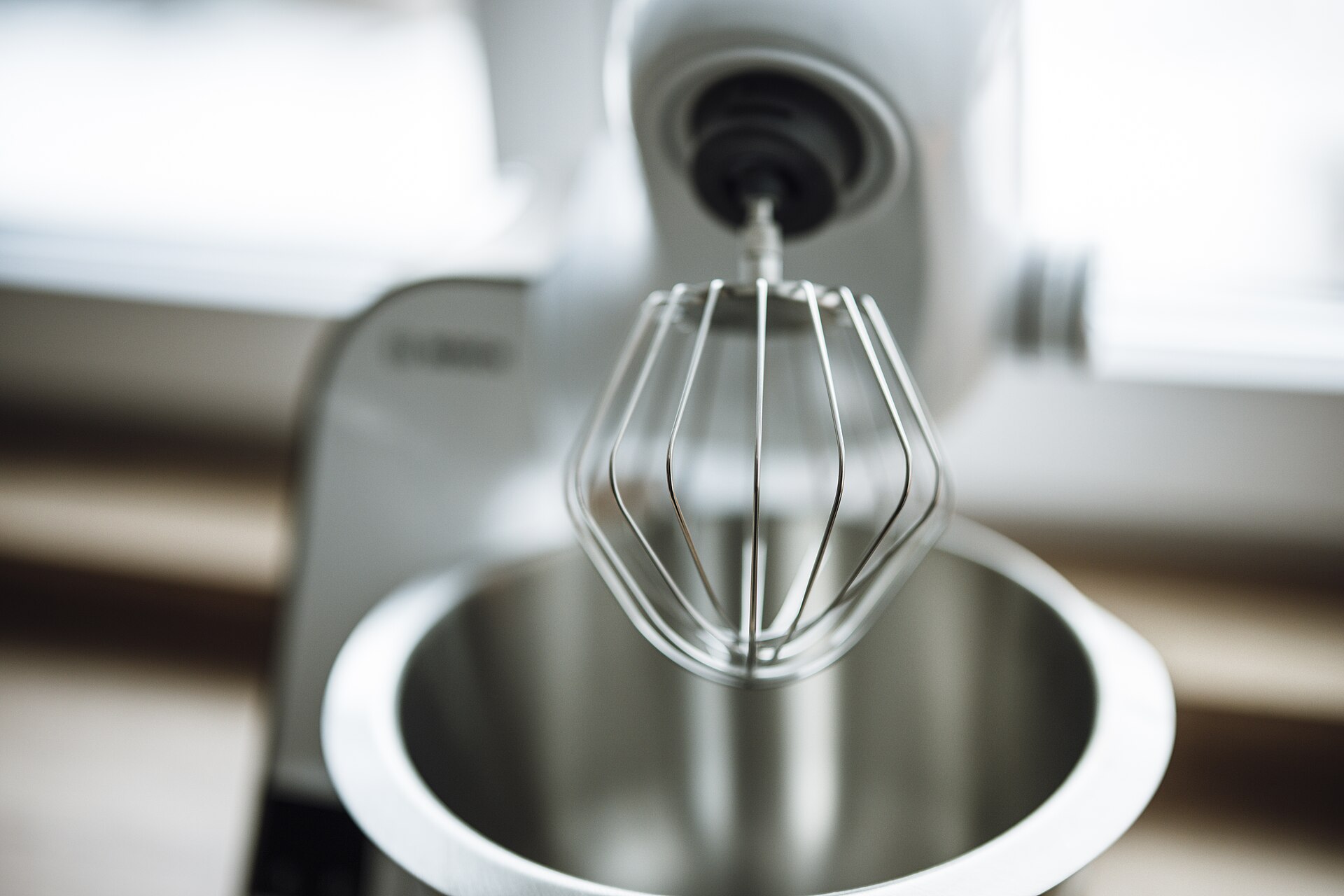
A stand mixer is one of the largest, heaviest and most expensive small appliances most kitchens own, so it pays to buy the right one the first time. The spec sheets lean heavily on wattage and bowl capacity, but neither number tells the whole story. This guide explains what the figures mean, how the two main designs differ, and which details decide whether a mixer will suit the way you actually bake.
How a stand mixer works
Almost all home stand mixers use planetary mixing action: the beater spins on its own axis while also orbiting around the bowl, so it reaches most of the bowl without the bowl itself turning. The motor drives the beater through a gearbox, and the quality of that gearing, together with how rigid the body is, matters as much as the motor's rating when the machine is working through stiff dough.
Some older and specialist designs instead turn the bowl on a platform or drive the tools from underneath. They can work well, but the planetary head is the standard layout and the one this guide focuses on.
What the wattage figure tells you
Stand mixers are sold with power ratings from roughly 300 W to well over 1,500 W. It's tempting to read that as a strength ranking, but it isn't one:
- Wattage is input power, the electricity the motor draws, not the power delivered to the dough.
- Motor and gearing design vary. Some mixers use efficient motors and low gearing that produce strong torque at modest wattage; others quote high figures that don't translate into better kneading.
- Regional habits differ. Machines sold in Europe and the UK often carry higher wattage numbers than similar-sized machines sold in North America, partly because of how they are designed and marketed.
Wattage is useful for comparing models within one manufacturer's range. Across brands, the manufacturer's stated maximum dough or flour capacity is a better guide to what the machine can handle.
Choosing a bowl size
Bowl capacities usually run from about 3.5 to 7 litres (roughly 3.5 to 7 US quarts; a quart is slightly less than a litre). A practical way to choose:
- 3.5–4.5 litres: cakes, cookies, meringues and single loaves for one or two people. Compact and lighter to move.
- 4.5–5.5 litres: the most common size, and enough for most family baking, including a double batch of cookie dough or one or two loaves.
- 6 litres and above: large batches of bread dough, bakers who freeze in quantity, or big households.
Two cautions. First, the working capacity is smaller than the bowl's volume: batters rise up the sides and dough climbs the hook. Second, a very large bowl can struggle with small quantities, such as a single egg white or a small amount of cream, because the whisk may not reach far enough into the bottom. If you often make small batches, look for a model whose beater-to-bowl clearance is adjustable, or one sold with a smaller second bowl.
Stainless steel bowls are the most common and are durable and light. Glass bowls let you see what's happening and often have measurement markings, but they are heavier and can break.
Tilt-head versus bowl-lift
| Tilt-head | Bowl-lift | |
|---|---|---|
| How it works | The motor head hinges back to give access to the bowl | The head is fixed; a lever raises the bowl to the beater |
| Typical bowl size | Small to medium | Medium to large |
| Access | Easy to add ingredients and scrape down with the head raised | Adding ingredients happens around a fixed head |
| Stability with stiff dough | Good on most models; the head may rock slightly under heavy loads | Usually very rigid, which suits frequent bread making |
| Space | Needs clearance above it to tilt the head back | Taller when closed; check the height under your wall cabinets |
Tilt-head mixers suit most home bakers: they are friendly to use, easy to clean and usually a little cheaper. Bowl-lift mixers make sense if you bake bread or large batches often and want the most solid platform.
Whichever you choose, measure the space where it will live. Stand mixers commonly weigh somewhere between about 4 and 13 kilograms, so a machine that has to be lifted out of a cupboard every time tends to be used less.
Speeds and controls
Most mixers have somewhere between six and twelve speed settings, sometimes with a pulse function. More settings are not necessarily better; what matters is a genuinely slow lowest speed for adding flour without a cloud of it, and a smooth soft start that ramps up gradually to reduce splattering.
Other features that can be useful:
- a splash guard or pouring shield that clips onto the bowl;
- a timer, handy for kneading;
- overload protection that stops the motor if it overheats, rather than letting it burn out;
- a built-in scale or bowl light on some models.
Check the manual's guidance on kneading. Many manufacturers recommend using only low speeds with the dough hook and give a maximum flour weight for bread dough. Exceeding it regularly is one of the most common ways to strain a mixer's gearbox.
Attachments: what comes in the box and what's extra
Nearly every stand mixer comes with three standard tools:
- a flat beater (or paddle) for cake batters, cookie dough and mashed potatoes;
- a dough hook for bread and pizza dough;
- a wire whisk for cream, egg whites and light batters.
Many also include, or offer as an extra, a flexible-edge beater with a silicone or rubber wiper that scrapes the sides of the bowl as it turns, which cuts down on stopping to scrape by hand.
Beyond these, many mixers have a power hub, a covered outlet on the front or top of the head that drives optional accessories. Common ones include:
- meat mincers and sausage fillers;
- pasta rollers and cutters;
- slicers and shredders;
- grain mills;
- ice cream bowls;
- blender or food processor attachments.
If you expect to use these, check which attachments are made for the specific model and hub you're buying, and what they cost: a full set can add substantially to the price. An attachment that fits your mixer may be less capable than a dedicated appliance, but it saves cupboard space. For smoothies and soups a separate appliance is usually the better tool; our guide to blender types explains the options.
Is a stand mixer right for you?
A stand mixer earns its space if you bake regularly, knead bread, make meringues or buttercream, or want hands-free mixing while you do something else. If you bake only occasionally, a hand mixer handles cakes, whipped cream and most cookies for a fraction of the cost and space, although it isn't designed for kneading heavy dough.
Also consider noise, how easy the outer surfaces are to wipe clean, whether the bowl and tools are dishwasher-safe (some coated beaters are not), and the length and terms of the warranty, particularly on the motor.
The short version
- Treat wattage as a rough guide only; compare the maximum dough or flour capacity instead.
- Choose a bowl size for your usual batch: about 4.5–5.5 litres suits most households.
- Pick tilt-head for easy everyday use, bowl-lift for frequent heavy bread dough or large batches.
- Check for a slow lowest speed, soft start and overload protection.
- Make sure the standard trio of beater, hook and whisk is included, and price any attachments you want.
- Measure your counter and the height under your cabinets before you buy.
Bloiq is reader-supported. Some links may earn us a commission; it never affects what we write. How we make money.
Cover photo: Shixart1985, CC BY 2.0, via Wikimedia Commons