Coffee grinders explained: burr vs blade, flat vs conical, grind size
Why consistent grinding matters, how blade, conical and flat burr grinders differ, and which grind setting suits espresso, pour-over, drip and French press.
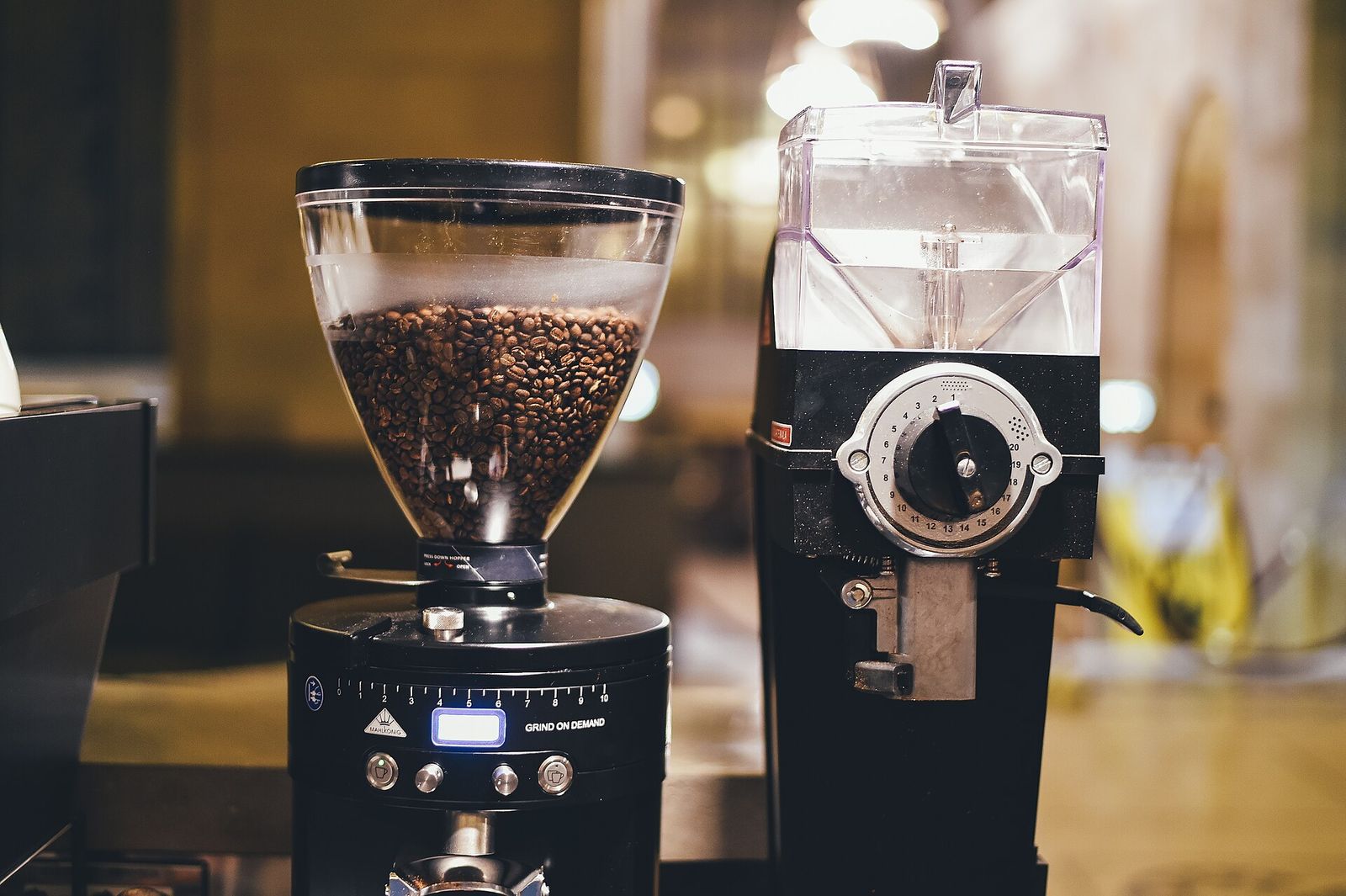
Of all the upgrades you can make to home coffee, grinding your own beans just before brewing is one of the most noticeable. Ground coffee loses aroma quickly, and the size and consistency of the grounds decide how evenly the coffee extracts. This guide explains the main types of grinder, what the design differences mean in the cup, and which grind size suits each brewing method.
Why grind consistency matters
Brewing dissolves flavour compounds out of the grounds. Small particles give up their flavour quickly; large ones slowly. If the grounds are a mix of fine dust and large chunks, the fine particles over-extract, tasting bitter and harsh, while the big ones under-extract, tasting sour and thin, all in the same cup.
A good grinder produces grounds that are mostly the same size, so you can adjust one variable, the grind setting, to make coffee taste better. That consistency is the whole reason burr grinders exist.
Blade grinders
A blade grinder is essentially a small chopper: a spinning blade smashes the beans into pieces for as long as you hold the button. It's cheap and compact, but:
- the particle size is uneven, with lots of dust and larger pieces;
- the result depends on how long you grind, so it's hard to repeat;
- it can't produce the fine, even grind that espresso needs.
A blade grinder is still better than buying pre-ground coffee that has sat open for weeks, and it's handy for spices. Shaking the grinder while you pulse helps even out the result for drip or French press coffee.
Burr grinders
A burr grinder crushes beans between two hard, ridged surfaces called burrs. One burr turns while the other is fixed, and the gap between them sets the grind size. Beans pass through only once they are small enough to fit, so the grounds are much more uniform.
Burrs are usually steel or ceramic. Steel burrs are sharp and common in both home and commercial grinders. Ceramic burrs stay sharp for a long time but can chip if a small stone slips through with the beans.
Conical or flat burrs?
| Conical burrs | Flat burrs | |
|---|---|---|
| Design | A cone-shaped burr turns inside a ring-shaped burr | Two flat, parallel rings face each other |
| Where you'll find them | Most hand grinders and many home electric grinders | Many mid-range and higher-end electric grinders, and many commercial ones |
| Typical traits | Often slower-running and compact; generally retain less coffee inside | Often praised for very uniform grounds; some designs retain more coffee |
| Flavour tendencies | Often described as fuller-bodied | Often described as clearer and more defined |
Both types can be excellent, and flavour differences are subtle and debated. Burr quality, size and alignment matter more than shape: a well-made conical grinder will beat a poorly made flat one, and vice versa. For most home users, the choice comes down to the grinder as a whole rather than burr geometry.
Grind settings: stepped or stepless
- Stepped grinders have fixed clicks. They are easy to return to a known setting, but the gaps between steps may be too big for fine-tuning espresso.
- Stepless grinders adjust continuously, allowing very small changes. This matters most for espresso, where a tiny adjustment can change a shot noticeably.
Check the range too. Some grinders are designed for filter coffee and can't grind finely enough for espresso; others are designed for espresso and are awkward for coarse French press grounds. If you want both, look for a grinder that covers the range and is easy to adjust between the two.
Which grind size for which brew
Grind size charts are only a starting point: adjust to taste and to your particular grinder.
| Brewing method | Grind size | Rough comparison |
|---|---|---|
| Turkish coffee | Extra fine | Powder, like flour |
| Espresso | Fine | Finer than table salt |
| Moka pot | Fine to medium-fine | A little coarser than espresso |
| Pour-over (cone) | Medium-fine | Between table salt and sand |
| Drip coffee machine | Medium | Like sand |
| Chemex-style large pour-over | Medium-coarse | Coarse sand |
| French press | Coarse | Like coarse sea salt |
| Cold brew | Extra coarse | Coarse, like cracked pepper |
The rule when adjusting: if coffee tastes sour or weak, or brews too fast, grind finer. If it tastes bitter or harsh, or brews too slowly, grind coarser.
Hand grinders versus electric grinders
Hand grinders can produce excellent, consistent grounds for the price, because the money goes into the burrs rather than a motor. They are quiet, portable and good for one or two cups. The trade-off is effort, especially for fine espresso grinding or larger batches.
Electric grinders are faster and more convenient for families or several cups a day. Features to look for:
- Grinding by time or by weight, so you get the same dose each time;
- Low retention, meaning little coffee is left inside to go stale and mix into your next dose;
- Single-dose designs, where you weigh beans for each brew instead of storing them in a hopper, useful if you switch between coffees;
- Anti-static features, since static makes grounds cling and spray.
A light spritz of water on the beans before grinding is a common trick to reduce static; check that your grinder's manufacturer doesn't advise against it.
Grinder and espresso machine
If you're buying for espresso, budget for the grinder as seriously as the machine. An espresso machine can only perform as well as the grounds it receives, and many entry-level burr grinders can't adjust finely enough. Our espresso machine guide explains how the two work together.
Cleaning and upkeep
Coffee oils build up on the burrs and chute and eventually turn rancid, which affects flavour. Brush out the burrs and chute regularly, following the manual for removing the top burr. Some people use grinder-cleaning tablets designed for the purpose; many manufacturers advise against grinding rice, which can strain the motor. Burrs wear slowly, and replacement burrs are available for many grinders.
The short version
- Choose a burr grinder over a blade grinder if your budget allows.
- Don't overthink conical versus flat; build quality and alignment matter more.
- For espresso, choose a grinder with fine, stepless or small-step adjustment.
- Consider a hand grinder for great value if you brew one or two cups at a time.
- Look for low retention and dosing by time or weight in an electric grinder.
- Use the grind chart as a start, then adjust: sour means finer, bitter means coarser.
Bloiq is reader-supported. Some links may earn us a commission; it never affects what we write. How we make money.
.jpg)