Espresso machines for beginners: bar pressure, boilers and baskets
Why 9 bar matters more than 15 or 20, how thermoblocks and boilers differ, and why the grinder decides your shots as much as the espresso machine.
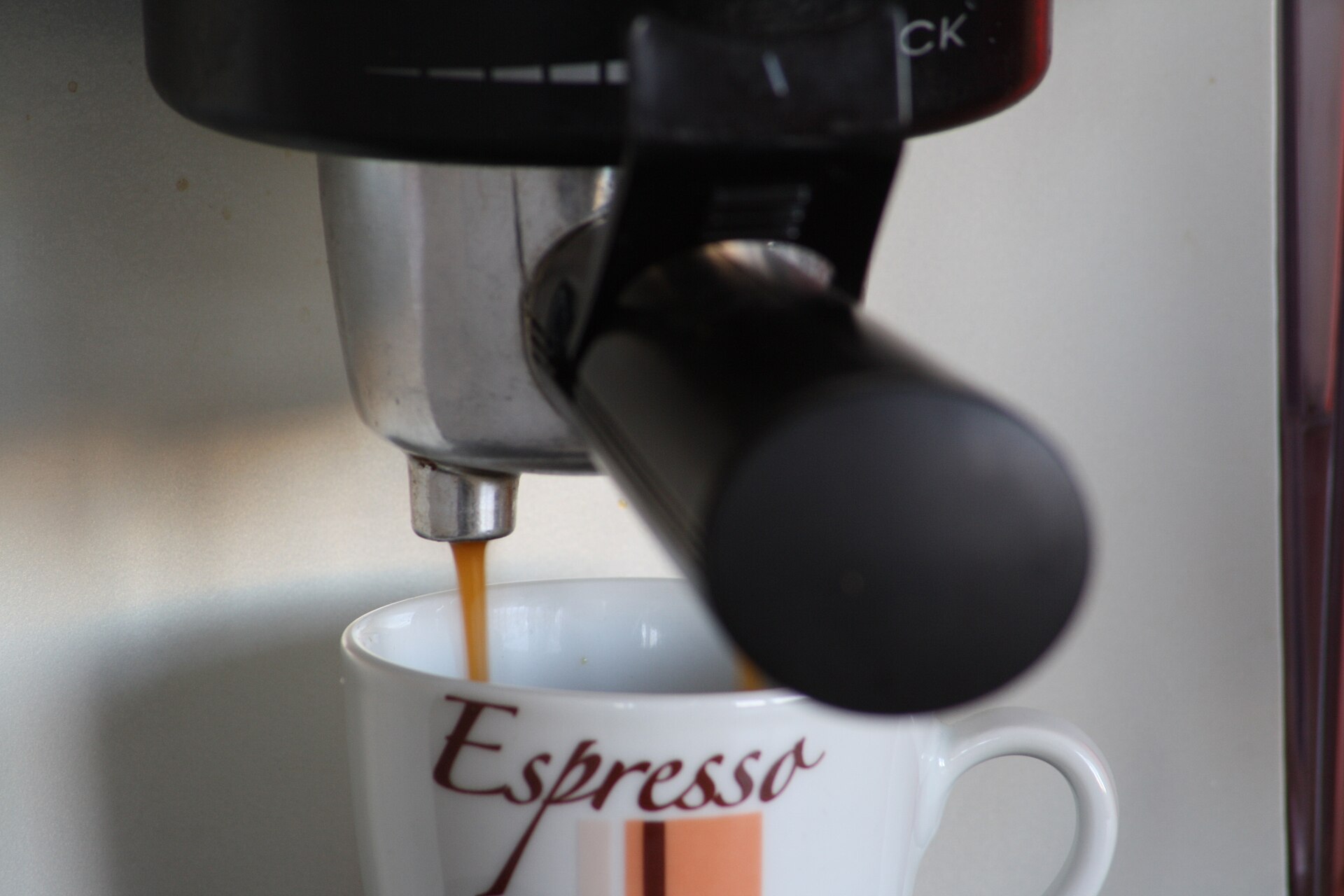
Home espresso machines are sold on numbers: 15 bar, 20 bar, 1,350 W, 25-second heat-up. Most of those figures say little about the coffee in the cup. What matters is how steadily the machine controls pressure and temperature, what kind of filter basket it uses, and, above all, whether you can grind fresh coffee finely enough. This guide explains the jargon so you can buy the right first machine and avoid paying for the wrong specifications.
What pressure really does
Espresso is made by forcing hot water through a tightly packed bed of finely ground coffee, called the puck. The resistance of the puck is what builds pressure, and that pressure is what extracts the oils and dissolved solids that give espresso its body and crema.
The long-standing reference for espresso is roughly 9 bar at the coffee, about nine times atmospheric pressure. Café machines are set up around that figure, and many experienced home baristas deliberately brew a little lower. More pressure does not mean better coffee; beyond a point it tends to compact the puck and cause uneven extraction.
Why boxes say 15 or 20 bar
Most affordable machines use a small vibratory pump. The 15 or 20 bar printed on the box is usually that pump's maximum rating, measured against a closed outlet, not the pressure the coffee sees during a shot. In practice, brew pressure depends on the grind, the dose and the basket, and on whether the machine has a valve that limits pressure.
That valve is called an over-pressure valve (OPV). On better machines it is set to around 9–10 bar, and on some it can be adjusted. A pressure gauge on the front, or a stated brew pressure in the manual, is more informative than the pump rating.
Rule of thumb: a 15-bar or 20-bar claim is not a reason to buy a machine. Look for controlled brew pressure near 9 bar, not a bigger pump number.
Heating systems: thermoblock, single boiler, heat exchanger, dual boiler
Espresso wants water at roughly 90–96 °C, while steaming milk needs steam well above boiling point. How a machine handles both jobs is the biggest difference between price tiers.
| System | How it works | Pros | Cons |
|---|---|---|---|
| Thermoblock / thermocoil | Water is heated on demand as it flows through a heated metal block or coil | Heats up in a minute or less, compact, efficient | Less temperature stability; steam is often weaker or wetter |
| Single boiler | One small boiler, switched between brew and steam temperature | Stable brew temperature, simple | You wait between brewing and steaming |
| Heat exchanger (HX) | A boiler at steam temperature, with brew water passing through a tube inside it | Brew and steam at the same time | Brew water can run hot; may need a short flush before each shot |
| Dual boiler | Separate boilers for brewing and steam, usually with digital control | Precise, stable, brew and steam together | Expensive, larger, slower to heat up fully |
PID temperature control is a digital controller that holds the water temperature much more precisely than a basic thermostat. It is worth having on any machine you intend to use seriously, and it is now found on some entry-level models too.
If you rarely drink milk drinks, a good thermoblock or single-boiler machine is plenty. If you make several lattes or cappuccinos in a row, a heat exchanger or dual boiler will save a lot of waiting.
Pressurised vs non-pressurised baskets
The filter basket inside the portafilter is one of the most important and least advertised features.
- Pressurised (dual-wall) baskets have a single small exit hole or valve. The basket creates the resistance itself, so it produces a crema-like foam even with pre-ground or stale coffee and an uneven tamp. They are forgiving, but they limit how good the espresso can become.
- Non-pressurised (single-wall) baskets have hundreds of small holes. All the resistance must come from the coffee, so the grind has to be fine and consistent, and the dose and tamp repeatable. The reward is proper control over the flavour of the shot.
Many machines ship with both. A sensible path is to start with pressurised baskets while you learn, then move to single-wall baskets once you have a suitable grinder.
Also check the portafilter size. Common sizes are about 51, 54 and 58 mm; 58 mm is the traditional café standard and has the widest choice of baskets, tampers and accessories.
The grinder matters as much as the machine
Espresso needs a very fine, very consistent grind that you can adjust in tiny steps, because a small change in grind noticeably changes how fast the shot runs.
- Blade grinders chop beans unevenly and are not suitable for espresso.
- Burr grinders crush beans between two burrs and produce a consistent particle size. Conical and flat burrs both work well; the quality of the burrs and the adjustment matters more than the shape.
- Espresso-capable grinders offer either stepless adjustment or many fine steps in the espresso range. Some general-purpose burr grinders cannot grind finely enough.
- Hand grinders can be an affordable route to espresso-quality grinding if you only make a shot or two a day.
Many experienced home baristas suggest spending about as much on the grinder as on the machine. A modest machine with a good grinder usually beats an expensive machine with pre-ground coffee.
A starting recipe
A common starting point with a non-pressurised basket is a 1:2 ratio: for example, 18 g of ground coffee producing about 36 g of espresso in roughly 25–30 seconds. If the shot runs much faster and tastes sour, grind finer; if it runs much slower and tastes bitter, grind coarser. A small kitchen scale that reads to 0.1 g makes this far easier.
Fresh beans help enormously. Look for a roast date on the bag and use the beans within a few weeks of roasting.
Other features to check
- Steam wand. A traditional single-hole wand gives more control over milk texture than a "panarello" sleeve, which froths automatically but produces bubblier foam.
- Tamper. Many included tampers are plastic and slightly undersized; a metal tamper that fits the basket properly helps.
- Water tank and descaling. Hard water causes scale that damages boilers and thermoblocks. Use filtered or softened water if your supply is hard, and follow the manufacturer's descaling instructions.
- Built-in grinder. All-in-one machines save space, but you cannot upgrade the grinder separately.
- Cleaning routine. Backflushing (for machines with a three-way valve), cleaning the shower screen and purging the steam wand after each use keep flavour and performance consistent.
The short version
Ignore 15-bar and 20-bar claims and look for controlled brew pressure near 9 bar, ideally with a gauge or adjustable OPV. Choose a thermoblock or single boiler for mostly straight espresso, and a heat exchanger or dual boiler if you make lots of milk drinks. Start with pressurised baskets if you only have pre-ground coffee, but budget for a proper espresso-capable burr grinder, because that is what lets any machine make genuinely good espresso.
Bloiq is reader-supported. Some links may earn us a commission; it never affects what we write. How we make money.
Cover photo: Frettie, CC BY-SA 3.0, via Wikimedia Commons