Child car seats explained: infant, convertible and booster seats
How infant, convertible, all-in-one and booster seats differ, what the safety standards mean, how installation works in general terms, and why car seats expire.
A correctly used car seat is one of the most effective ways to protect a child in a car, and a child will usually use several seats before they're big enough for an adult belt. The choices can be confusing: infant carriers, convertibles, all-in-ones, combination seats and boosters, each with its own limits and standards. This guide explains the types, what the labels mean and how installation works in general terms. Your seat's manual, your vehicle's manual and your local rules always come first.
The stages at a glance
Children move through the same broad stages, whichever seats they use:
- Rear-facing with a harness, from birth.
- Forward-facing with a harness, once they've outgrown rear-facing.
- Booster seat, which positions the adult seat belt correctly.
- Adult seat belt alone, once the belt fits properly without a booster.
Road safety agencies advise keeping a child in each stage until they reach the maximum height or weight allowed by the seat, rather than moving up at the first opportunity. Each step up offers somewhat less protection for a small body. They also advise that children ride in the back seat until around age 13.
Infant seats: portable, rear-facing only
An infant seat (often called an infant carrier or bucket seat) is rear-facing only, with a carry handle, and usually clicks into a base that stays installed in the car. Many also click into a compatible stroller.
Good for: newborns and young babies; parents who want to move a sleeping baby without unbuckling them.
Consider: babies usually outgrow infant seats within the first year or so, often by height before weight. A child has outgrown it when they reach either limit on the label, or when their head is too close to the top of the shell as specified in the manual. It's a seat for the car, not a crib: don't leave babies to sleep in a carrier outside the car.
Convertible and all-in-one seats
A convertible seat installs rear-facing for babies and toddlers and later turns forward-facing with a harness. Convertible seats usually have much higher rear-facing limits than infant seats, which lets children stay rear-facing longer. Some families use one from birth; others move to one when the infant seat is outgrown.
An all-in-one (or 3-in-1) seat adds a booster mode, so in theory one seat lasts from birth to booster age. In practice, it may not fit a newborn as well as an infant seat, and it may reach its expiry date before the child finishes the booster stage.
Consider: convertible seats are large and heavy, stay in the car, and take up more front-to-back space when rear-facing. Check the fit in your car before you commit, especially in smaller vehicles.
Combination and booster seats
A combination seat is forward-facing with a harness, then converts to a belt-positioning booster.
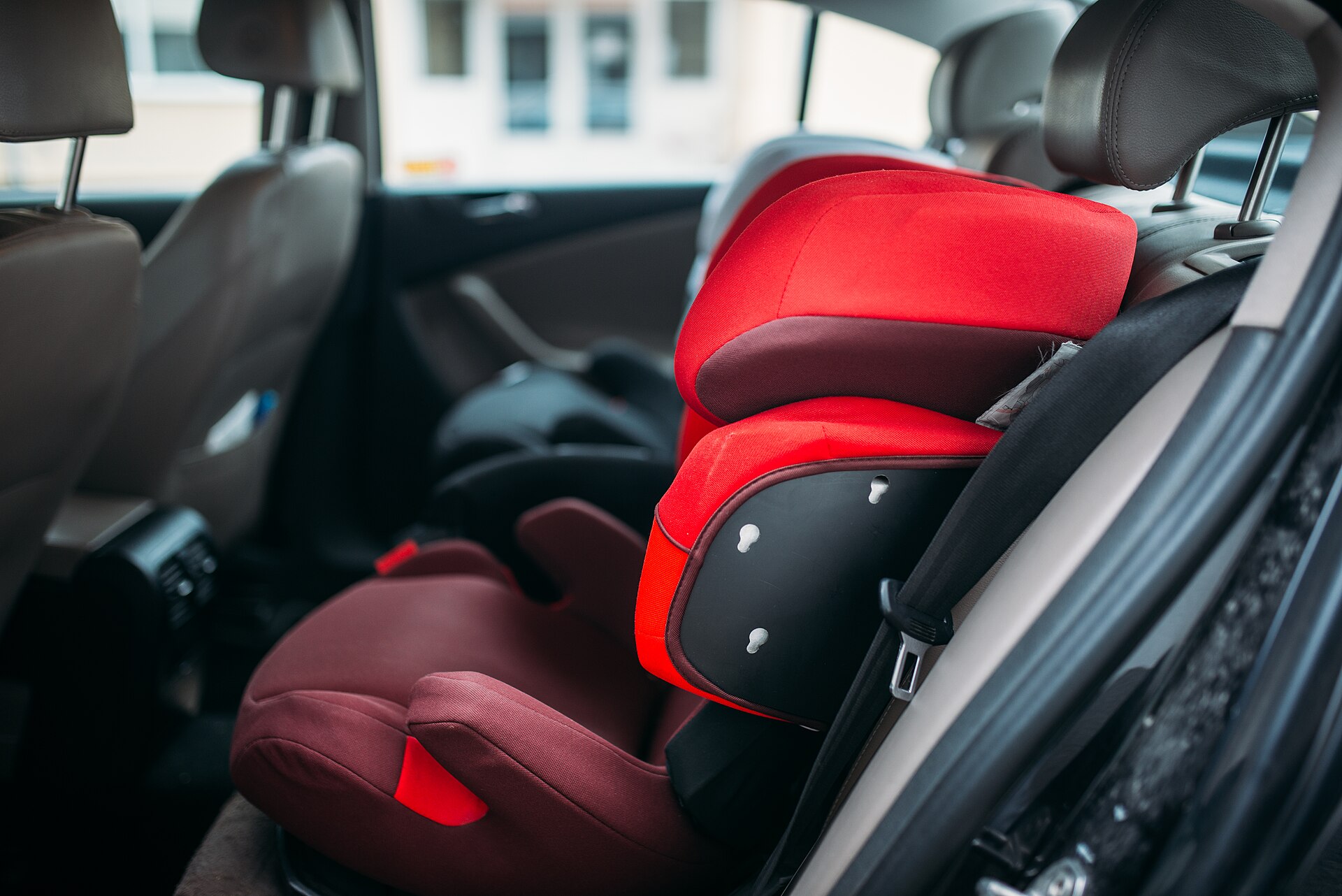
A booster seat doesn't restrain the child itself. It raises the child so that the vehicle's adult belt sits in the right place: the lap belt low across the hips and upper thighs, and the shoulder belt across the middle of the shoulder and chest, not the neck. High-back boosters add head and side support and a guide for the shoulder belt, and suit cars without rear head restraints. Backless boosters are compact and easy to move between cars, but only suit vehicles with proper head restraints.
Boosters must be used with a lap-and-shoulder belt, never a lap belt alone.
When a child is ready for the adult belt
Age alone isn't the test. Many children need a booster until they're about 145 cm (4 ft 9 in) tall, often somewhere between 8 and 12 years old. The belt fits when the child can:
- sit with their back against the vehicle seat back,
- bend their knees comfortably at the edge of the seat,
- keep the lap belt on the upper thighs, not the stomach,
- keep the shoulder belt across the chest and shoulder, not the neck or face,
- stay seated like this for the whole journey.
If any answer is no, they still need a booster. Legal minimum ages and heights vary by country, state and province; check the current rules where you live and drive.
Safety standards and labels
Every seat must be approved to the standard of the country where it's used:
- United States: seats are certified to the federal standard FMVSS 213, and a label on the seat states that it conforms.
- Canada: seats must carry the National Safety Mark, showing they meet Canadian standards. Seats bought elsewhere, even from well-known brands, generally aren't legal for use in Canada.
- Europe, the UK and many other countries: seats are approved to UN regulations. The newer R129 (i-Size) standard classifies seats by the child's height and includes side-impact testing; seats approved to the older R44 standard are classified by weight groups. R44 seats are no longer sold new in the EU, and rules on continuing to use them vary, so check the current rules.
- Australia and New Zealand have their own standard, AS/NZS 1754.
Because standards differ, a seat bought abroad may not be legal, or even compatible with the vehicle's anchors, in the country where you live.
Installation in general terms
Seats are installed either with the vehicle's seat belt or with lower anchors, known as LATCH in the US, UAS in Canada and ISOFIX in Europe. Neither method is safer when done correctly; use whichever gives a secure fit in your car. Don't use both at once unless the seat's manual says you can, and note that lower anchors have a weight limit, after which the manual will tell you to switch to the seat belt.
Forward-facing seats with a harness should also use the top tether, a strap to an anchor behind the vehicle seat. It reduces how far the child's head moves forward in a crash, and some jurisdictions require it. Some seats also use a load leg or anti-rebound bar.
A few general checks apply to most seats:
- Tightness: the seat shouldn't move more than about 2.5 cm (1 in) side to side or front to back when you pull at the belt path.
- Angle: rear-facing seats have a recline indicator; follow it so a baby's airway stays open.
- Harness: snug enough that you can't pinch a fold of webbing at the collarbone, with the straps at the height the manual specifies for rear- or forward-facing use.
- Airbags: never put a rear-facing seat in front of an active front airbag.
- Winter coats: bulky coats compress in a crash and leave the harness too loose. Buckle the child in normal clothing and put a coat or blanket over the harness. Our winter car kit checklist covers other cold-weather preparation.
Many areas offer free checks by trained car seat technicians, often through hospitals, fire services or road safety organisations. They're well worth using, especially for a first seat.
Expiry dates and second-hand seats
Car seats have an expiry date, usually printed on a label or moulded into the shell. The useful life is typically between 6 and 10 years from manufacture, depending on the model. Plastics degrade with heat, cold and sunlight, parts and webbing wear, and standards improve over time.
Replace a seat after a crash as the manufacturer instructs; many require replacement after any crash, and safety agencies publish criteria for minor ones. Register a new seat with the manufacturer so you're told about recalls.
Only use a second-hand seat if you know its full history, it hasn't been in a crash, it isn't expired or recalled, and it still has all its parts, labels and the manual.
The short version
- Keep children rear-facing for as long as their seat allows, then forward-facing with a harness to the seat's limits.
- Move to a booster only when the harness is outgrown, and to the adult belt only when it fits properly.
- Buy a seat approved for your country that fits your child and your car.
- Install it tightly, use the top tether when forward-facing, and follow both manuals.
- Check the expiry date, register the seat and replace it after a crash as instructed.
Bloiq is reader-supported. Some links may earn us a commission; it never affects what we write. How we make money.
Cover photo: Shixart1985, CC BY 2.0, via Wikimedia Commons