Home / Travel / Universities / Sweden
Lund University campus tour: a walk through Sweden's student town
What to see at Lund University: the white Main Building, Lundagård, the cathedral, the ivy-clad library, the student nations and the old town, plus how to get there.
This guide contains affiliate links, marked as such. If you book through them, Bloiq may earn a commission at no extra cost to you.
Founded in 1666, Lund University is one of the oldest universities in northern Europe, and it sits in the middle of one of Sweden's oldest towns. Lund is small, flat and full of bicycles, with a twin-towered cathedral, cobbled lanes and a university whose buildings begin a few minutes' walk from the railway station. This guide follows a route from the historic centre north through the campus and explains how student life here is organised.
How the university fits into the town
Lund's medieval centre is compact. The cathedral marks its middle, and the park of Lundagård runs north from it to the university's main square. From there the campus stretches north and north-east in a long band: first the older faculties and the University Library, then the hospital and the science buildings, and finally the engineering campus on the edge of town. A tram line and cycle paths run along the same axis.
The University Main Building
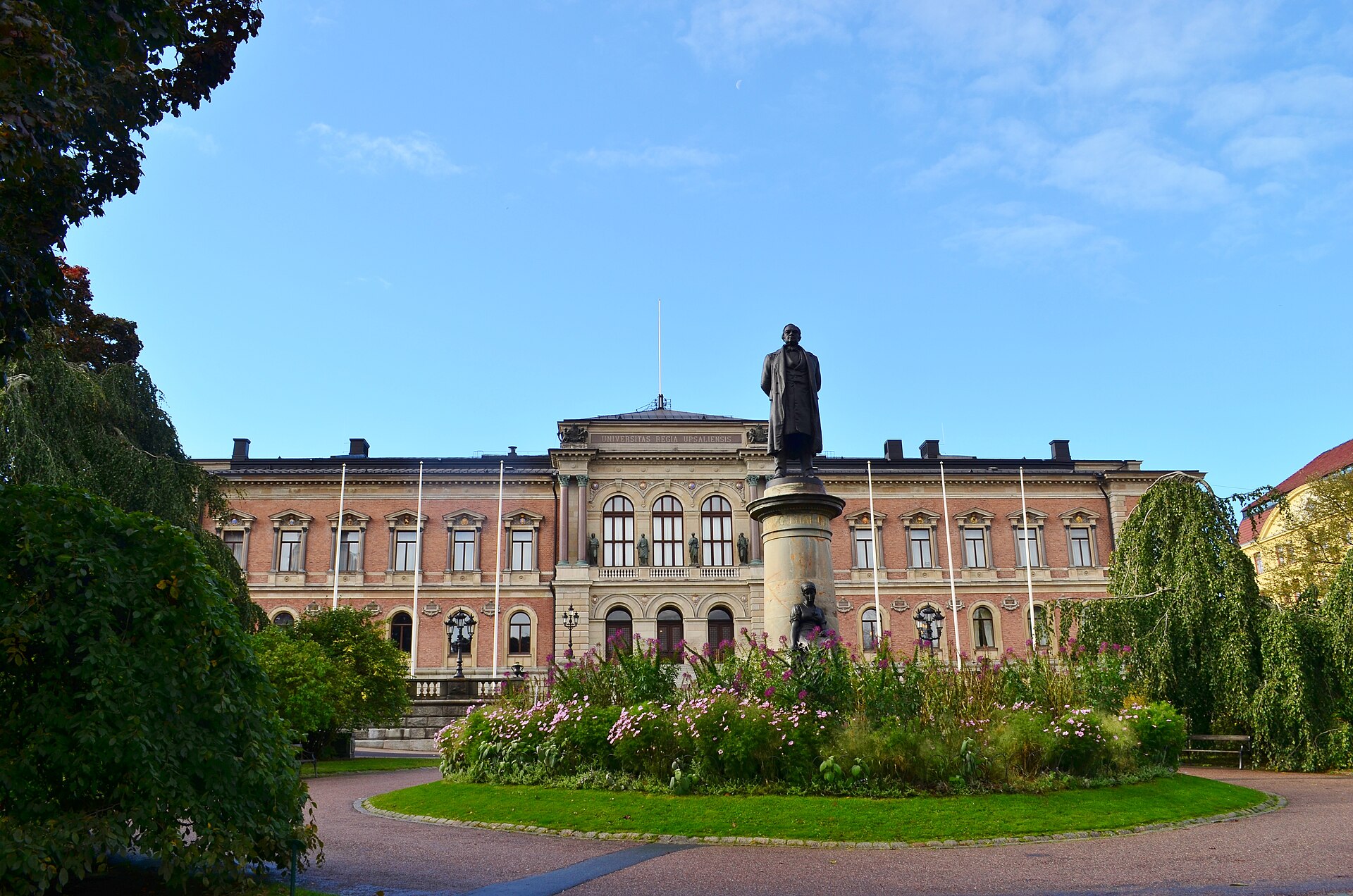
The University Main Building is a bright white, classical hall designed by the architect Helgo Zettervall and opened in 1882. Sphinxes sit on its roof, and it faces a round fountain on Universitetsplatsen, the university square. The magnolia trees here are a local institution: when they bloom, spring has officially arrived. Each year on the first of May, the student choir sings in the season from the steps.
The building holds the university's assembly hall and is used for ceremonies rather than everyday teaching.
Lundagård and the King's House
Next to the main building, the tree-filled park of Lundagård was once the walled grounds of the archbishop's residence. In it stands the King's House (Kungshuset), a red-brick building with a round stair tower, built in the late 1500s for King Frederick II of Denmark, when this part of Sweden was Danish. The university took it over in the 17th century, and it served as the main building for almost two hundred years.
Across the square is AF-borgen, the castle-like home of the Academic Society (Akademiska Föreningen), a student-run organisation that has put on theatre, debates, balls and concerts here since the mid-19th century.
Lund Cathedral
At the south end of Lundagård is Lund Cathedral, a grey sandstone Romanesque church with two towers, consecrated in 1145. Lund was then the seat of an archbishop whose province covered all of Scandinavia. Inside, look for the medieval astronomical clock, which plays at set times each day, and the crypt, with its carved pillars. The university's Historical Museum is just beside the cathedral.
The University Library
A short walk north through quiet streets brings you to the University Library, known to students simply as UB. The red-brick building dates from 1907 and is almost entirely covered in climbing vines, green in summer and deep red in autumn, which makes it the most photographed building on campus. The lawn in front is a favourite place to sit between lectures.
Science and engineering to the north-east
Further out, the Faculty of Engineering, known by its Swedish initials LTH, occupies a campus of dark brick buildings laid out in the 1960s by the architect Klas Anshelm, with ponds and lawns between them. Beyond it are a science park and, on the edge of town, two large research facilities, MAX IV and the European Spallation Source, which are one reason Lund attracts researchers from around the world.
Bachelor's programmes are mostly taught in Swedish, and many master's programmes are taught in English.
Nations, spex and the carnival
As at Uppsala, student social life runs through nations. Lund has thirteen, most named after Swedish provinces or towns. Each has its own house, and together they offer pubs, lunches, club nights, formal dinners called sittningar, sports and, in many cases, student rooms. New students usually join one in their first weeks.
Lund is also known for spex, a home-grown form of student musical comedy, and above all for the Lund Carnival, held every four years in May, when students fill Lundagård with tents, shows and a parade through town.
Most students live in corridor rooms or small flats, run by a student housing foundation, the nations or private landlords. Rooms are widely reported to be scarce at the start of the autumn term, so new students are advised to arrange housing early.
The old town, museums and the Botanical Garden
East of the cathedral, lanes such as Adelgatan are lined with low, colour-washed houses and hollyhocks. Three places nearby are worth an hour each:
- Kulturen: one of the world's oldest open-air museums, with historic buildings from southern Sweden gathered in two town blocks.
- The Botanical Garden: the university's garden, a few minutes east of the centre, with greenhouses and a large park that is open to everyone.
- Skissernas Museum: the university's museum of sketches and models for public art.
Visiting as a prospective student
Swedish universities do not usually run North American-style admissions tours. The university has offered information events and online sessions for prospective and international students, and its public spaces, parks and museums can be explored freely. For anything more, check Lund University's official pages for prospective students and visitors, since what is on offer changes from year to year.
Getting there and around
- By air: Copenhagen Airport, across the Öresund Bridge in Denmark, is the nearest major airport, with direct trains to Lund. Carry your passport or ID card, as you are crossing a border.
- By train: Malmö is roughly a quarter of an hour away, and trains from Stockholm take upwards of four hours.
- In town: the Main Building is five to ten minutes on foot from Lund Central. A tram runs from the station past the hospital and the engineering campus to the research facilities.
Where families usually stay
- Central Lund: a small number of hotels, all within walking distance of the university.
- Malmö: a wider choice and a short train ride.
- Copenhagen: practical if you are combining cities; see where to stay in Copenhagen and our University of Copenhagen campus tour.
Practical tips
- Come in term time. Lund empties out in summer, when many student venues close.
- Late April and early May bring the magnolias and the spring celebrations.
- Walk or cycle; nothing in the centre is far.
Bloiq is reader-supported. Some links may earn us a commission; it never affects what we write. How we make money.
Cover photo: Einaz80, CC BY-SA 4.0, via Wikimedia Commons