Home / Travel / Universities / Spain
University of Barcelona campus tour: the Historic Building and beyond
What to see at the University of Barcelona: the Historic Building, its cloisters and garden, the Diagonal campus, Gaudí's Güell Pavilions and student life.
This guide contains affiliate links, marked as such. If you book through them, Bloiq may earn a commission at no extra cost to you.
The University of Barcelona traces its origins to 1450, when King Alfonso the Magnanimous granted its founding charter, and it is the largest university in Catalonia. It is a city university in the fullest sense: its faculties are spread from the edge of the old town to the hills, and its most beautiful building stands on a busy square five minutes from Plaça de Catalunya. This guide covers the Historic Building, the main modern campus and the neighbourhoods students actually live in.
Where the university is
The university groups its faculties into several campuses. Three matter most on a visit:
- The Historic Building and the city centre: the ceremonial heart on Plaça de la Universitat, with the Raval humanities faculties and the medical school at the Hospital Clínic both a short walk away.
- The Diagonal campus: law, economics and business, physics, chemistry, biology, pharmacy, earth sciences and fine arts, along Avinguda Diagonal in the west of the city.
- Mundet and Bellvitge: education and psychology on a hillside campus in the north, and health sciences next to a large hospital to the south-west.
Barcelona has other public universities as well, including the Autonomous University, the Polytechnic University and Pompeu Fabra. Make sure you are looking at the right one; the abbreviation for this one is UB.
The Historic Building
The university has not always been here. After the War of the Spanish Succession it was closed and replaced by a new university in the small town of Cervera, and it returned to Barcelona only in the 19th century. The Historic Building was its new home: designed by the Catalan architect Elies Rogent, begun in 1863 and first used for teaching in the early 1870s. Rogent drew on Catalan Romanesque architecture, with round arches, a symmetrical stone facade and two towers.
Go in through the main doors to a vaulted vestibule lined with statues of scholars, with a grand staircase beyond. Philology and mathematics are still taught in the building, so it is busy with students on weekdays.
Cloisters and garden
On either side of the vestibule is a two-storey cloister, one traditionally the courtyard of letters and the other of sciences. Both are planted and shaded, and students read and talk on the benches between classes. Behind the building is a garden with a pond, palms and old trees, a surprisingly quiet place given the traffic on the Gran Via outside.
The Paranymph and the library
The Paranymph is the university's ceremonial hall, on the first floor above the entrance. It is decorated from floor to ceiling in a Moorish-inspired style, with a coffered ceiling and large history paintings, and it is used for the opening of the academic year, honorary degrees and other ceremonies. The building also holds a historic library, whose main reading room has galleries of books on two levels under a skylight.
Access to these rooms depends on the university's schedule; the university has offered guided visits of the Historic Building, so check its official pages for current arrangements.
The Diagonal campus
Most science, law and economics students study on the Diagonal campus, a long strip of faculty buildings on both sides of Avinguda Diagonal near the Palau Reial and Zona Universitària metro stations. The architecture is a tour of the later 20th century. The Faculty of Law, completed in 1958, is a clean, light, glass-and-steel building that is regarded as a landmark of modern architecture in Spain. The red, fortress-like Faculty of Biology and the long blocks of physics and chemistry stand nearby, and the Polytechnic University's north campus is next door.
The area is green and open compared with the centre. The gardens of the Pedralbes Royal Palace are across the avenue, and FC Barcelona's stadium is a short walk south.
Gaudí's Güell Pavilions
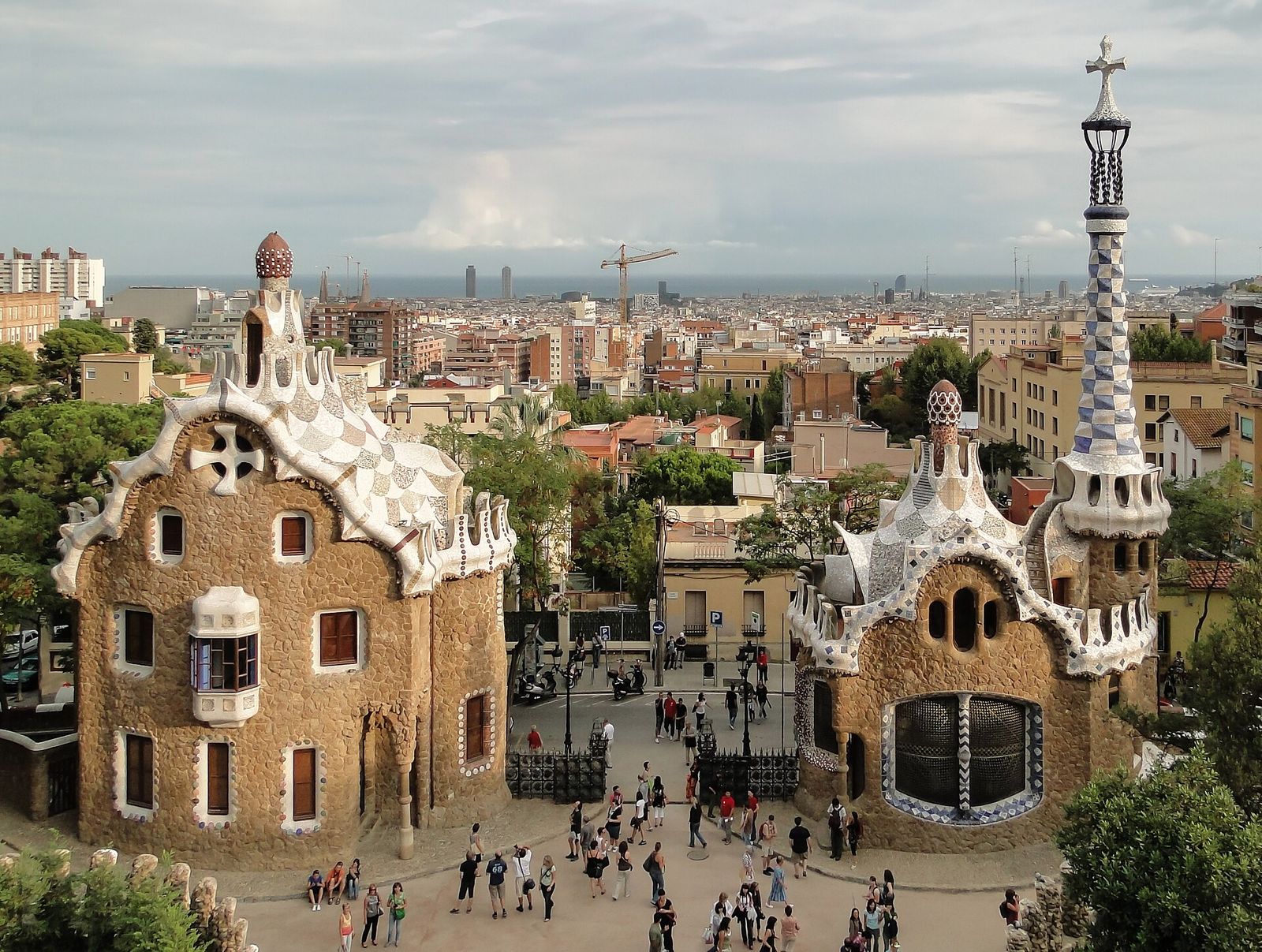
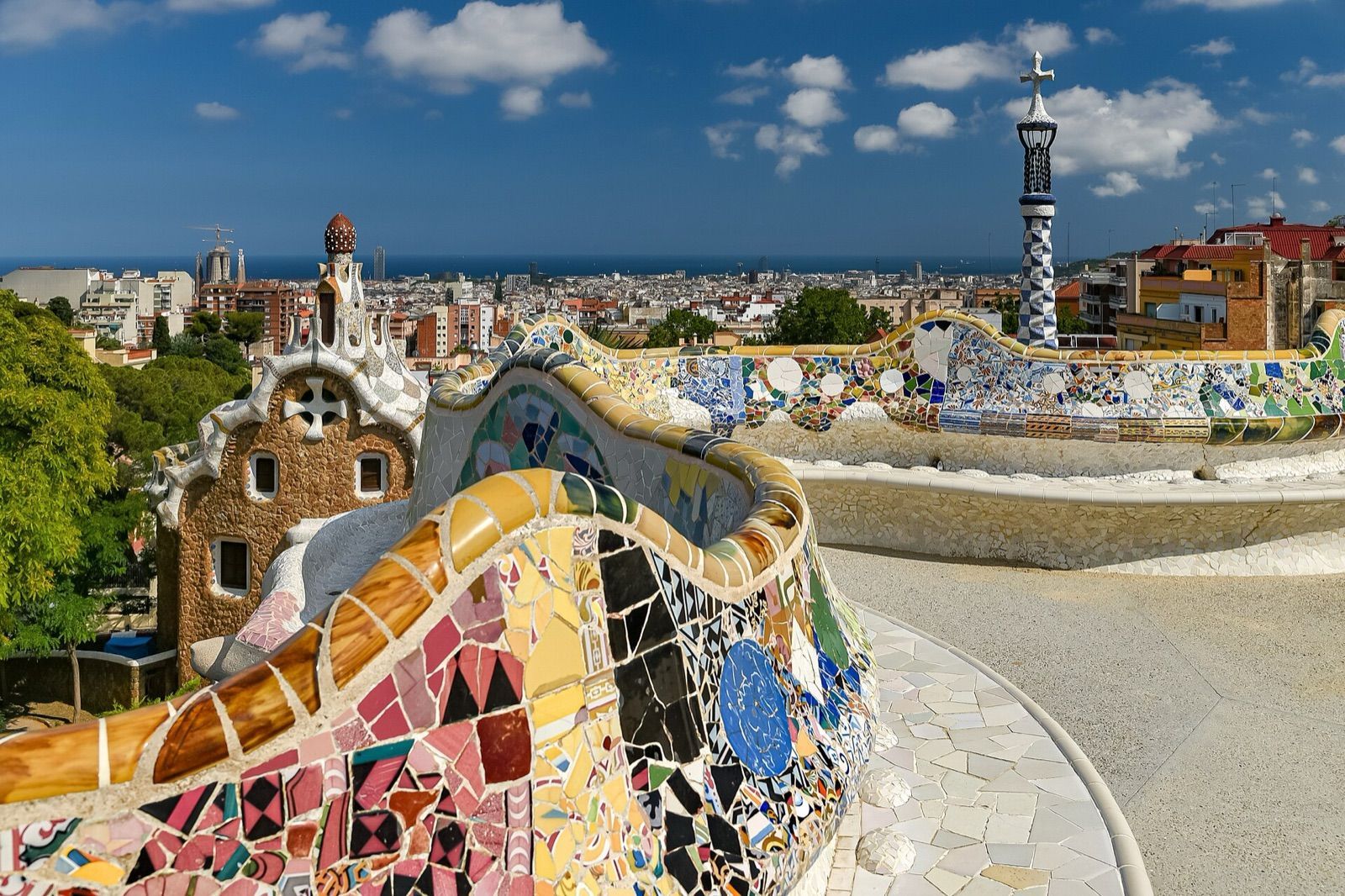
A few minutes from the Faculty of Law, on Avinguda de Pedralbes, are the Güell Pavilions, the gatehouse and stables that Antoni Gaudí built in the 1880s for his patron Eusebi Güell. Their great wrought-iron gate takes the form of a chained dragon. The pavilions were acquired by the university in the 1950s and still belong to it. The gate can be seen from the street; check whether the site itself is open, as it has been closed at times for restoration.
The Raval and student life
History, geography and philosophy are taught in a modern faculty in the Raval, the dense old-town district next to the Historic Building, beside the city's museum of contemporary art. The streets around it, and those of the neighbouring Sant Antoni and Eixample districts, are full of inexpensive lunch menus, bookshops and bars.
Like most Spanish universities, this one is not residential. Many local students live with their families and commute; others share flats in districts such as the Eixample, Gràcia, Sants and Les Corts, and there are a number of halls of residence. Housing in Barcelona is in high demand, so new students are advised to start looking early.
Teaching is mainly in Catalan and Spanish, and the language of each course is normally published in advance. Some master's programmes are taught in English.
Visiting as a prospective student
The cloisters and garden of the Historic Building are normally open to walk through on weekdays in term time. The university has also held information days for prospective students and provides guidance for international applicants. Dates and formats change, so check the University of Barcelona's official pages before you plan.
Getting there and around
- By air: Barcelona's airport is linked to the centre by train, metro and airport buses, which take around half an hour.
- To the Historic Building: Universitat metro station is directly outside, and Plaça de Catalunya is a five-minute walk.
- To the Diagonal campus: take the metro to Palau Reial or Zona Universitària, or the tram along the Diagonal.
Where families usually stay
The Eixample, close to the Historic Building, is the most practical base, with the Gothic Quarter and Gràcia as alternatives. Our guide to where to stay in Barcelona compares the districts.
Practical tips
- See the Historic Building in the morning and the Diagonal campus and Güell Pavilions in the afternoon.
- August is very quiet at the university; come in term time if you can.
- To fit the visit into a longer trip, see our Barcelona in two days and three-day Barcelona itinerary.
Bloiq is reader-supported. Some links may earn us a commission; it never affects what we write. How we make money.